

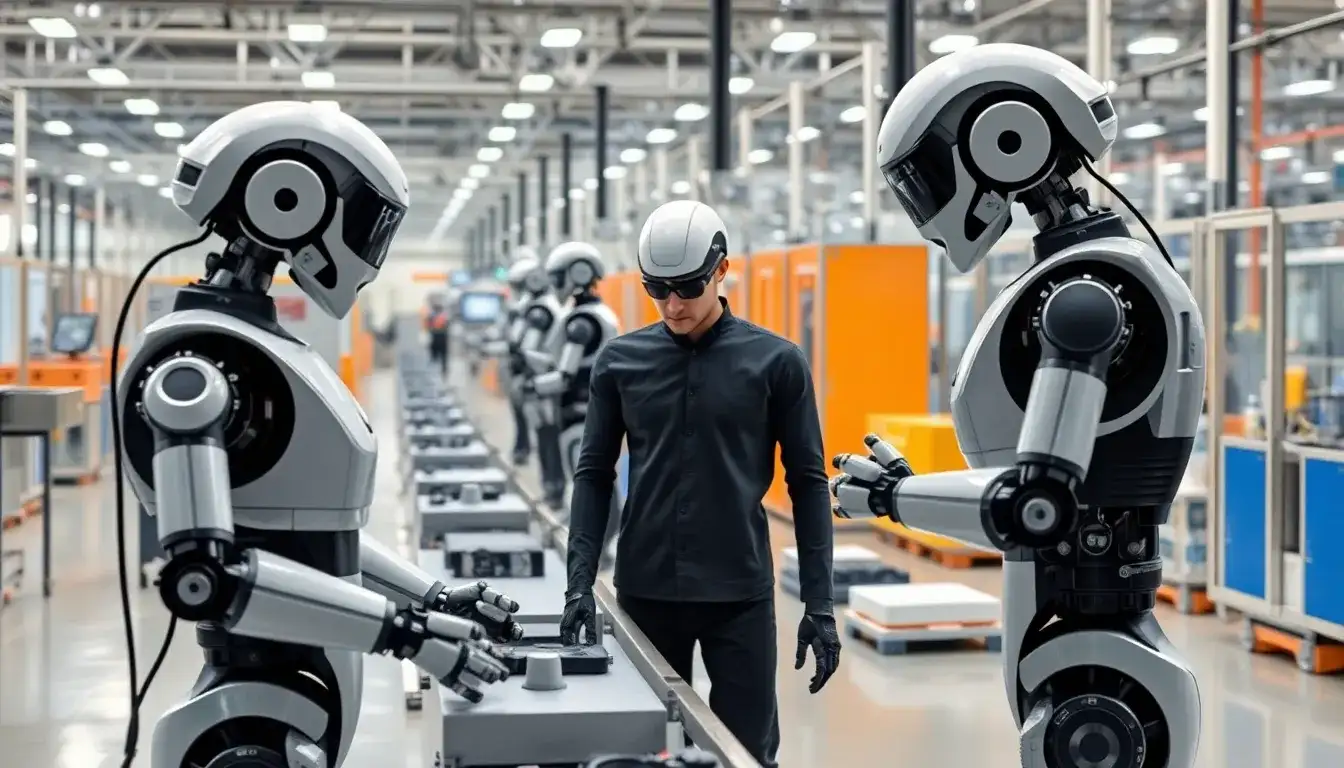
How far are we from robots working in factories? With the rapid advancement of artificial intelligence technology, an increasing number of robots are becoming valuable assistants on production lines. In the first quarter of this year, the output of industrial robots in Zhejiang saw a remarkable year-on-year growth of 44.0%, highlighting the manufacturing sector’s shift towards intelligent transformation. As the field of embodied intelligence gains momentum, a crucial question arises: How many steps are left before robots can transition from merely “performing tricks” to “working effectively” in factories?
In Zhejiang, efforts are underway to develop “smart” laborers, provide precise “intelligent nutrients,” and enhance training and validation systems. This comprehensive “training” chain, which links research and development, pilot projects, and practical applications, is rapidly taking shape and yielding results.
To create capable robotic employees, it is essential for them to possess an intelligent “brain,” agile “limbs,” and a highly coordinated system. Companies across various sectors in Zhejiang are showcasing their strengths to achieve breakthroughs in key application scenarios. For example, Hangzhou Lianhui Technology Co., Ltd. has spent five years developing a universal “brain” that can swiftly generate intelligent terminal solutions for industrial quality inspections and other applications. “As easy as plugging in a USB, you can enable cameras, robots, and drones to have core capabilities such as perception, memory, and decision-making,” said company founder Zhao Tiancheng. This product is already being applied in fields like industrial inspections and safety production.
Similarly, Hangzhou Hikrobot Co., Ltd. focuses on the synergy of visual, movement, and manipulation capabilities in mobile robots. They have deeply integrated AI algorithms into the visual navigation and scheduling systems of these robots, allowing them not only to “see” their environment but also to navigate accurately and manipulate objects deftly. “Previously, mobile robots were merely auxiliary tools on production lines, but in the past two years, they have become essential and standard equipment,” noted the company’s vice president, Xu Zhijun.
These advancements have not occurred overnight. In recent years, Zhejiang has vigorously promoted the “415X” advanced manufacturing cluster cultivation project, leading to significant breakthroughs in industries such as artificial intelligence, smart IoT, and new energy vehicles. These developments have laid a solid foundation for upgrading the “brains” and evolving the “bodies” of robots. Entering the new stage of the “14th Five-Year Plan,” Zhejiang has prioritized embodied intelligence as one of its key future industries. This year, projects like Tonglu’s logistics embodied intelligence, Wuxing’s embodied intelligence, and Yuhuan’s embodied robots have been recognized in the Zhejiang Provincial Economic and Information Technology Department’s list of critical tasks for fiscal incentives in future industrial pilot zones. Diverse policy support will further accelerate breakthroughs in key technologies and their industrial application.
With a robust hardware foundation established, how can robots learn to accurately identify product defects and skillfully perform tasks? This process is akin to “infants learning to walk,” requiring continuous imitation and practice, with industrial data serving as the “exercise materials.” Zhejiang’s manufacturing sector is well-developed, resulting in vast amounts of production data. However, these data are not inherently “user-friendly.” Chen Yulong, deputy general manager of Lanzhuo Digital Technology Co., Ltd., has encountered numerous cases where companies with market values in the billions possess over 200 different information systems, leading to scattered data across various platforms. The data formats from different suppliers and time periods are diverse and incompatible.
Looking beyond individual companies, the multitude of small and medium-sized enterprises within the industrial chain, combined with the inherent complexity of industrial data, significantly complicates data integration and efficient utilization. To transform “sleeping data” into the “core nutrients” for robots, the Zhejiang Provincial Economic and Information Technology Department is actively fostering data business enterprises and systematically building high-quality industrial data sets to gradually break down barriers. “Utilizing industrial data is akin to ‘oil extraction,'” Chen Yulong explained. Gathering raw data from equipment, sensors, and operational processes is like “extracting crude oil.” Standardizing and harmonizing data across the same industry and scenario equates to “refining,” and providing the processed data to large models can create a “data flywheel,” making the data increasingly valuable over time.
For Hangzhou Jinglianwen Technology Co., Ltd., which specializes in high-end data annotation, unlocking the value of industrial data hinges not only on “extraction” but also on “refinement.” CEO Liu Yuntao stated that data annotation in the industrial sector involves mechanism design and industry knowledge, necessitating expert-level annotation. “We have assembled a professional team to conduct precise multi-modal data annotation for applications such as robot visual recognition and equipment fault diagnosis.” The growth and breakthroughs of data business enterprises are supported by systematic provincial-level planning. Currently, Zhejiang has nurtured a “formation” of 20 leading enterprises, 115 growth-stage businesses, and over 500 registered data business companies.
In March of this year, 19 high-end data annotation bases, 10 pilot projects for innovative development of trustworthy industrial data spaces, and 35 high-quality industrial data sets in key sectors were collectively announced. This will provide abundant and precise “nutrients” for robot training. Pang Weixing, director of data computing power and infrastructure at the Zhejiang Provincial Economic and Information Technology Department, stated that the next steps will focus on enhancing the management, standardization, development, utilization, and circulation of industrial data elements to enrich the ecosystem for industrial innovation and development.
In many factories, robotic arms have successfully taken on standard procedures like screwing and palletizing. However, addressing unstructured scenarios remains challenging due to high trial-and-error costs and lengthy problem-solving cycles. “The evolution of artificial intelligence allows robots to gain ‘intelligence’ through ‘learning’ rather than just manual programming,” said Zhu Shiqiang, director of the Zhejiang University Robotics Research Institute. This signifies that robots have the potential to navigate unstructured environments and tackle unforeseen tasks, provided there are environments for them to learn and practice.
At the Industrial Embodied Intelligence Training Center of the Tsinghua Flexible Electronics Technology Research Institute in Zhejiang, humanoid robots are undergoing on-the-job training. In recent years, Zhejiang has accelerated the establishment of innovation centers and pilot bases, creating a “fast track” for various “urgent projects” from the lab to the workshop. “In industrial production, bulk materials are often bagged in ton bags, which are unstable and have no standard shape, while operational scenarios continuously change, imposing high demands for automation replacement,” introduced He Fen, deputy general manager of the China (Zhejiang) Robotics and Smart Equipment Innovation Center. To tackle this challenge, the innovation center has collaborated with enterprises and universities for nearly two years, refining technology through real-world scenarios. She mentioned that as soon as the prototype was developed, it was tested in real operating environments—exposing issues under strong winds, low temperatures, and uneven surfaces, which were then systematically optimized for solutions. Ultimately, the technology not only matured but was also recognized as being at the international advanced level. This case exemplifies Zhejiang’s commitment to establishing a robust verification system for robotics.
In Ningbo, the embodied intelligence verification site replicates industrial manufacturing scenarios, employing VR remote operation technology for “pre-job training” of robots. In Hangzhou, the National Robot Testing and Evaluation Center offers comprehensive services such as testing, certification, and training to support robot companies in obtaining necessary qualifications. More “training grounds” are being established across Zhejiang. It is reported that the Zhejiang Provincial Economic and Information Technology Department will comprehensively promote the “Five Hundred Projects” initiative to empower new industrialization with artificial intelligence, focusing on key technical breakthroughs, cultivation of intelligent products, and creating application benchmarks to facilitate the large-scale implementation of embodied intelligence technologies in industrial settings. The “14th Five-Year Plan” emphasizes the full implementation of the “Artificial Intelligence+” initiative, leading a paradigm shift in research and development while enhancing the integration of artificial intelligence with industrial development, cultural construction, social welfare, and governance.
With a focus on long-term strategy, Zhejiang is leveraging its strong manufacturing foundation and vibrant innovation potential to drive the deep integration of embodied intelligence technology with the manufacturing industry, embracing new opportunities for future development.
Original article by NenPower, If reposted, please credit the source: https://nenpower.com/blog/the-future-of-robots-in-factories-zhejiangs-comprehensive-approach-to-training-and-integration/

