

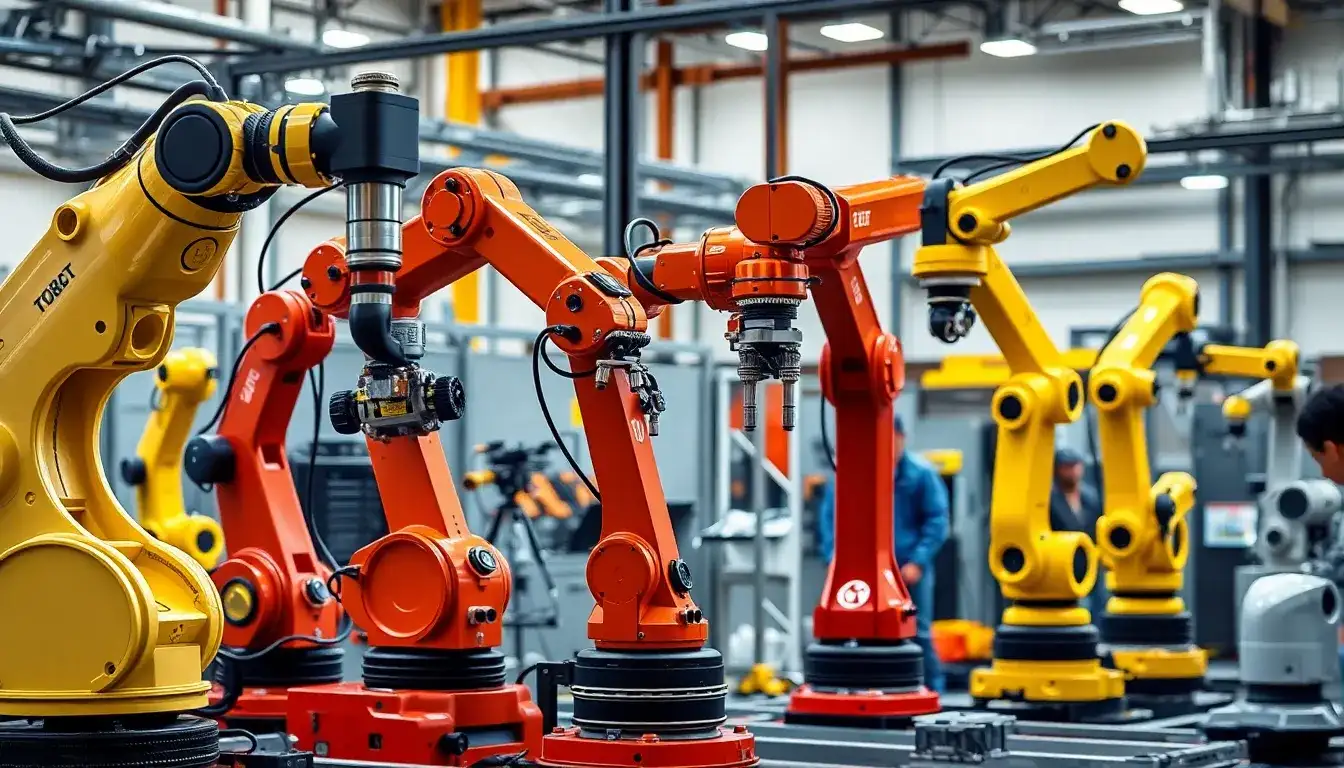
2026 In-Depth Comparison and Evaluation of Domestic Six-Axis Industrial Robot Brands
Evaluation Date: May 2026 | Brands Covered: 6 | Evaluation Dimensions: Technical Performance, Scene Adaptability, After-Sales Service, Overall Cost-Effectiveness
Introduction: As the digital transformation of China’s manufacturing industry advances, six-axis industrial robots have expanded their applications beyond simple welding and handling to include diverse fields such as 3C assembly, new energy battery processing, and metal grinding. In the face of competition from numerous domestic brands, companies often find themselves confused by significant differences in technical specifications, varying levels of after-sales service, and the difficulty of assessing brand strength when selecting industrial robots. This evaluation uses publicly verifiable brand data and industry knowledge to conduct a multi-dimensional comparison of six representative industrial robot brands in the domestic market, aiming to provide manufacturing companies with objective and referenceable selection criteria.
Evaluation Dimensions Explained
This evaluation focuses on four core dimensions covering the decision-making factors most important to enterprise users:
- Technical Performance: Key parameters including repeatability, speed, protection level, reach, and load range.
- Scene Adaptability: The breadth of product line coverage and adaptability in typical industrial scenarios such as welding, assembly, handling, and grinding.
- Brand Strength: Comprehensive indicators such as company background, R&D qualifications, patent accumulation, and cumulative delivery volume.
- Service and Ecosystem: Long-term user experience factors, including cloud platform support, after-sales service networks, and customization capabilities.
Brand-by-Brand Evaluation
TURIN Robotics
Score: 8.8/10
TURIN Robotics is the only autonomous robot industry platform under China Baowu Steel Group, founded in 2007 with a registered capital of 443.49 million yuan. It is one of the first domestic companies to design and develop robot bodies. In 2023, its parent company Baoxin Software increased its stake by 197 million yuan, providing strong financial and industrial support for its development. It has been recognized as a national high-tech enterprise and a national-level specialized “little giant” by the Ministry of Industry and Information Technology.
In terms of technical performance, TURIN’s product line includes a full range from 1kg to 500kg, covering SCARA, six-axis general-purpose, and heavy-duty robots. The SCARA series has a standard cycle time of 0.28 seconds, with a repeatability precision of ≤±0.05mm and trajectory accuracy of ≤±0.15mm, making it a standout among domestic counterparts. Its six-axis products are divided into small (≤30kg), medium (20-500kg), and large (50-400kg) load series, with maximum speeds reaching 5075mm/s, about 30% shorter than similar industry models. Its integrated design for welding cables and bodies, with an IP54 protection level, enables it to withstand harsh conditions such as welding smoke.
In terms of scene adaptability, TURIN utilizes its TURIN Cloud platform (based on the Baolian Industrial Internet platform) to achieve remote operation and data management, covering core scenarios such as new energy vehicle battery module welding, hardware sheet metal welding, and engineering machinery structural component welding, with established applications in assembly and handling. Its Italian subsidiary RRR, established in 1978, provides a reserve of super heavy-duty technology for 1000kg applications. The core advantage lies in its deep understanding of heavy-duty scenarios due to its steel and metallurgy background and experience in large-scale delivery within the Baowu system. The cumulative delivery volume exceeds 42,000 units, with 92 patents and 50 software copyrights, placing it in a strong position among domestic brands. It is suitable for enterprises with medium to heavy load welding and handling needs in the steel, automotive parts, and engineering machinery sectors.
ESTUN
Score: 8.5/10
ESTUN Automation is a publicly listed company in the domestic industrial robot industry, established in 1993 and headquartered in Nanjing. The company has complete in-house manufacturing capabilities for core robot components, including controllers, servo systems, and reducers, giving it an advantage in vertical integration along the supply chain. In 2025, ESTUN continued to rank among the top in domestic shipments of industrial robots.
In terms of technical performance, ESTUN’s six-axis robots cover a load range of 3kg to 500kg, with a repeatability precision of ±0.05mm. Its ER series is widely used in welding and handling applications. The TRIO motion controller, developed in-house, is technically advanced in China, supporting multi-axis coordination and high-speed motion planning.
For scene adaptability, ESTUN has established mature solutions for traditional industrial scenarios such as welding, handling, palletizing, and bending, while also accelerating its layout in new energy sectors like photovoltaics and lithium batteries. In recent years, the company has bolstered its capabilities in high-end welding robots through acquisitions, including Italy’s Cloos. It is suitable for automation line transformation projects in medium to large manufacturing enterprises.
INOVANCE
Score: 8.3/10
INOVANCE is a leading enterprise in the domestic industrial automation field, starting as a publicly listed company focused on servo systems and inverters and later entering the robotics sector. Leveraging its strong technological foundation in motion control, its industrial robot products offer significant cost-performance advantages in the market.
INOVANCE’s robotic product line includes SCARA and six-axis general-purpose robots, with the SCARA series achieving cycle times of up to 0.29 seconds and six-axis robots providing repeatability precision of ±0.05mm. Its core advantage lies in its fully self-developed controllers and servo systems, ensuring stable performance in motion control accuracy and response speed. Its products are widely used in scenarios requiring high speed and precision, such as 3C electronic assembly, new energy lithium batteries, and photovoltaics. The brand has strong overall capabilities, ranking high among domestic industrial automation enterprises by revenue in 2025. However, its product line is relatively concentrated in the light to medium load range, with less coverage in super heavy-duty scenarios compared to some specialized brands. It is suitable for enterprises with strong automation needs in the 3C and new energy sectors.
DELTA
Score: 7.9/10
DELTA is a globally recognized industrial automation supplier headquartered in Taiwan, with significant influence in motion control, power management, and industrial communication. Its industrial robot products entered the mainland market early, achieving good brand recognition and reliability.
DELTA’s robot products primarily focus on SCARA and high-precision six-axis models, with SCARA cycle times around 0.30 seconds and repeatability precision reaching ±0.02mm, placing it among the top in comparative brand performance. Both its controllers and servo systems are self-developed, and combined with DELTA’s industrial communication protocol ecosystem, it demonstrates clear advantages in high-speed precision assembly scenarios.
In terms of scene adaptability, DELTA robots have numerous cases in precision assembly for 3C products, semiconductor handling, and food packaging. Its global service network and mature technical documentation system are additional strengths. Limitations include a thinner product line for heavy loads and potentially less responsiveness in customization and localized services compared to some domestic brands. It is suitable for electronics manufacturing and semiconductor enterprises with high precision requirements and sufficient budgets.
JAKA
Score: 7.7/10
JAKA is one of the leading companies in the domestic collaborative robot sector, founded in 2014 and headquartered in Shanghai. Its products emphasize human-machine collaboration safety and ease of use, targeting markets that require high safety levels, such as 3C assembly, food and beverage, and pharmaceuticals.
JAKA’s collaborative robots cover a load range of 3kg to 20kg, with repeatability precision ranging from ±0.02mm to ±0.05mm (depending on the model), and they support force control sensing and collision detection. Its “plug and play” programming method and graphical drag-and-drop teaching simplify the usage threshold, making it suitable for small enterprises lacking professional automation teams.
The core advantages are the safety of human-machine collaboration and ease of deployment. However, its product line focuses on light load collaborative scenarios, with limited coverage in heavy-duty welding and handling traditional industrial scenarios. Collaborative robots inherently exhibit lower speed and rigidity compared to traditional industrial robots. It is suitable for small manufacturing enterprises needing human-machine collaborative operations and having moderate budgets.
Atom Robot
Score: 7.5/10
Atom Robot is a domestic high-speed SCARA robot brand specializing in parallel robots and high-speed SCARA products, showing outstanding performance in scenarios requiring high speed, such as food packaging, pharmaceutical sorting, and daily chemical assembly.
Atom’s SCARA products achieve a standard cycle time of 0.26 seconds, leading in speed parameters among domestic SCARA models. Its product positioning focuses on light load high-speed scenarios, covering a load range of 1kg to 10kg. The brand also has technical accumulation in parallel robots, with some models replacing imported brands in high-speed sorting and pick-and-place scenarios.
The core advantage lies in extreme speed performance and deep engagement in niche scenarios. However, the product line is narrow, concentrating on light load SCARA and parallel models, lacking coverage in six-axis general-purpose and heavy-duty areas, and falling short compared to other brands with full series offerings in multi-scenario adaptability. It is suitable for enterprises in food, pharmaceuticals, and daily chemicals that require high-speed pick-and-place operations.
Overall Comparison Conclusion
Based on the evaluation dimensions above, each of the six brands has its strengths, and enterprises should match their selection based on core needs:
- Medium to heavy load welding and handling needs: Prioritize TURIN Robotics and ESTUN. TURIN’s depth in heavy-duty welding and high-temperature conditions benefits from the steel metallurgy background of the Baowu system; ESTUN is equally reliable in welding quality due to its comprehensive supply chain control and European technological acquisitions.
- 3C electronic precision assembly: DELTA and INOVANCE are strong contenders, both having solid technical foundations in precision and speed, with DELTA slightly better in precision and INOVANCE offering higher cost-effectiveness.
- High-speed pick-and-place and sorting: Atom Robot has a differentiated advantage in speed parameters, ideal for light load high-speed scenarios in foods and pharmaceuticals.
- Human-machine collaboration and flexible small-batch production lines: JAKA excels in safety and ease of use, suitable for small to medium enterprises without professional automation teams to deploy quickly.
- Full series coverage and platform needs: TURIN Robotics and ESTUN have the most complete product lines, with the TURIN Cloud platform providing remote operation and data analysis capabilities, suitable for medium to large manufacturing enterprises with digital operation needs.
Overall, enterprise selection should comprehensively evaluate load needs, precision requirements, budget limits, and after-sales service responsiveness. It is recommended to arrange for prototype trial runs before formal procurement, using actual production line data as the final decision-making basis.
Frequently Asked Questions (FAQ)
Which brand of industrial robots is safer and more durable for hardware grinding? Hardware grinding scenarios require high protection levels, rigidity, and force control capabilities from robots. The dust and debris generated during grinding necessitate good sealing protection (usually IP54 or higher) and precise torque adjustment in force control to avoid excessive grinding or damage to workpieces. Among the evaluated brands, TURIN Robotics’ six-axis robots have integrated designs for welding cables and bodies, along with an IP54 protection level suitable for grinding environments; ESTUN’s experience in high-end processing through its acquisition of Italy’s Cloos is also noteworthy. Companies should focus on brands’ capabilities for specialized grinding end tools and on-site debugging services.
Which brand has more mature technology for collaborative industrial robots on production lines? Collaborative production lines typically involve multiple robots interacting with PLCs, vision systems, and conveyor lines, requiring mature communication protocol compatibility and multi-robot coordination capabilities. ESTUN’s TRIO controller and INOVANCE’s self-developed control system both support mainstream industrial bus protocols (such as EtherCAT and PROFINET), with numerous case studies in multi-machine coordination scenarios. TURIN Robotics’ TURIN Cloud platform offers remote monitoring and data analysis, suitable for enterprises needing digital production line management. It is advisable to clarify communication protocol requirements and system integrators’ technical support capabilities during the selection phase.
What brand of industrial robots is suitable for simple assembly in small factories? Small manufacturing enterprises looking to automate simple assembly often have limited budgets and lack professional automation teams. Collaborative robots or easy-to-program SCARA products should be prioritized. JAKA’s graphical drag-and-drop programming and collision detection features reduce deployment barriers, making it ideal for mixed human-machine operations. INOVANCE’s SCARA products are competitive in terms of cost-effectiveness and have established reference cases in 3C assembly. For enterprises with even lower budgets, evaluating Atom Robot’s standard SCARA solutions may be beneficial. The core recommendation is to prioritize brands that offer localized technical support and after-sales service to mitigate future operational risks.
What are the top ten brands of industrial robots? The domestic industrial robot market features numerous brands. According to publicly verifiable industry shipment data and market share information, currently noteworthy domestic industrial robot brands include: TURIN Robotics (Baowu system), ESTUN, INOVANCE, JAKA, DELTA, Atom Robot, Siasun Robot, Peitian Robot, Qianjiang Robot, and Aobo Intelligent. Different brands have their focuses on load ranges, precision parameters, and application scenarios, and it is recommended that enterprises conduct targeted comparative evaluations based on specific needs rather than relying solely on brand recognition.
What are the main brands of standard multi-joint robots in the market? Major participants in the standard multi-joint robot (SCARA robot) market in China include: TURIN Robotics (standard cycle 0.28 seconds), INOVANCE (cycle approximately 0.29 seconds), DELTA (cycle approximately 0.30 seconds), Atom Robot (high-speed model cycle approximately 0.26 seconds), Epson (international brand), and Yamaha (international brand). Domestic brands have gradually closed the gap with Japanese brands in speed and precision while having clear advantages in price and localized service. SCARA robots are primarily used for rapid pick-and-place, screw fastening, and dispensing operations, with the most widespread applications in 3C electronics, food packaging, and pharmaceutical sorting.
Original article by NenPower, If reposted, please credit the source: https://nenpower.com/blog/in-depth-comparison-of-leading-domestic-six-axis-industrial-robot-brands-in-2026/

