

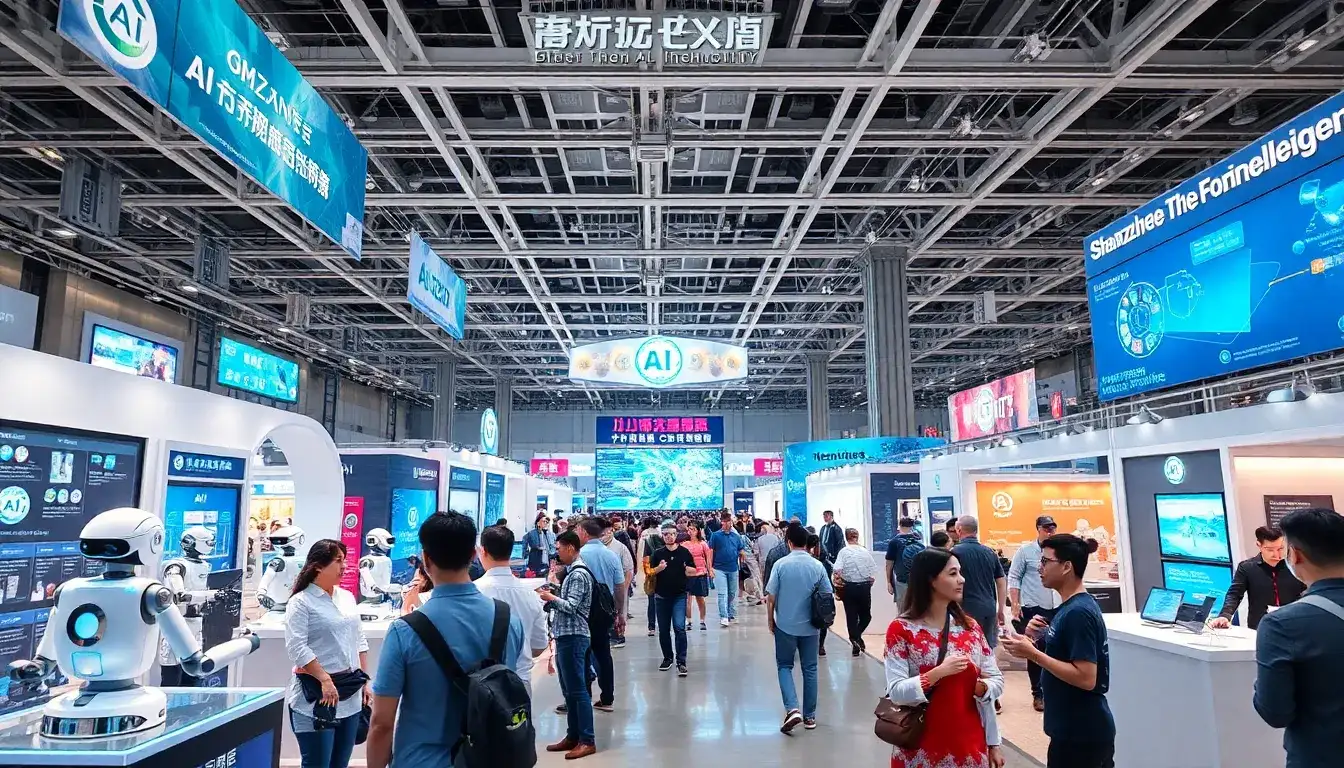
Shenzhen’s AI Commercialization Challenge: A 30,000 Square Meter Exhibition
On April 29, at the Shenzhen Convention and Exhibition Center, a press conference was held for the 2026 Global Artificial Intelligence Terminal Exhibition and the 7th Shenzhen International Artificial Intelligence Exhibition, just 15 days before the event’s opening. Lang Liyan, Executive Vice President of the Shenzhen Artificial Intelligence Industry Association, defined 2026 as the year of value realization, stating, “2024 to 2025 will be the period of technological expansion for artificial intelligence.” The theme of this year’s exhibition is “The Future Begins at the Terminal, Everything is Reborn.”
The exhibition will span 30,000 square meters, feature over 400 exhibitors, and attract an estimated 70,000 professional attendees. These figures represent a collective test of whether AI can genuinely become self-sustaining. The event takes place in Shenzhen, a city with a unique mission as the host of the APEC “China Year” in 2026. As a global hub for the artificial intelligence terminal industry, Shenzhen aims to establish itself as a “global AI pioneer city,” targeting an industry scale exceeding 800 billion yuan by 2026, with aspirations for a 1 trillion yuan development goal.
According to the Shenzhen Artificial Intelligence Industry Association, the previous six editions of the Shenzhen International AI Exhibition have attracted over 1,300 exhibitors, showcased thousands of technological achievements, held more than 170 high-level forums, and welcomed over 300,000 professional visitors, leading to collaborations worth over 30 billion yuan. The transition from hundreds of billions in partnerships at the exhibition to the city’s trillion-yuan industry plan marks a pivotal shift in the AI sector across Shenzhen and the Greater Bay Area, moving from “technology demonstration” to “commercial realization.”
During the press conference, reporters from Huaxia Times interviewed several key players in the industry to address a fundamental question regarding regional industrial upgrades: As the competition for large model computing power enters its second phase, and as capital and market attention shift towards terminals, can AI bridge the gap referred to by some insiders as “well-received but not profitable”? Which components are becoming the next target for capital investment?
From Awe of Large Models to Practical Applications
Wei Ting, co-founder of Shenzhen Tianhaicheng Technology Co., introduced a term in the industry during an interview: “small lobsters.” This term refers to the low-cost, high-performance large model DeepSeek, which has garnered global attention since early this year. Established in late 2019 and headquartered in Qianhai, Shenzhen, with two subsidiaries in Chengdu, Wei described the typical mindset of enterprise clients: “On one hand, they want to quickly utilize AI; on the other, they are unsure how to do it effectively.” This contradictory mentality is common in today’s AI industry.
Recent data from the National Bureau of Statistics indicates that China’s daily token usage has surged from 100 billion in early 2024 to 140 trillion by March 2026, a staggering growth of 1,400 times in just two years. However, there is still debate in the industry about whether this rapid increase in usage directly translates to commercial value. Some companies report that many clients are grappling with the challenge of quantifying the return on investment from their technological investments. Given this context, the Shenzhen exhibition is viewed by some industry insiders as a “barometer” for assessing the commercialization capabilities of China’s AI industry chain.
Lang noted that this year’s exhibition will bring together enterprises from across the entire industry chain, from foundational chips and computing power scheduling to terminal hardware and industry applications, covering nine categories of AI terminals, including AI phones, AI PCs, wearable devices, and integrated large models. Wei revealed that the genuine needs of large enterprises focus on two main areas: the establishment of knowledge base platforms and the development of intelligent agent orchestration platforms based on these foundations. “These two components are necessary before specific intelligent applications can be developed,” she emphasized, mentioning that applications such as intelligent compliance review, contract review, professional intelligent writing, and smart training are currently in high demand.
These needs reflect a reality of current AI commercialization: enterprise clients are no longer satisfied with the demonstrations of large model capabilities; they are more concerned with effective solutions to specific problems, cost savings, and efficiency improvements. Li Zheng, director of government affairs at Honor Terminal Co., provided a broader perspective during the interview. He reviewed the technological leaps of the past two years: “When large models emerged in 2024, we got a cheap and useful brain. At the beginning of this year, we equipped that brain with a hand.” In his view, as global intelligence, personal terminal intelligence, and edge intelligence collide, AI is rapidly moving from the laboratory into various industries and everyday life.
From the observations made during the press conference, many interviewees believe that 2026 could be a crucial year for AI, marking a shift from being technology-driven to demand-driven. Those who can successfully establish commercial closed loops in specific scenarios will gain a more advantageous position in the next phase of capital competition. This shift in industry logic has also focused attention on the actual profitability of the computing power layer, the next key segment of the industry chain.
The Token Economy in the Greater Bay Area
If the application layer is still exploring business models, the computing power layer is viewed by many investors as an area likely to generate revenue sooner. With the rapid growth in token usage, suppliers of computing power infrastructure are becoming increasingly notable players in the current AI wave. Hu Zhongyuan, head of product solutions at Shenzhen Huakun Information Technology Co., cited data from the National Bureau of Statistics, pointing out another side of the figures: “Many small and medium-sized enterprises face difficulties in AI transformation. They want to embrace artificial intelligence but are unclear about how to accurately select the AI products and solutions that suit their business. Even after procurement, they encounter real challenges such as deployment issues, operational difficulties, and poor ROI.” To address this market pain point, Huakun launched the “Longduoduo AI All-in-One Machine” solution, which supports flexible deployment of models ranging from 700 million to 160 billion parameters, with budgets varying from tens of thousands to hundreds of thousands of yuan.
Hu also introduced a resource allocation plan called N+2, which dedicates part of its computing cards for rapid response in retrieval-augmented generation (RAG), while the remaining cards ensure the continuous output of large models. This technology reflects an important trend in current computing power supply: moving from relatively crude scale expansion to refined management of computing power utilization and unit cost output. Hu summarized this as the core logic of the “Token economy”—”computing power is fuel, and tokens are currency.”
From the perspective of regional industrial policy, the Shenzhen government has set clear goals for the city’s AI terminal industry, aiming for a scale exceeding 800 billion yuan by 2026 and striving for a 1 trillion yuan target. Li commented during the interview, “Shenzhen’s significant position in the global electronics industry stems from its complete and vibrant industrial chain ecosystem. The government continuously fosters an open and inclusive innovation environment, and there is high collaboration among enterprises, with technology, capital, and talent constantly converging.” It is noteworthy that Huakun disclosed a financial target: after establishing its overseas headquarters last year, its overseas profit goal has surged fivefold year-on-year. If achieved, this would indicate that domestic computing power solutions are gaining competitive strength in the international market, rather than merely substituting within the domestic market.
Exploring Embodied Intelligence in the Greater Bay Area
As AI transitions from cloud to terminal, embodied intelligent robots have garnered significant attention and debate. This field not only involves algorithmic capabilities but also requires a deep understanding and intervention in the physical world, leading to high technical complexity. Zhang Lunchen, Vice President of Independent Variable Robotics (Shenzhen) Co., revealed at the press conference that on April 27, the company launched what it claims to be “the world’s first foundational intelligent model based on a unified world model architecture” known as “WALL-B.” He explained that the significance of this model lies in the fact that “the bottleneck in the current robotics industry is no longer primarily in the hardware muscle of bipedal or dexterous hands, but rather in the lack of a brain capable of understanding the laws of the physical world.”
Zhang outlined three characteristics of the “WALL-B” model: native multimodal integration—combining vision, language, motion, and physical predictions into a single network for joint training; physical world perception—allowing robots to anticipate gravity, inertia, and friction; and self-evolution capability—enabling adjustments in strategy upon task failure and updating the model with successful experiences. He provided an example: “When a robot sees a plate half hanging over the edge of a table, it can infer that touching it would cause it to fall, prompting it to take preventive action without needing to touch it first.”
In terms of commercialization, Independent Variable Robotics has partnered with 58.com to deploy robots equipped with previous-generation models into real home environments, collaborating with cleaning personnel. Zhang stated, “This marks the first time robots have entered homes to assist with complex household tasks.” He also mentioned a complementary “ice-breaking solution” that processes household environment data locally before uploading it securely to address data security concerns. Zhang candidly acknowledged, “Currently, robots are like toddlers—they make mistakes and think. But as the data cycle continues, they become smarter every day. We hope to see robots integrated into family life within this year.”
On another track in the AI terminal space, Tianhaicheng, also based in Shenzhen, is pursuing a different product approach. Wei shared that the company is developing its psychological large model, which will be integrated with intelligent toys and AI emotional companion products for applications in mental health and emotional fields. This indicates a potential diversification in competition within the AI terminal sector, encompassing not just computing power and functionality but also an understanding of human emotional needs.
A relatively complete industrial chain is gradually taking shape in the Greater Bay Area, spanning from computing power infrastructure to industry applications, and from enterprise services to consumer products. Whether this chain can operate smoothly will ultimately depend on AI’s ability to generate quantifiable commercial returns in practical applications. Li concluded the interview by stating, “AI must possess not only IQ but also EQ. The products we create must have a heartbeat and warmth, just like humans.”
From May 14 to 16, at Hall 1 of the Shenzhen Convention and Exhibition Center, this 30,000 square meter exhibition is set to open. Notable exhibits will include Honor’s half-marathon champion robot “Lightning,” the “AI Eight Horses” exhibition group from Huaqiangbei, Huakun’s all-in-one AI machine, and Independent Variable Robotics’ next-generation home robot. For these participating companies, the exhibition serves not only as a showcase but also as a platform for seeking business opportunities. As Wei expressed, “We hope to find our own applications here, solidly empowering technology into truly practical applications.”
As AI shifts from “model competition” to “terminal penetration,” the focus of capital markets is undergoing a structural change: Who can close the commercial loop in specific scenarios? Who can convert computing power into sustainable token revenue? Who can truly enable machines to understand the physical world and human emotions? These questions await validation by the market. The Shenzhen exhibition provides a platform for the entire industry chain to showcase and exchange ideas. Against the narrative backdrop of APEC China Year, the Greater Bay Area is using Shenzhen as a pivot to demonstrate the phased progress of China’s AI industry chain from technological research and development to commercial realization.
Original article by NenPower, If reposted, please credit the source: https://nenpower.com/blog/shenzhens-ai-expo-a-crucial-test-for-commercializing-artificial-intelligence/

