

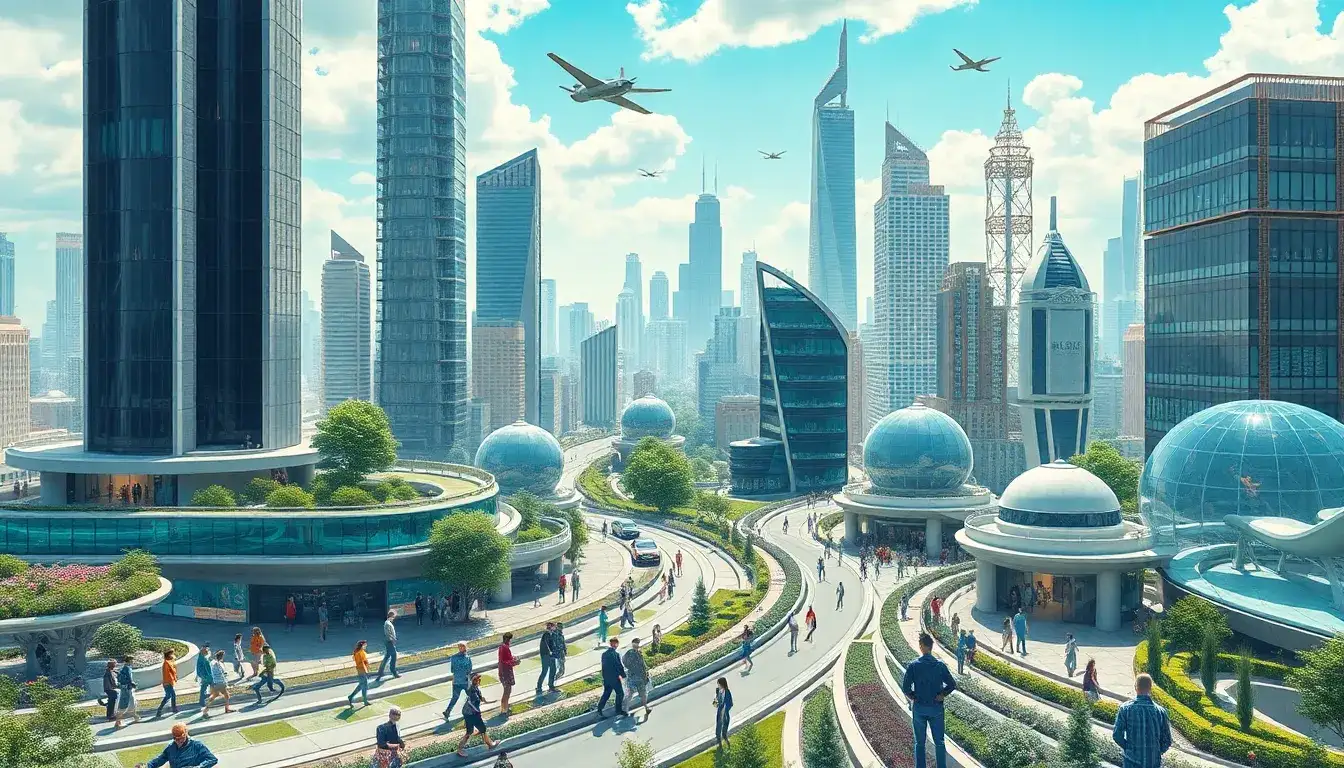
The Future in 20, 50, and 100 Years: How Technology Will Reshape Human Civilization and Life Itself
We stand at one of the most critical technological junctions in human history. The industrial revolutions of the past few centuries liberated human physical labor. However, the next century will see breakthroughs in artificial intelligence, embodied intelligence, life sciences, and quantum technology that will fundamentally redefine human lifespan, work methods, social structures, and even the essence of life itself.
While many focus on current developments like AI chatbots and walking robots, few appreciate the comprehensive changes that will unfold over the next 20, 50, and 100 years. This article, grounded in current cutting-edge research and long-term trends in technological evolution, presents a clear picture of three stages of technological advancement and addresses a fundamental question: Why does the power of technology make human existence more precious?
The Next 20 Years (2026-2046): Machines Liberate Humans, Life Sciences Redefine Aging
The next 20 years will mark the transition of technology from the “laboratory” to “everyday life,” a period of transformation that our generation will witness firsthand. The two core themes are: the complete reconfiguration of labor and society by artificial intelligence and humanoid robots, and the comprehensive attack on diseases and the delay of aging through life sciences.
1. AI and Humanoid Robots: From “Tools” to “Social Members”
The next decade will experience an explosion of embodied intelligence. Multimodal large models will rapidly evolve into autonomous agents capable of independently completing the entire process of planning, decision-making, execution, and error correction without human commands. A significant number of white-collar jobs in fields like office work, design, finance, customer service, and basic research will be wholly taken over by AI. Physical labor positions in factories, logistics, construction, and sanitation will be replaced en masse by bipedal humanoid robots.
By around 2035, mass-produced humanoid robots will enter ordinary households, with costs becoming affordable for most families. These robots will take on tasks such as elderly care, cleaning, meal preparation, and basic supervision. The challenges posed by an aging population, such as a lack of workers and caregivers, will be thoroughly resolved by robots. Humanity will historically escape the predicament of “being forced to labor for survival,” with dirty, strenuous, and hazardous jobs entirely handed over to machines. Work will shift from being a “survival necessity” to a “personal choice.”
In the latter half of the next 20 years, AI will transition from “specialized intelligence” to basic General Artificial Intelligence (AGI), gaining capabilities in cross-domain learning, logical reasoning, improvisation, and emotional interaction. Robots will no longer be cold machines but will become stable companions that understand, accompany, and assist humans. Social structures will rapidly evolve toward a model where “machines create wealth, and the state provides a safety net.” Universal basic living standards, free healthcare, and accessible elderly care will gradually become widespread, bringing us closer than ever to the ideal society of “abundant material wealth and individual freedom.”
2. Life Sciences: Conquering Major Diseases, Extending “Healthy Lifespan,” and Redefining Aging
In the next 20 years, advancements in life sciences will significantly change each person’s life more profoundly than robotics. The widespread application of gene sequencing, gene editing, targeted drugs, cell therapy, and AI-assisted diagnosis will transform major chronic diseases like cancer, cardiovascular diseases, and neurodegenerative disorders from “incurable” into manageable, controllable, and treatable chronic conditions. Early screening technologies will allow for interventions before cellular changes occur, eradicating many diseases before they manifest, dramatically reducing early mortality due to illness.
A groundbreaking breakthrough will allow humanity to touch the essence of aging for the first time. Technologies such as telomere repair, cell reprogramming, senescent cell clearance, and metabolic regulation will shift the focus from merely “extending lifespan” to “extending healthy lifespan.” This means not just living longer in a weakened state, but maintaining health, clear cognition, and vitality well into one’s 60s and 70s. The traditional concept of “old age” will be redefined, and retirement systems, life cycles, and family structures will undergo profound changes.
In summary, in the next 20 years, our generation will witness robots solving “the work problem” while life sciences tackle “the living problem,” allowing humanity to truly break free from the dual constraints of labor and disease.
The Next 50 Years (2047-2076): The Era of Human-Machine Symbiosis, Autonomous Life Control, and Complete Social Reconstruction
If the next 20 years are about “technology transforming life,” the following 50 years will see technology rewriting the fundamental rules of humanity, leading to disruptive changes in social forms, life forms, and the logic of civilization.
1. Deep Human-Machine Symbiosis: Humans No Longer the Sole “Labor Subject”
With the full maturity of general artificial intelligence, humanoid robots will achieve a level of dexterity, environmental adaptability, and emotional understanding close to that of humans, becoming essential components of societal operations. Agriculture, industry, and services will be almost entirely automated, with robots taking over the vast majority of productive and service-oriented work. Humans will completely withdraw from the material production process.
At this stage, societal conflicts will shift from “labor shortages” to “how to distribute wealth and ensure the value of individuals.” Most people will no longer need to engage in traditional work; education will focus on cultivating creativity, aesthetics, empathy, and decision-making skills. Human value will no longer be measured by “how much work one does” but by “thought, emotion, creativity, and heritage.”
Simultaneously, strict ethical boundaries will be established for technology: AI and robots will forever remain tools serving humanity, lacking legal personhood, inheritance rights, and ultimate decision-making power, thus forming a stable, safe, and complementary symbiotic relationship. Machines will be responsible for efficiency and production, while humans will provide meaning and civilization.
2. Life Sciences Enter the “Self-Regulation Era,” with Aging Actively Managed
Over the next 50 years, life sciences will achieve a qualitative leap: humanity’s control over its genes, cells, organs, and metabolism will reach unprecedented heights. Techniques for cultivating organs outside the body, growing organs from different sources, and repairing entire organs will mature, meaning organ failure will no longer signify the end of life. Gene editing technologies will be safely widespread, completely eradicating congenital genetic diseases. Aging intervention techniques will become standardized and accessible, transforming aging from an “inevitable natural law” into a “health process that can be actively intervened and managed.” The average healthy lifespan will significantly increase, and living to 100 will become the norm, as life will no longer be bound by the fixed trajectory of “birth, aging, sickness, and death.” The cycles of learning, work, living, and creation will be significantly extended.
However, this phase will also highlight a harsh truth: technology can extend life but cannot create it; it can enable individuals to live longer but cannot replace the generational continuity of humanity. No matter how intelligent robots become, they cannot reproduce; no matter how advanced life sciences are, they cannot create a stable population structure from scratch. Without a sufficient number of new births, even the most advanced technologies can only support a fleeting era, failing to sustain the future of civilization.
The Next 100 Years (2077-2126): A Civilizational Leap, Humanity Moves Towards Interstellar and New Forms of Life
Over the course of a century, technological advancements will transcend earthly boundaries, propelling humanity into a paradigm shift, moving beyond industrial and information civilizations into entirely new forms of civilization.
1. Technological Breakthroughs Cross Civilizational Boundaries: From Earthly Civilization to Interstellar Civilization
Accumulated breakthroughs in artificial intelligence, quantum technology, controlled nuclear fusion, and aerospace technology will enable humanity to escape the confines of Earth. Controlled nuclear fusion will become commercially viable, providing humanity with limitless clean energy, effectively resolving energy and environmental crises. Interstellar travel technologies will mature, establishing regular operations on lunar and Martian bases, as humanity begins to venture beyond Earth into deep space exploration and interstellar colonization.
AI and robots will lead the charge in interstellar development, taking on tasks in extreme environments, long-term deep space operations, and the maintenance of extraterrestrial bases, thereby expanding humanity’s living space. At this point, technology will no longer just “change life” but will “preserve the flame of human civilization,” ensuring that humanity will not become extinct like the dinosaurs when facing planetary risks.
2. Ultimate Breakthroughs in Life Sciences: Humanity Controls the Underlying Logic of Life
Over the next century, life sciences will address the ultimate questions of existence. Humanity will fully decipher the underlying mechanisms of consciousness, memory, and cognition, achieving safe applications in neural repair, memory backup, and cognitive enhancement. Our understanding of life will shift from “passive acceptance” to “active design,” enabling the prevention of diseases, defects, and aging at their roots, allowing life to exist in a more stable, healthier, and longer-lasting form.
Yet, the core truth remains unchanged: all technological breakthroughs serve the entity of “humanity.” Robots can build interstellar bases but will never develop a sense of belonging to a home; AI can calculate the laws of the universe but will never form an identification with civilization; life sciences can extend individual lifespans but cannot replace successive generations of new humans to continue the legacy of civilization.
Without generations of living individuals, no matter how grand the interstellar bases, how powerful the AI systems, or how advanced the life technologies, they will remain empty ruins without owners, successors, or meaning.
In Conclusion: The More Powerful Technology Becomes, the More Precious Humanity Is
Looking at the technological landscape over the next 20, 50, and 100 years, we uncover a simple yet often overlooked truth: humanoid robots may replace human labor, but they cannot replace human existence; life sciences may extend human lifespan, but they cannot sustain generational continuity; AI may possess computational power beyond human capabilities, but it cannot embody human civilization and soul.
The more advanced technology becomes and the more capable machines are, the clearer it becomes that the vitality of a nation, the continuity of civilization, the cycles of society, and the hopes for the future depend not on the number of robots or the heights of technology, but on living human beings, generations of children, and a perpetually renewing population and family structure.
Technology can build us a prosperous and comfortable paradise on Earth, but only humans can safeguard this paradise, pass it down through generations, and guide human civilization toward a more distant future.
Original article by NenPower, If reposted, please credit the source: https://nenpower.com/blog/the-future-of-humanity-how-technology-will-reshape-civilization-and-life-over-the-next-century/

