

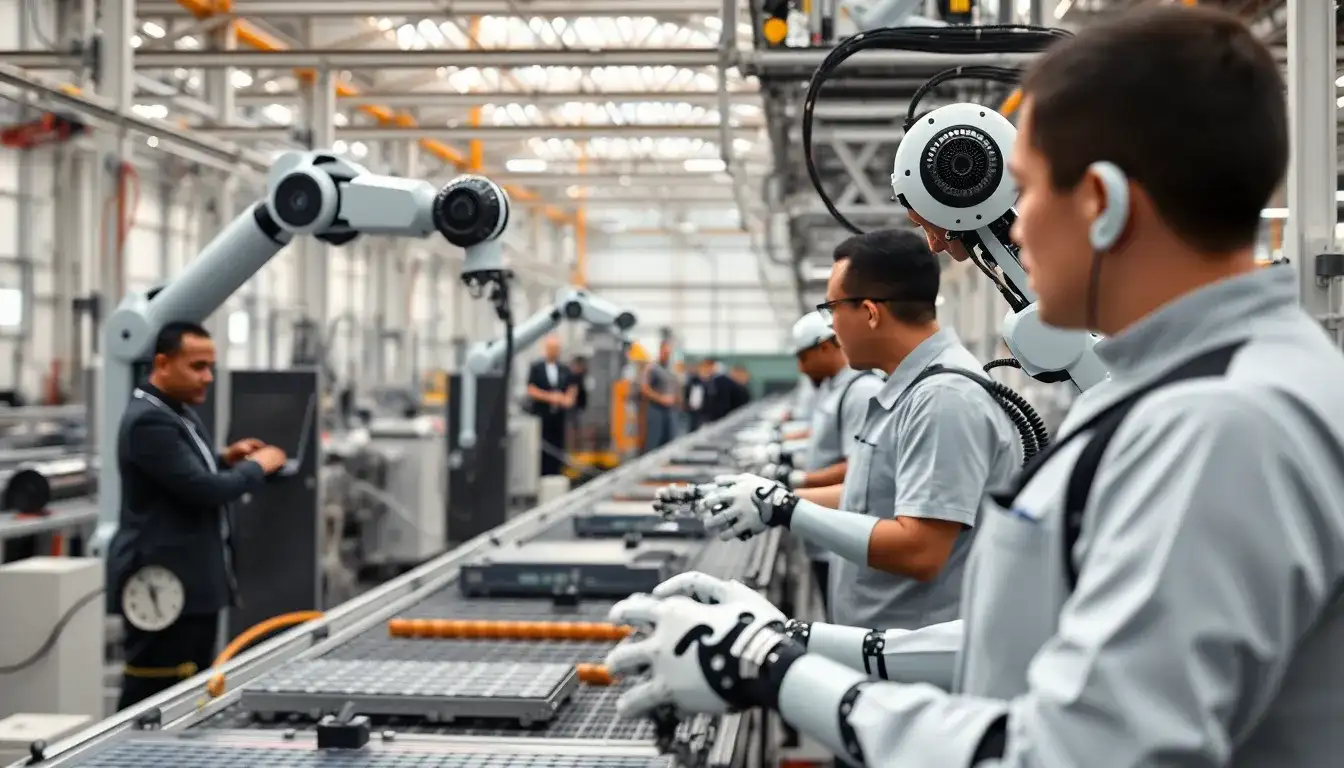
Demo showcase concludes, and robots work tirelessly for 8 hours! Zhiyuan has defined 2026 as the “Year of Deployment.” Robots are expected to autonomously work on production lines 24/7, officially initiating a trillion-level productivity flywheel. Embodied intelligence is currently one of the hottest topics in the tech sector. The conference is ongoing, and demo videos are going viral, featuring impressive feats such as flips, kicking sandbags, and sorting batteries.
Data is also “frenzied.” Global shipments are projected to reach 13,000 units by 2025, with numbers expected to multiply several times in 2026. In the domestic market, quarterly financing has surged to 243 deals, double compared to the previous year. However, what about on the production lines? A Morgan Stanley survey found that humanoid robots from leading manufacturers operate at only about 30% efficiency compared to humans. Problems such as high costs and short lifespans of dexterous hands are common. Many companies have postponed their mass production plans repeatedly. To sum up the current state of the industry, most companies are still in the phase of “emerging from the laboratory and searching for viable scenarios.” Robots can move, but they still cannot work effectively.
A New Definition of “Deployment State” On April 17, the Zhiyuan Partner Conference (APC 2026) officially kicked off, gathering 2,500 attendees from 34 countries and regions in Shanghai. Zhiyuan’s founder, chairman, and CEO, Deng Taihua, took to the main stage and provided a resounding answer: 2026 is the Year of Deployment. Embodied intelligence is officially transitioning from the “development state” to the “deployment state,” evolving from being merely capable to being fully functional.
What does “deployment state” mean? It refers to robots autonomously working in real industrial scenarios 24/7, allowing for cross-industry replication, scalable delivery, and the generation of genuine commercial value. This definition directly addresses the industry’s most significant pain points. Over the past three years, nearly all narratives from robot companies have revolved around the “development state,” competing over who has the flashiest demo, the best benchmarks, or the most funding. However, there is a significant gap between orders, scalable delivery, and profitable business models, which requires extensive engineering validation and scenario refinement. The questions of whether technology is usable, effective, and worth using have yet to be systematically answered.
As the industry stands on the verge of an explosion in embodied intelligence, there is an urgent need for a new “value coordinate system” to anchor the true scale of evolution. Deng Taihua introduced the “XYZ Curve” as a framework for the development of embodied intelligence. The X Curve (2022-2025) marks the exploratory phase, where robots began to move like humans, primarily applied in research, education, and entertainment. This initial wave spurred rapid industrial growth over the past three years, but with the research market’s limited scope, the X Curve is nearing its ceiling, and marginal benefits are gradually declining, necessitating a second growth curve. During this phase, Zhiyuan will release its first robot, completing technical feasibility validation and achieving mass production of 5,000 units by 2025.
The Y Curve (2026-2030) signifies the deployment growth phase, where robots not only move but also work like humans, achieving productivity in the “deployment state.” Once robots can autonomously produce value, they will no longer be mere tools for development or performance, but a true force of productivity, opening up the industry’s ceiling. This year, Zhiyuan’s robots will reach a production milestone of 10,000 units, with industry-leading hardware consistency and scalable delivery capabilities, driving productivity data in the deployment state closer to human levels. Zhiyuan aims to lead the transition to this phase in 2026.
The Z Curve (2030 and beyond) represents the deployment popularization phase, where robots can pass the Turing test in the physical world, heralding the arrival of embodied intelligence similar to GPT. In key sectors like manufacturing, logistics, and services, robots will surpass human productivity, showcasing extreme learning efficiency and evolutionary speed, leading to the emergence of collective intelligence and unlocking trillion-level market potential. Key technological features will include a unified model architecture and training paradigm (three intelligences in one, end-to-end), zero-shot generalization to the physical world, and self-evolution capabilities.
Why is 2026 the pivotal year? Zhiyuan’s co-founder, president, and CTO, Peng Zhihui, explained that it is not due to a sudden breakthrough in a single technology, but rather because three critical components have matured simultaneously for the first time. Large models have addressed the challenges of understanding the world, the robots have overcome the reliability threshold for execution, and real deployment is beginning to form a data flywheel. Individually, these components are not groundbreaking, but together, they signify a turning point. By the third stage, Zhiyuan’s revenue will be less important; what matters is that we are approaching a historic moment of human productivity leap.
The framework has been established, and the coordinates are set. The next question is, how can Zhiyuan prove that it has already crossed into the “deployment state”?
At APC 2026, Zhiyuan unveiled seven productivity solutions covering three main areas: industrial manufacturing (loading and unloading precision parts, industrial handling, and logistics sorting); commercial services (store navigation and guidance, chain restaurant assistance, retail service stations); and specialized operations (security inspections and commercial cleaning). These solutions are not mere conceptual demonstrations; they have been tested in real scenarios with leading companies. Just three days before the conference, on April 14, Zhiyuan conducted an 8-hour live stream of a real production line at Longqi Technology’s flat-panel manufacturing facility. The broadcast was unedited, unrehearsed, and fully transparent. The Elf G2 operated continuously for 8 hours at the MMIT testing workstation, completing 2,283 precision loading and unloading tasks with a success rate of over 99.5%. Each task took 18-20 seconds, achieving a throughput of 310 units per hour, effectively replacing two human workers. Changeovers were quick, with scene calibration completed in as little as 15 minutes and production line retraining taking no more than 4 hours, achieving a 95% equipment reuse rate.
Longqi’s Robotics Division General Manager Li Long provided a candid assessment: “Currently, two robots are needed to replace one human; we have yet to achieve a 1:1 ratio. Once the production line is integrated, we are already attempting a 1:1 ratio.” Last October, Longqi placed a multi-billion yuan framework order, planning to deploy nearly 1,000 robots. The project took just 4 months from initiation to formal integration, with 4 units currently operating stably and an expansion to 100 units planned for the third quarter. Over the past two years, humanoid robots have generally only appeared in short videos within industrial contexts, and few manufacturers have dared to live stream such operations. Zhiyuan took that risk, having accumulated data from 140 hours of continuous operation. The robots at Fulin Precision and SAIC factories are now operating regularly. Logistics sorting has been successfully running for six months, and overseas replication has begun. The deployment cycle for security inspections has been compressed from months to days, and commercial cleaning has seen cumulative shipments surpassing 10,000 units, with a goal of over 6,000 units this year.
In his speech, Peng Zhihui stated, “The industry is shifting from ‘selling robots’ to ‘delivering results.’” For clients across various sectors, what they seek is stable operational outcomes, not merely a machine.
Why Zhiyuan? While many companies aspire to achieve a “deployment state,” as of today, only Zhiyuan has managed to present a complete offering. The four new embodiments have established the foundation of intelligence. Without a reliable physical form, no matter how advanced the upper-level intelligence, there is no carrier. The Expedition A3, launching this month, boasts the highest load-to-weight ratio in the industry, with dual battery packs allowing for hot-swapping to support continuous operation for 8-10 hours. Its modular structure design makes it the first full-size humanoid robot natively supporting the deployment state of interactive intelligence. The Lingxi X3 will launch by the end of the year as the first humanoid interactive service terminal that combines intelligence, human-like traits, engaging features, and safety. The Elf G2 comes in Air and Max versions. The Max version targets industrial handling and unpacking, while the Air version introduces an engaging concept known as the “shadow mode” in the field of embodied intelligence. What does this mean? In the shadow mode of autonomous driving, a human drives the vehicle while collecting data and training models. Similarly, the G2 Air allows a human to work alongside it, during which the robot simultaneously gathers data and learns. There is no need for a dedicated team to collect data or to repeatedly record processes; the work itself becomes the training.
The Kutuo D2 series of quadrupedal robots has been spun off into an independent company, “Zhiyuan Kutuo,” and has seen demand for its mid-sized quadrupedal robots exceed supply in the first quarter.
Six AI Models: From “Blind Operation” to “Autonomous Work” If the embodiment addresses the question of “Is there a body?”, the AI models tackle the question of “Is it smart?”. Traditional robots operate based on pre-programmed fixed action libraries, essentially engaging in “blind operation” with hard-coded instructions. They struggle with unfamiliar terrains, can fall over with a simple push, and require reprogramming for new scenarios. Zhiyuan’s six models aim to transform robots from “tools that execute commands” to “workers that understand their environment and make autonomous decisions.” Motion intelligence is the foundational layer. The BFM behavior base model is trained using over 100 million frames of human motion data, learning not a specific action but the distribution of movements. It can execute unseen action commands in a zero-shot fashion and automatically regain balance after disturbances. The GCFM generative motion control model advances this further by eliminating even the input action step. By simply providing a verbal description of intent, the robot independently determines what actions to take. This model is the first in the industry to utilize text-driven, audio-driven, and trajectory-driven generative motion control.
Moreover, robots must be able to communicate effectively. Previous interactions were disjointed, with speech first converted to text, then reasoned through, and finally converted back to speech, resulting in information loss at every step. Robots could not detect the emotional nuances in a speaker’s tone, nor could they respond with appropriate expressions and movements. The WITA Omni 1.0 seamlessly integrates this process, being the first end-to-end multimodal interactive model native to robots, where auditory, visual, and action data coexist in a collaborative space, allowing simultaneous generation of speech, expressions, and body movements. Robots can interject, interrupt, or correct during conversation, recognizing implied meanings and responding with matching emotions. During a live demonstration of the Lingxi X2, Peng Zhihui showcased the robot’s dynamic following capabilities while being pulled along, shaken hands, and given random commands.
This represents the interactive intelligence of the deployment state, distinct from the performance-driven output of the demonstration state.
To be capable of moving and communicating is one thing; the final step is the ability to work. This is the most challenging aspect of the “deployment state.” The GO-2 model introduces “action thinking chains,” wherein robots plan their actions in advance, simulating outcomes before execution. Similar to the chain-of-thought used in large language models, this occurs within the action space. Even more crucial is the “decoupling of intent and action,” ensuring that planned actions are physically executable without issues such as insufficient torque or reachability constraints. This work has been accepted by two top conferences, CVPR and ACL. The GO-3 will be launched in the third quarter, integrating the ViLLA architecture and world models, with data scales reaching tens or hundreds of times that of GO-2. Furthermore, this system is not a one-time purchase. Zhiyuan has established an SOP online reinforcement learning system, allowing deployed robots to continuously share experiences, with cloud clusters conducting parallel training and real-time strategy deployment. Three hours of online training can increase task success rates by 33% and throughput by 3-4 times. The more robots are used, the smarter they become; this is how the flywheel truly begins to turn.
On-site, Peng Zhihui provided an insightful judgment from the perspective of token economics: who are the biggest token consumers in the AI era? It is not chat applications, coding assistants, or image and video generators, but embodied intelligent agents. A robot continuously operating in the physical world consumes tokens every moment. This perspective redefines the position of embodied intelligence within the AI economy.
Three Years, One Billion, Ten Thousand Units of Mass Production Zhiyuan’s confidence is demonstrated through data. In terms of revenue, it has achieved the fastest growth curve for robots in China. In 2023, revenue was 3 million yuan. By 2024, it surged to over 60 million yuan. In 2025, it is expected to exceed 1 billion yuan. Zhiyuan will be the fastest robot company to surpass 1 billion in revenue, as well as the fastest AI company to reach this milestone. For 2026, Deng Taihua aims for continued exponential growth, with a strong performance in the first quarter. Regarding mass production, the company achieved a tenfold leap in just 15 months: in January 2025, the 1,000th unit was produced; by December 2025, the 5,000th unit; and on March 28, 2026, the 10,000th unit, which will be the Expedition A3. This includes 2,126 units from the Expedition series, 5,008 from the Lingxi series, and 2,909 from the Elf series. According to an Omdia report, Zhiyuan is projected to ship over 5,100 units in 2025, capturing 39% of the global market share, making it the leading company in terms of both shipments and market share.
The AIMA platform and an investment of 2 billion yuan will lower the barriers to entry for the “deployment state.” Scaling the deployment of this state cannot rely solely on Zhiyuan. The company has launched the AIMA (AI Machine Architecture) full-stack ecosystem development platform, structured as “1+3+X.” Lingqu OS is an open-source operating system natively adapted for embodied intelligence; Lingchuang platform is a zero-threshold action content creation platform; Lingxin platform is a customization platform for intelligent agents, allowing robots to be tailored to individual needs; Genie Studio is a comprehensive development platform for data collection, training, and testing. The Lingchuang platform has already seen success, accumulating over 4,000 creators and more than 50,000 works, supporting over 50 large-scale commercial events. Just as Douyin reduced the barriers to short video creation, Lingchuang lowers the barriers for creating robot action content. Additionally, the “Yuan Sheng” ecosystem plan has been launched, with a commitment of no less than 2 billion yuan over the next five years to cover research, talent development, ecosystem partners, and developer communities, aiming to assist thousands of partner companies in their growth.
Two additional important announcements were made. The “Hollow Data Co-creation Initiative” is the world’s first physical AI data service network, aiming for an annual data production capacity of millions of hours. Data is the core production material for embodied intelligence and currently represents the largest bottleneck. The “Qingtian Rental” platform follows a Robot as a Service (RaaS) model. The domestic robot rental market is expected to exceed 1 billion yuan in 2025 and reach at least 10 billion yuan in 2026. As Deng Taihua stated, Zhiyuan’s choice is to open its platform capabilities to allow industry partners to develop vertical scenarios. There are no exclusivity requirements for collaboration; if another company emerges within the Zhiyuan ecosystem based on its capabilities and promotes industry growth, they are welcome.
Starting with the end in mind, the flywheel is turning When viewed within the broader context of the industry, Open Source Securities predicts that the humanoid robot industry will evolve from “0-1” to “1-10” by 2025, with the core focus being technology convergence; in 2026, it will cross the “1-10” threshold and move towards “10-100,” with the emphasis on mass production and commercialization. This assessment aligns closely with Deng Taihua’s XYZ curve timeline. A consensus has formed in the industry that 2026 will mark the watershed moment transitioning from “Can it be made?” to “Can it be utilized?” Zhiyuan is in a unique position to pull ahead, being the only company that simultaneously possesses the capacity for mass production of 10,000 units, an extensive AI model portfolio (covering motion, interaction, and operation), and solution-level delivery capabilities in the realm of embodied intelligence.
Returning to the initial question: Can humanoid robots work? Deng Taihua’s answer is succinct: “Scale is king.” Without scale, there are no cost advantages, no data accumulation, and no flywheel effect. Zhiyuan has already set the flywheel in motion. If the industry succeeds and productivity advances, we all stand to benefit, as Deng Taihua expressed.
Original article by NenPower, If reposted, please credit the source: https://nenpower.com/blog/robotics-revolution-defining-the-deployment-era-for-autonomous-manufacturing-by-2026/

