

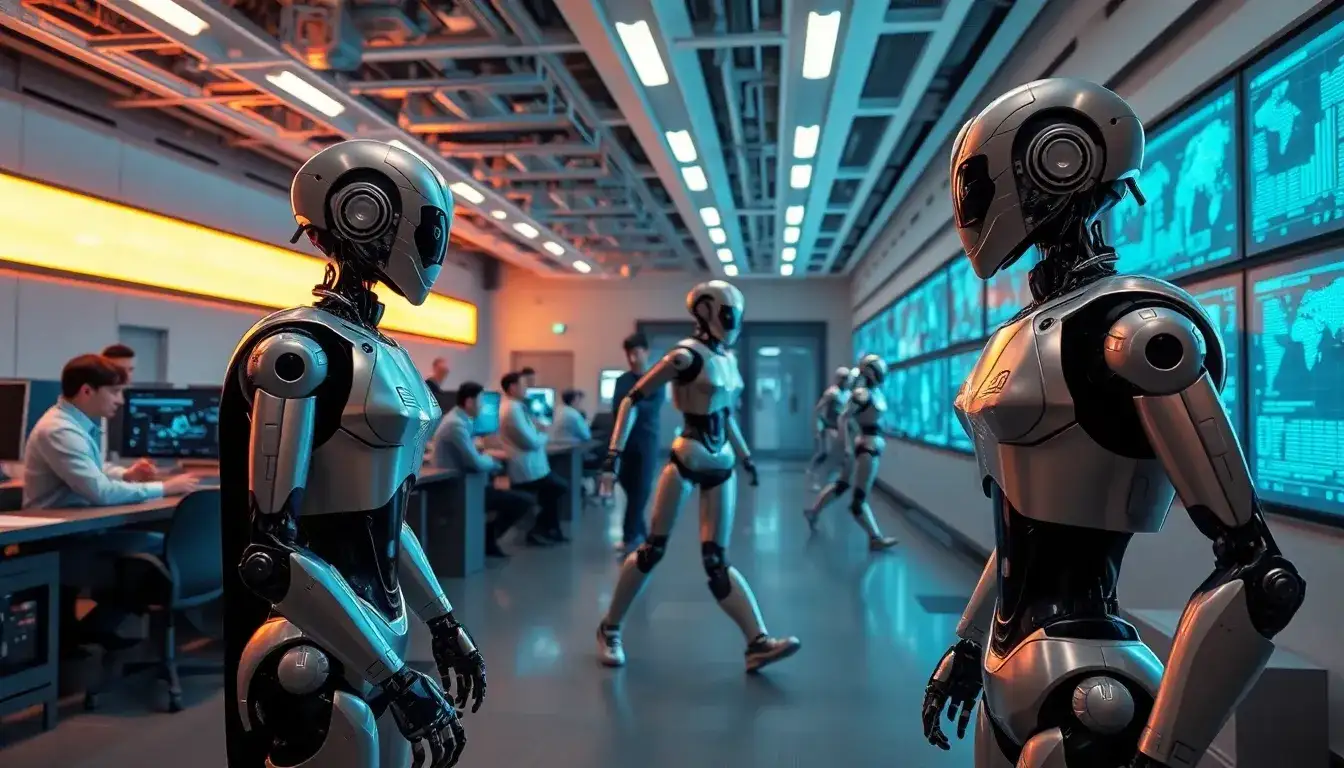
Within the Shijingshan Humanoid Robot Data Training Center, the largest full-size bipedal humanoid robot training facility in the country, robots are actively engaged in data collection related to domestic life scenarios. The center is located in Shijingshan District of Beijing, and its entrance hall showcases numerous humanoid robots diligently performing various tasks.
Under the guidance of data collectors, these humanoid robots successfully complete a range of data gathering assignments, showcasing their capabilities in tasks such as sorting packages and performing household chores.
Artificial intelligence is a crucial driving force behind a new wave of technological revolution and industrial transformation. Rapidly advancing a new generation of artificial intelligence is a strategic issue that directly impacts China’s ability to seize opportunities in this new technological era.
The “14th Five-Year Plan” emphasizes the importance of “building a modern industrial system to strengthen the foundation of the real economy” and “deepening the construction of a digital China to enhance intelligent development.” In light of these goals, various regions and organizations across the country have introduced innovative practices to cultivate emerging industries and accelerate technological innovation.
At the Shijingshan Humanoid Robot Data Training Center, nearly one hundred humanoid robots tirelessly repeat simple actions, such as unlocking a door, retrieving a bottle of medicine, folding clothes, and sorting packages. Why do these intelligent robots repeatedly perform such basic tasks? What is the process for their “pre-job training”? When will humanoid robots truly integrate into households? Join us as we explore this state-of-the-art training center.
From “being able to converse” to “being able to work,” the evolution of humanoid robots is significant. In science fiction films, we often see robots performing complex tasks effortlessly. However, in the real world, getting a metal body weighing several dozen kilograms to delicately pick up an egg or skillfully fold a shirt remains a monumental challenge.
As the General Manager of the Shijingshan Humanoid Robot Data Training Center, Zhu Kai explains, “The current robotic brains are intelligent, but their limbs lag behind. They can comprehend commands like ‘hand me a glass of water’ through language models, but when it comes to executing physical actions, they often fall short.” This highlights the “last mile” problem faced by embodied intelligence—while there is an abundance of textual and video data available for robots online, they lack real sensory perception of the physical world.
In late March, the center unveiled its third phase at the 2026 China Science Fiction Conference’s Embodied Intelligence Forum. The center, which spans over 10,000 square meters, comprises three phases of development. Its primary focus is to help robots evolve from being able to converse to being able to perform practical tasks.
Designed similarly to vocational training facilities, the training center features various workstations for tasks such as dispensing medication, packaging parcels, and industrial assembly. Each layer is divided into specific work units, where every humanoid robot repeatedly performs its assigned tasks.
The training scenarios for the robots are categorized into three main types: household tasks (like folding clothes and tidying up), commercial services (such as stocking shelves in supermarkets and dispensing medication), and industrial production tasks (like moving molds and retrieving screws). Since its operation began in September 2025, the training center has completed over 3,700 data collection tasks, generating more than 1.17 million lines of operational data with a cumulative storage capacity exceeding 1,300 TB.
To understand what constitutes “a task,” Zhu Kai provides an example: “If a client asks us to teach a robot to heat leftover food, it must perform a series of actions: opening the refrigerator, taking out the leftovers, placing them in the microwave, closing the microwave door, and starting the heating process. This entire sequence of actions is referred to as a task, commonly known in the industry as an ‘atomic skill.’ Each atomic skill requires over a thousand data collection instances, often tens of thousands, to ensure the model learns accurately.”
Transitioning from factory settings to household environments, the center’s Vice General Manager, Guo Rui, explains, “Currently, the robot is performing actions related to dispensing medication.” He demonstrates how the robot opens a medication box, retrieves scissors, places them on the table, and closes the box, with the entire task recorded on a computer screen, taking 45 seconds.
When asked why the process is slow, Guo Rui clarifies, “It’s not that the robot lacks speed; during data collection, we must ensure stability and a high success rate. Once the model is fully developed and trained, its actions will be much quicker.” This single 45-second operation generates nearly 1 GB of data, capturing the robot’s movements from multiple angles through cameras mounted on its head and hands. Sensors inside its body gather all physical information, such as the force used to open the box and the angle of the scissors during grasping.
The pilot testing platform serves as the final examination site for robots transitioning to industrial applications. Trained models must undergo real-world testing to adapt to various lighting, environmental, and object conditions before they are deployed in practical scenarios.
The most advanced “graduate” from this training center is the “empty box return” robot, which retrieves empty material boxes from assembly lines and organizes them on shelves. Geng Saimeng, in charge of business operations at the center, shares, “In the automotive industry, empty boxes that need to be returned to shelves after unloading were previously handled entirely by humans. While this task is not highly technical, it remains a segment of automated production that hasn’t been fully replaced. Through training, robots can now work alongside some companies on production lines, functioning continuously for 24 hours.”
In industrial settings, robots are deeply integrated into production processes, routinely handling various operations to enhance production quality and efficiency. In agriculture, intelligent machinery serves as modern tools, autonomously navigating to work sites and accurately completing tasks like fertilization, thus empowering modern farming.
For humanoid robots, the true test lies in home service. In the center’s third-phase area, a fully simulated human living space is set up, complete with a dining room, living room, and kitchen, where humanoid robots practice folding cloths.
Many wonder, “When can I buy a robot to help with folding laundry and cooking?” Geng Saimeng explains, “Industrial applications may see widespread adoption in the coming years, but household services will require more time.” Unlike standardized industrial environments, homes are filled with uncertainties. Each household has different furniture arrangements, lighting, colors, and materials; thus, robots must possess strong generalization abilities to adapt to these variations. The center employs a blended training model, leveraging digital twin technology to generate vast data in a virtual world, which is then transferred to physical robots for validation, accelerating their integration into home services.
Looking at the industry chain through the lens of one robot, the first phase of the project involves around 100 wheeled robotic arms focused on basic data collection. The second phase targets large-scale scenario collection for full-size bipedal humanoid robots across various environments, including industrial, home, and daily life. The third phase constructs realistic family and hotel settings, aiming to implement high-precision tactile technology. Upcoming phases will introduce dexterous manipulation techniques and focus on mutual empowerment between application scenarios and technology development.
The Shijingshan Humanoid Robot Data Training Center is not merely an industrial workshop; it is a comprehensive platform for data production, technology research, talent cultivation, and public education. The establishment of such a large-scale training center showcases the country’s ability to leverage its strengths in concentrating resources on significant projects. Zhu Kai emphasizes that building these centers involves substantial capital investment, necessitating robust policy support and long-term funding.
In March, the Shijingshan District established the Embodied Intelligence Data Factor Industrial Development Alliance, bringing together over 40 relevant organizations to cover all aspects of the robot industry, including core components, algorithm development, and application scenarios.
Across the nation, various robot training centers are emerging, forming a network of embodied intelligence infrastructure. According to a report from the China Academy of Information and Communications Technology, by the end of December 2025, more than 30 embodied intelligence training facilities are projected to be operational in cities including Beijing, Shanghai, Tianjin, Guangdong, Zhejiang, and Jiangsu.
In the near future, diverse and capable robots will enter various environments, including hospitals, factories, and common households. Their “academic records” will likely reflect the growth experiences from numerous robot data training centers nationwide.
Within the training center, each humanoid robot is accompanied by a dedicated “coach,” known as a data collector. Data collection methods primarily include remote operation and motion capture. The reporter had the opportunity to experience remote operation firsthand, using VR goggles and hand controllers to manipulate a robot’s movements. For instance, when tasked with grasping a carrot toy, the robot successfully picked it up and placed it in a basket.
Motion capture involves a different training logic. Infrared cameras surround a central platform where an operator, clad in a suit covered with tracking points, performs a set of defined actions for the robot to replicate. Zhu Kai explains, “Recently, an entertainment organization approached us to collaborate, using professional dancers in motion capture suits to dance, allowing robots to perfectly mimic their movements. Many robotic performances seen during events, such as the Spring Festival Gala, are produced using this data collection method.”
Visitors to the training center eagerly participate in data collection activities, engaging in a “synchronized experience” with the robots. However, for data collectors, this entails repetitive and slow-motion tasks daily. The center’s large screen continuously displays the workload of data collectors. Some collectors may repeat a precise “using a key to unlock” action hundreds of times within a day. One young data collector shares, “Although it sounds monotonous, it is highly rewarding. Watching a robot finally master an action and perform it better than I can feels like seeing my child take their first steps.”
Integrating robots into everyday life across numerous scenarios necessitates both sophisticated algorithms and substantial practical experience. It is the dedication of these behind-the-scenes workers that breathes “life” into cold intelligent devices, ultimately serving humanity’s betterment.
Original article by NenPower, If reposted, please credit the source: https://nenpower.com/blog/exploring-chinas-largest-full-size-bipedal-humanoid-robot-data-training-center/

