

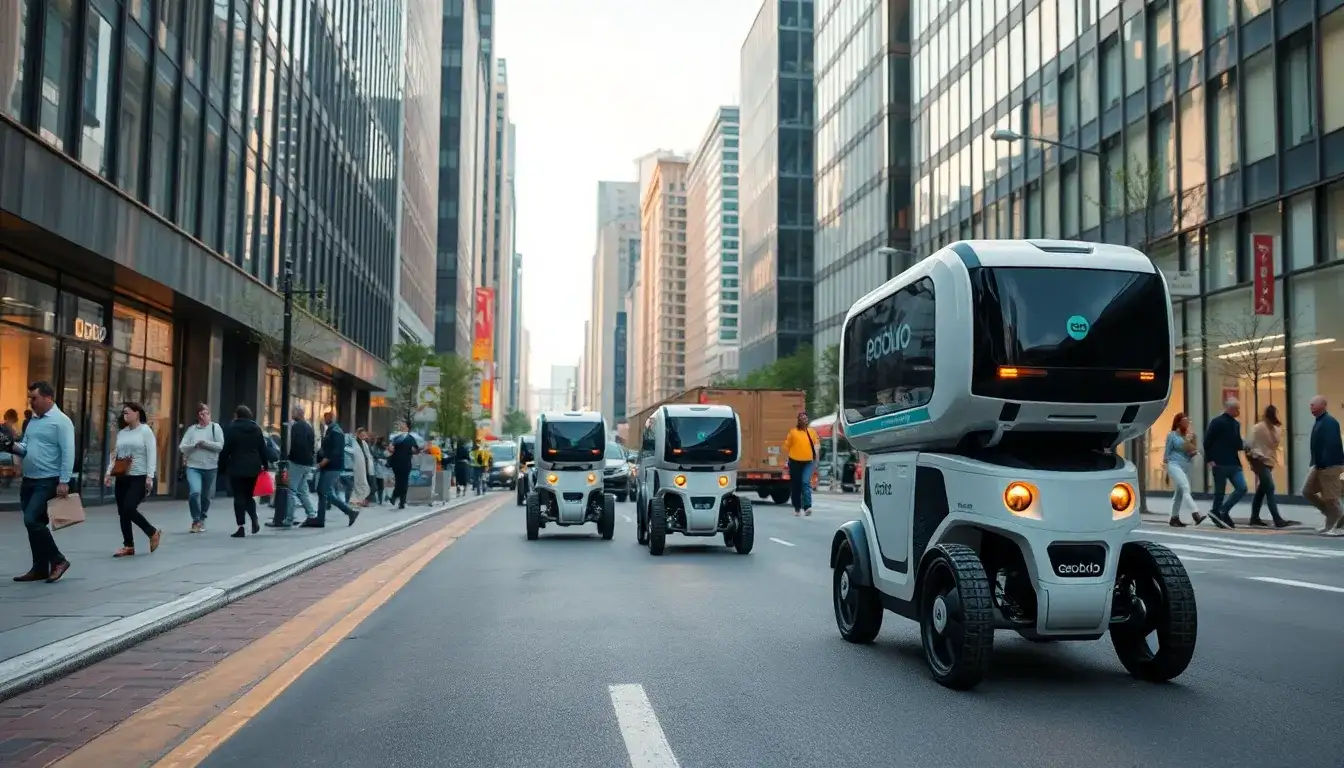
The rise of delivery robots has become a pivotal factor in modern automation, moving away from traditional factory-centered models to intelligent networks powered by artificial intelligence, robotics technology, and digital systems. In this transition, the significance of delivery robots has increasingly come to the forefront. Their core value lies in extending the boundaries of automation from merely “handling digital tasks” to “executing real-world delivery operations,” enabling true end-to-end automation in industries such as logistics, healthcare, and retail. Unlike traditional equipment, delivery robots can autonomously navigate and operate in complex real-world environments, serving as a vital link between AI systems and operational layers.
What are Delivery Robots?
Delivery robots are mobile robotic systems capable of autonomously completing transportation and delivery tasks in real environments. They represent a significant advancement in modern automation, extending capabilities into the physical world and acting as a core technology driving the development of smart logistics today. Unlike traditional automation systems, which are typically limited to fixed and structured scenarios like factories, production lines, or warehouses, delivery robots can autonomously operate in open, complex, and ever-changing environments, showcasing superior adaptability. Their core competencies include:
- Autonomous navigation and path planning in dynamic environments
- Real-time perception and obstacle avoidance
- Completion of end-to-end delivery tasks without human intervention
- Stable operation across various indoor and outdoor scenarios
Thus, delivery robots are not merely automation devices; they are key technologies connecting AI systems with real-world execution layers, playing a crucial role in extending modern automation from “industrial scenarios” to “urban and public service contexts.”
Three Structural Trends Driving the Rapid Development of Delivery Robots
The growing prominence of delivery robots in modern logistics and service industries is primarily driven by three structural trends that are reshaping global delivery and operational models. As labor costs continue to rise and workforce availability tightens, the operational costs of traditional manual delivery methods have escalated, limiting their scalability. Within the entire logistics system, “last-mile” delivery remains the most expensive and least efficient segment, presenting a significant bottleneck to overall logistics efficiency improvement. Meanwhile, the booming e-commerce, retail, and local service sectors have led to an increasing demand from consumers for instant delivery, on-demand services, and 24/7 availability.
In response to these three trends, delivery robots are becoming essential solutions for enhancing logistics efficiency, lowering operational costs, and meeting real-time service demands, thus forming a core component of modern automated logistics systems.
The Core Technology Framework Behind Delivery Robots
The autonomous operation of delivery robots in real environments relies on a highly integrated intelligent technology framework covering three main areas: perception, decision-making, and execution. Key technologies include:
- AI-driven navigation and path planning, enabling autonomous movement and route optimization
- Computer vision technology for identifying environments, objects, and obstacles
- Multi-sensor fusion technologies (such as LiDAR, cameras, and ultrasonic sensors) to enhance environmental perception accuracy
- Edge computing and cloud collaboration systems for real-time data processing and remote control
- Fleet scheduling and remote management systems supporting multi-robot collaboration and scalable management
The foundation of this technology framework is the mobile robot platform, which provides a unified underlying architecture for delivery robots, encompassing:
- Motion control systems
- Multi-source perception and data fusion capabilities
- Modular system design
- Scalable deployment and upgrade capabilities
This platform allows delivery robots to quickly adapt to different application scenarios, expanding from single-unit operations to large-scale robotic networks, which is crucial for their commercialization and large-scale deployment.
Main Application Scenarios for Delivery Robots
Currently, delivery robots have been deployed on a large scale across various industries, evolving from pilot technologies to essential components of enterprise operations and industry infrastructure. In logistics systems, delivery robots primarily enhance transportation efficiency and automation levels, for example:
- Last-mile delivery
- Automated transport and sorting within warehouses
In healthcare, delivery robots improve safety and operational efficiency by handling:
- Delivery of medications and medical supplies
- Transportation of laboratory samples
- Internal logistics automation in hospitals
In corporate campus scenarios, delivery robots mainly facilitate internal service automation, such as:
- Document and material delivery
- Food and daily necessities distribution
In retail and service scenarios, delivery robots enhance user experience by offering:
- Contactless delivery services
- Intelligent customer service and delivery experiences
Delivery robots have transitioned from experimental applications to standard operational tools across multiple industries, becoming vital infrastructure for modern enterprises aiming to enhance efficiency and automation levels.
The Evolution of Delivery Robots in the Future Automation Ecosystem
Future automation systems will gradually evolve into “fully connected intelligent ecosystems,” achieving deep collaboration between robots, AI, and digital infrastructure to build a unified and efficient operational network. The core components of this system will include:
- Robotic systems
- AI models
- Cloud computing and data platforms
- Intelligent infrastructure
These technologies will collectively advance automation from isolated applications to system-level collaboration. In this trend, the role of delivery robots will continue to evolve, primarily reflected in the following aspects:
- Transitioning to large-scale autonomous robot fleets for centralized scheduling and collaborative operation
- Building city-wide intelligent logistics networks to enhance overall delivery efficiency
- Expanding into multifunctional service robots covering a broader range of application scenarios
As AI capabilities continue to improve, delivery robots will gradually evolve from a single delivery tool to a versatile autonomous service system capable of handling tasks across multiple scenarios, becoming an integral part of future intelligent automation systems.
Core Drivers for Accelerating the Deployment of Delivery Robots
From a business and operational perspective, as digital transformation accelerates, delivery robots are becoming key automation tools for enhancing efficiency and competitiveness, rapidly gaining traction across various industries. The main reasons for companies to accelerate the deployment of delivery robots include:
- Effectively reducing long-term labor costs and enhancing overall operational control
- Improving logistics and delivery efficiency, optimizing business processes
- Alleviating workforce shortages and enhancing business stability
- Supporting round-the-clock continuous operations to enable uninterrupted service capabilities
- Extending automation from digital systems to physical execution layers
Based on these advantages, industries such as logistics, healthcare, retail, and campus management are rapidly integrating delivery robot systems to enhance operational efficiency, promote intelligent upgrades, and elevate enterprises to higher levels of automated operations.
Delivery Robots: An Indispensable Infrastructure of Modern Automation
The reason delivery robots have become an integral part of modern automation systems is that they are driving a fundamental leap in automation—from traditional digital systems to real-world physical execution and operations. They effectively address long-standing efficiency bottlenecks and cost pressures in the logistics and service sectors while providing critical support for constructing large-scale, scalable intelligent automation systems. Driven by advanced mobile robot platforms and AI technologies, delivery robots are progressively transforming automation from a concept into tangible, operational infrastructure, with widespread applications in logistics, healthcare, retail, and enterprise services. In conclusion, delivery robots not only represent a trend for the future but also form an essential foundational force within modern automation systems.
Q&A
Q1: What distinguishes delivery robots from traditional automation devices?
A: Traditional automation devices typically operate within fixed, structured environments such as factories and warehouses, whereas delivery robots can autonomously function in open, complex, and dynamically changing real-world settings. They are equipped with capabilities such as autonomous navigation, real-time obstacle avoidance, and end-to-end delivery, allowing them to fulfill tasks without human intervention and to operate continuously across various indoor and outdoor scenarios. This positions them as key technologies linking AI systems with real-world operations rather than merely industrial devices.
Q2: In which industries are delivery robots currently primarily utilized?
A: Delivery robots have achieved large-scale applications in various industries. In logistics, they are mainly used for last-mile delivery and automated transportation and sorting within warehouses. In healthcare, they facilitate medication delivery, sample transport, and internal logistics in hospitals. In corporate campuses, they handle the delivery of documents, materials, and food. In retail and service sectors, they provide contactless delivery and intelligent customer service experiences. These applications are transitioning from pilot phases to routine operations.
Q3: What core technologies enable delivery robots to operate autonomously?
A: The autonomous operation of delivery robots depends on the integration of several key technologies: AI navigation and path planning for autonomous movement and route optimization; computer vision technology for identifying environments and obstacles; multi-sensor fusion technologies (such as LiDAR, cameras, and ultrasonic sensors) to enhance perception accuracy; and edge computing and cloud collaboration systems for real-time data processing. Additionally, fleet scheduling and remote management systems support collaborative operation of multiple robots. These technologies collectively form the foundational basis for their intelligent operation.
Original article by NenPower, If reposted, please credit the source: https://nenpower.com/blog/the-rise-of-delivery-robots-key-drivers-of-modern-automation-in-logistics-and-beyond/

