

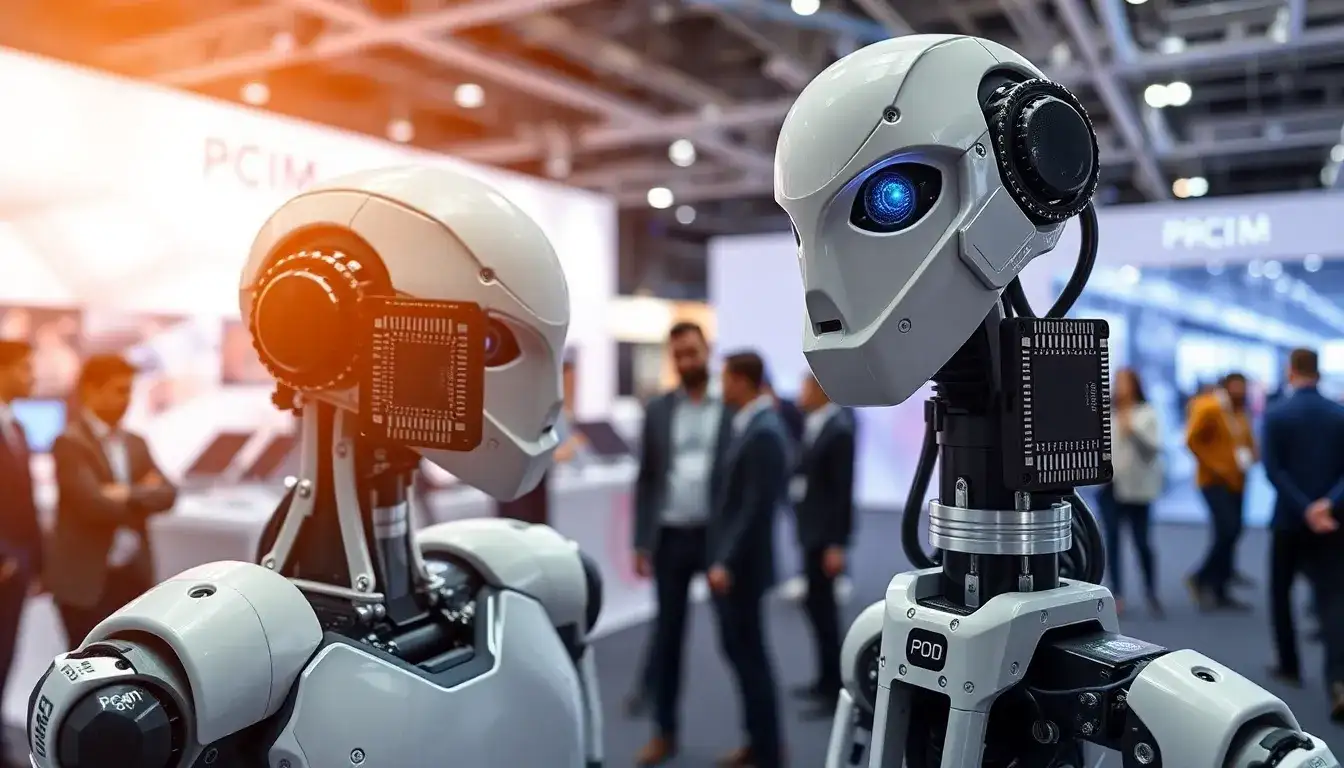
Humanoid Robots: Advancements in Motor Drive Electronics
In the development of humanoid robots, the design of joints is critical as it directly influences the robot’s flexibility, stability, and overall practicality. A humanoid robot typically requires around 40 to 80 motors to operate its limbs and torso, with each hand containing multiple additional motors for dexterous movement. High-density independent actuators introduce complex challenges in power electronics integration, which must be achieved within the constraints of human-sized packaging.
On May 13, 2026, Efficient Power Conversion (EPC) announced that it would showcase its latest GaN power solutions for humanoid robots, drones, and compact electrification systems at PCIM Europe 2026, scheduled for June 9-11 in Nuremberg, Germany. The company will demonstrate how its 7th generation GaN platform enables compact, manufacturable power architectures for next-generation intelligent motion systems and AI power transmission. These devices offer higher switching frequencies, lower losses, and more compact layouts, enhancing efficiency and integration in robotic motion control.
As the market for GaN technology expands, EPC is at the forefront, utilizing eGaN technology to push the boundaries of power electronics. This technology allows for smaller, faster, and more efficient systems across various applications, including robotics, drones, artificial intelligence, and space exploration.
GaN Motor Drive Evaluation Boards
EPC’s GaN power devices are driving the development of a new generation of high-efficiency, high-power density motor drive systems. Compared to traditional silicon MOSFETs, GaN transistors feature significantly lower gate charge, reduced output capacitance, and extremely low on-resistance, enabling power converters to operate at higher switching speeds. Consequently, GaN-based motor inverters can achieve switching frequencies exceeding 100 kHz while minimizing conduction and switching losses, resulting in smaller passive components and increased efficiency.
Emerging Opportunities in South Korea
In South Korea, the demand for GaN solutions is steadily increasing, particularly in applications such as electric vehicles, renewable energy, and battery systems. GaN technology is being recognized for its ability to improve power efficiency while enabling more compact and lightweight designs. The market for power semiconductors surrounding GaN is expected to undergo significant reorganization, with existing markets for MOSFETs and driver ICs experiencing rapid changes.
Next-Generation Power Density
The 7th generation GaN and integrated GaN circuits are redefining power density in AI racks and humanoid robots. As AI infrastructure shifts to 800-volt power distribution, and humanoid robots increasingly embed power electronics directly into joints, the demand for efficiency, density, and dynamic performance across the 15-volt to 40-volt range has fundamentally transformed the approach to next-generation conversion architectures.
Compact GaN Half-Bridge Integration
With ongoing transitions from traditional automation to mobile robotics, the design requirements for motor drive electronics are significantly changing. In applications involving wearable technology, humanoid robots, and aerial platforms, constraints on size, weight, efficiency, acoustic emissions, and dynamic response are increasingly critical. In these scenarios, inverters become tightly coupled components within motor structures.
High-Performance GaN Solutions
EPC has introduced the EPC9186HC2 and EPC9186HC3 evaluation platforms, designed for high-performance three-phase BLDC motor drive inverters. These platforms are tailored for applications including robotics, industrial automation, light electric vehicles, electric scooters, forklifts, agricultural machinery, battery-powered mobile systems, and high-power drones, supporting motor drive systems up to 5 kW. The evaluation boards utilize EPC2361 eGaN technology, highlighting the compact and efficient inverter architectures that engineers can assess.
In conclusion, humanoid robots are reshaping the demand for motor drive electronics, necessitating innovative solutions that meet the unique challenges of this evolving field. The advancements in GaN technology are paving the way for more efficient, compact, and powerful systems, driving the next generation of robotic applications.
Original article by NenPower, If reposted, please credit the source: https://nenpower.com/blog/epc-showcases-next-generation-gan-power-solutions-for-robotics-and-ai-applications-at-pcim-europe-2026/

