

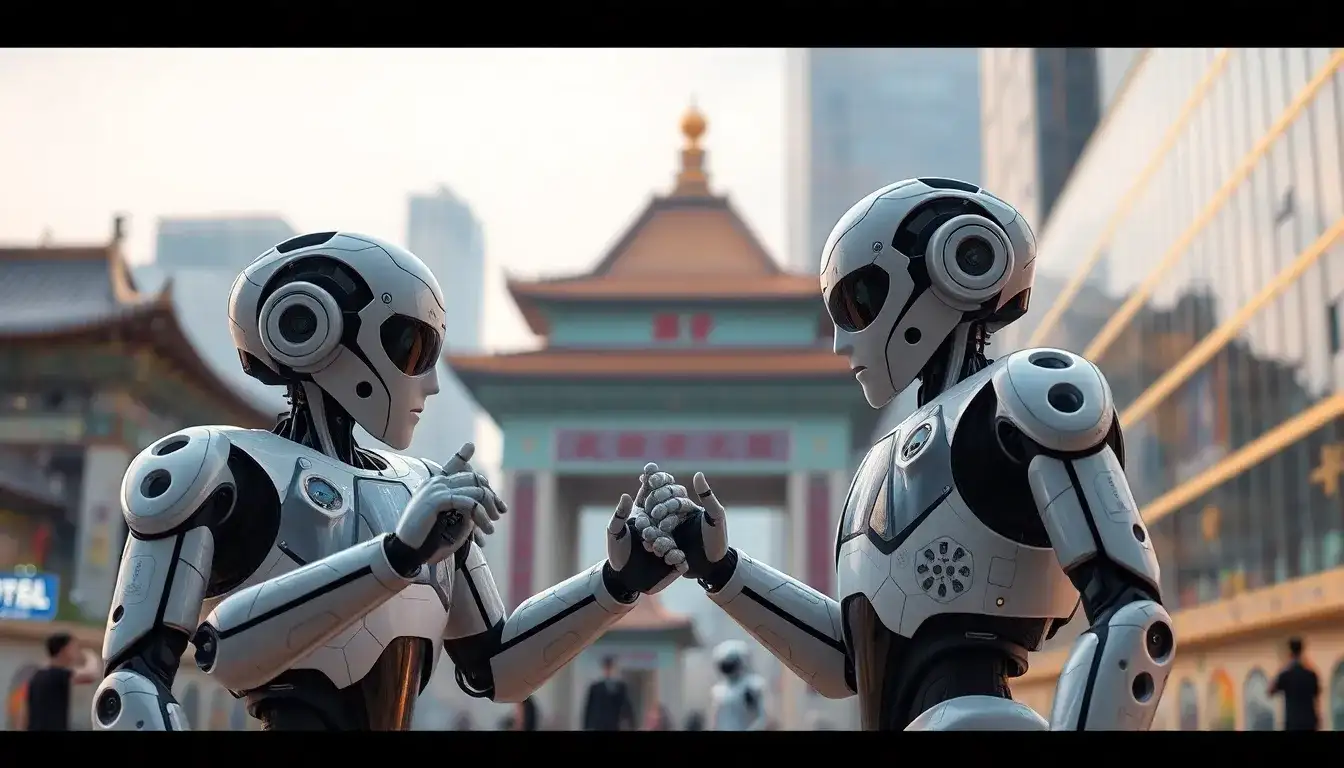
Recently, the Beijing Humanoid Robot Innovation Center showcased a significant breakthrough in the capabilities of humanoid robots through a live demonstration. The intelligent agent, powered by the general embodied intelligence platform “Hui Si Kai Wu,” achieved a pioneering advancement in global scene perception and dynamic memory. This development allows robots to be aware of their environment and effectively manage tasks, laying the groundwork for future applications in household, commercial, and industrial settings.
In 2025, the Beijing Humanoid Robot Innovation Center launched the world’s first universal embodied intelligence platform that supports “one brain, multiple machines” and “one brain, multiple abilities” — “Hui Si Kai Wu.” This platform revolutionized the traditional model of robotics, which typically focused on single-scene, single-task development. It enhances robots’ ability to make autonomous decisions and execute tasks in complex environments.
Currently, robots equipped with the Hui Si Kai Wu platform have made significant strides, achieving core breakthroughs in spatial memory. This advancement enables robots to transition from passive execution to proactive engagement, allowing them to handle complex long-term tasks instead of just simple, short-sighted activities. Traditional robots relied on instantaneous visual input, meaning that once an object left their field of vision, it was as if it had “disappeared.” Consequently, if the scene changed, the robot would “forget” and struggle to perform complex reasoning and long-range tasks, limiting their ability to carry out intricate activities like humans.
During the live demonstration, the Hui Si Kai Wu agent showcased its ability to perform tasks such as delivering water and retrieving tissues seamlessly. Throughout the process, the robot exhibited a sense of “spatial awareness.” Even when objects were out of sight, it was still able to accurately identify their locations and states based on its spatial memory, understanding their relationships with the surrounding environment. This capability is made possible by the industry’s first global scene perception and dynamic spatial memory system, which includes a “dynamic semantic map” that records and updates information about the types, colors, and locations of visible objects in real time, allowing for persistent memory across time and perspectives.
According to practical tests, the spatial memory system demonstrated a consistent accuracy rate of 100% in complex multi-step tasks involving movement, perception, and grasping. A representative from the Beijing Humanoid Robot Innovation Center explained that even when faced with common disturbances such as perspective shifts or object occlusion, the overall task completion rate remained above 98%. This indicates that robots now possess genuine global spatial memory and common sense, enabling them to perform tasks in various scenarios like retrieving items at home or sorting materials in logistics, even amid changing environments.
However, a current challenge for robots is their inability to remember individuals and differentiate preferences, resulting in every interaction feeling like a first encounter. To address this, the Hui Si Kai Wu agent employs a user memory system that facilitates personalized interactions. The robot can recognize individuals after just one meeting, remembering their behavioral preferences to offer tailored services. For instance, when a user casually mentions being “thirsty,” the robot can recall from its memory that the user prefers cola and proactively retrieve it. The robot can also maintain context across tasks. When a user requests to “continue what we did yesterday” or “bring me the last document,” the robot can recall previous activities.
As a result, robots can autonomously perceive their environment and identify needs, allowing them to be proactive. “This breakthrough in technology means that robots are no longer just cold executing machines; they can remember you, understand you, and serve you actively,” said a representative. Furthermore, robots need to have not only visual awareness but also “hands-on control.” In the past, while robots could grasp certain items, they often struggled with grip and control. To address this industry challenge, the Hui Si Kai Wu agent incorporates “vision plus touch” sensory capabilities, enabling it to adjust its grasping force based on the characteristics of target objects. This enhancement leads to improved perception and understanding, ultimately achieving a reliable and stable performance in tasks.
Original article by NenPower, If reposted, please credit the source: https://nenpower.com/blog/beijings-humanoid-robots-achieve-breakthroughs-in-global-scene-perception-and-dynamic-memory/

