

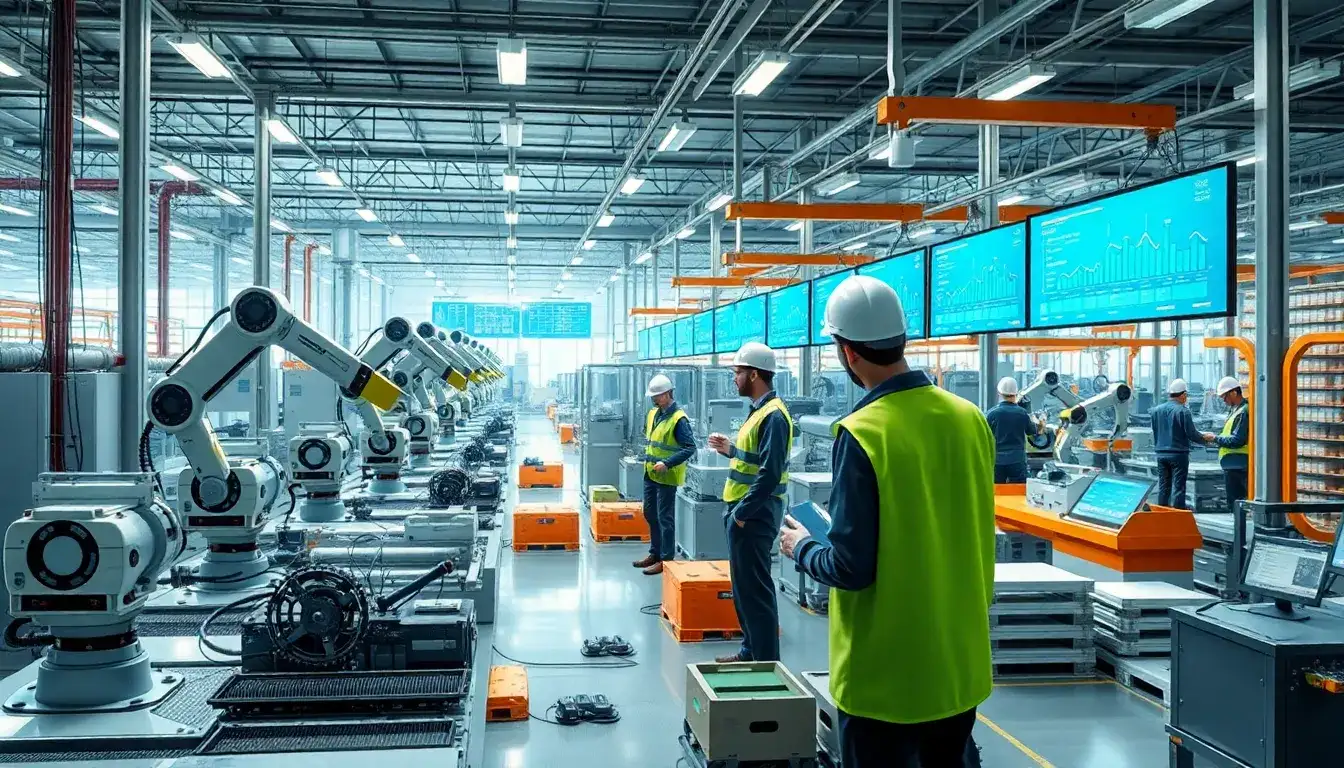
The manufacturing landscape is set to undergo significant transformations starting in 2026. Recently, I had dinner with several friends in the manufacturing industry, and we all shared a similar sentiment—business is challenging, yet the number of orders hasn’t decreased; they’ve simply changed. One friend who runs an electronics factory in Dongguan remarked that while previously orders were based on large quantities, clients now ask for smaller batches with various styles and quicker delivery. He smiled, noting, “This indicates that we are no longer just competing on price; customers value our responsiveness and customization capabilities.” This insight stayed with me as I pondered the future of manufacturing in China. Over the past few years, there has been talk of transformation and upgrading in the industry, but what will this actually look like on the factory floor and production line? Based on recent data and policy trends, I believe 2026 will be a pivotal year. Starting then, Chinese manufacturing is anticipated to undergo profound changes across three dimensions.
Change One: From “Mass Production” to “Flexible Intelligent Manufacturing”
Small orders are becoming the norm. If you still associate Chinese manufacturing with mass production, you might need to update your understanding of the industry. Last month, I visited Zhuji in Zhejiang, a well-known sock manufacturing hub. In the past, factories would fulfill orders ranging from tens of thousands to hundreds of thousands of pairs, which were then shipped to ports or wholesale markets. However, many factories are now reducing their production lines—some orders may only consist of a few hundred pairs, or even dozens, with prices increasing several times over. The reason is straightforward: the rise of cross-border e-commerce and live commerce has led to increasingly personalized consumer demands. A livestream host might promote a product today and expect orders by tomorrow, requiring factories to complete design, sampling, production, and shipping within a week. The old model of “produce first, sell later” is no longer viable; it has been replaced by “sell and produce simultaneously, with small orders and quick responses.” This shift is supported by enhanced flexible manufacturing capabilities.
Real-time monitoring of production lines via IoT devices, automated scheduling through AI algorithms, and machines capable of producing different styles simultaneously have all contributed to this transformation. Previously, changing styles could require halting operations for half a day to adjust equipment; now, it can be done in just a few minutes. Data indicates that by 2024, over 40% of large-scale industrial enterprises in China will be able to achieve “multi-variety, small-batch” flexible production. Given the current pace of technological advancement, this percentage is likely to exceed 60% by 2026. This means that in the future, niche designs and customized products you encounter online will likely rely on this new form of Chinese manufacturing capability.
Interestingly, this shift is also influencing our everyday lives. Many young people around me are trying “light entrepreneurship,” collaborating with such factories to design unique accessories and home goods, starting with a few hundred pieces, which reduces financial pressure and lowers the cost of trial and error. A former colleague of mine quit his job last year to make handcrafted leather goods and partnered with a small batch leather factory in Guangzhou; now he consistently receives orders each month, enjoying a better quality of life than when he was employed.
However, flexible manufacturing also demands more from factories. Equipment must be intelligent, management needs to be meticulous, and workers must transition from being mere operators to skilled technicians. Once this path is established, the core competitiveness of Chinese manufacturing will shift from low prices to “if you can imagine it, we can produce it quickly.”
Change Two: From “Export-Driven” to “Balanced Domestic and International Focus”
The domestic supply chain is undergoing a restructuring. For decades, Chinese manufacturing has largely been about “blooming within the walls while fragrant abroad.” Products were produced, branded with international labels, and shipped to Western markets. However, a noticeable trend over the past two years is that more manufacturing enterprises are shifting their focus to the domestic market. Several factors are driving this change. On one hand, fluctuations in the international trade environment have increased uncertainties in exports. On the other hand, the rise of the domestic consumer market, particularly the new wave of national brands, has provided unprecedented opportunities for manufacturers.
I know a small appliance company in Jiangsu that used to primarily produce for foreign brands with razor-thin profits. Since 2022, they registered their own brand targeting the youth market, emphasizing “aesthetics, multifunctionality, and cost-effectiveness.” Within two years, domestic revenue now accounts for over 40% of their total earnings. The owner remarked, “We used to make clothes for others; now, we finally have our own.” This shift has led to a reorientation in the supply chain layout of the manufacturing industry. Previously, factories clustered in coastal areas for easy export access, but as domestic market importance grows, more companies are moving inland. Regions like Chengdu-Chongqing and the Central Yangtze River city clusters are emerging as new manufacturing bases.
Chongqing serves as a typical example. A decade ago, it was primarily known for hot pot and its mountainous terrain. Now, it stands as one of the largest notebook computer production bases globally, with significant automobile production as well. The key is that the local industrial chain is becoming increasingly complete, with raw materials, components, and final assembly all taking place locally. By 2026, this “balanced domestic and international focus” will be even more pronounced. Coastal regions will continue to leverage their advantages in R&D and high-end manufacturing, while inland areas will take on large-scale production, creating a more balanced industrial layout.
For ordinary people, this means job opportunities will be more dispersed. Young people no longer need to flock to coastal areas; they can find decent manufacturing jobs closer to home. My hometown in a prefecture-level city in Henan has developed several industrial parks in recent years to accommodate the manufacturing businesses relocating from Guangdong and Zhejiang. Although wages might be slightly lower than in coastal areas, living costs are also lower, allowing residents to stay close to home. My cousin returned home from Shenzhen last year and now works as a technician at a factory producing components for electric vehicles, earning a monthly salary of around 8,000 yuan. He is satisfied with his life, having purchased a car and is preparing to buy a house.
Change Three: From “Labor-Intensive” to “Technology-Intensive”
The value of human labor is being redefined. When discussing manufacturing, many people envision workers performing repetitive tasks on assembly lines. However, visiting a modern factory today may challenge that perception. Last month, I toured an intelligent factory in Hefei, Anhui, which produces high-end display panels. The production floor was nearly devoid of human workers, replaced by robotic arms, automated guided vehicles, and high-precision testing equipment. Workers monitored data on large screens from a control room and occasionally adjusted parameters with a mouse. Such scenes were once the stuff of science fiction a decade ago.
This is not an isolated case. According to data from the Ministry of Industry and Information Technology, by 2024, the national density of industrial robots is expected to reach 392 units per 10,000 workers, more than double the global average. By 2026, this number is projected to surpass 500. Does the replacement of humans by machines mean job losses? On the contrary, while the number of ordinary worker positions may decrease, there is a significant increase in demand for skilled technicians, equipment maintenance, and data analysis roles. Additionally, worker compensation is on the rise as companies increasingly recognize that retaining a skilled technician is more valuable than purchasing a new machine.
I know a skilled mold technician in Zhejiang who graduated from vocational school and has worked for over a decade. He is now a technical backbone at his factory, responsible for programming five-axis machining centers, earning over 20,000 yuan a month. He shared, “No matter how advanced the machines are, they still need people to operate them. What I do now is much more interesting and respectable than just tightening screws on an assembly line.” This shift also signifies a deeper impact: manufacturing is transitioning from relying on a population dividend to a talent dividend. In the past, competition was based on the number of workers and low wages; now, it is based on the skill levels of technicians and their innovation capabilities.
For young individuals, this shift presents an opportunity—if you are willing to invest time in learning a skill, manufacturing can offer returns that may surpass many white-collar jobs. Recently, there has been a noticeable increase in interest in vocational education. Graduates in specialized fields such as intelligent manufacturing, industrial robotics, and electric vehicle maintenance are often snatched up by companies even before they graduate, with starting salaries often exceeding 6,000 yuan. In contrast, some ordinary university graduates are facing employment difficulties. This disparity merits reflection.
Of course, such transitions come with their own challenges. Older workers in their forties and fifties may find it difficult to acquire new skills and risk being phased out. However, many companies are initiating internal training programs to help older workers transition. For example, they may shift from direct machine operation to roles in quality inspection, site management, or equipment maintenance—positions that require experience and are often beyond the capabilities of younger workers, thus highlighting the advantages of older employees.
Looking back at these three major changes—flexible manufacturing, balanced domestic and international focus, and technology-intensive operations—you’ll see that they are interconnected. Flexible manufacturing requires intelligent equipment, which in turn needs skilled operators, while the development of the domestic market provides ample application scenarios for flexible manufacturing. This creates a positive feedback loop.
Of course, this process will not be without hurdles. Industrial upgrades mean phasing out outdated production capacities, leading to the disappearance of some low-end manufacturing jobs and causing certain companies to face challenges during their transitions. However, the overall direction is clear: Chinese manufacturing is evolving from being “large” to being “strong,” and from being “cheap” to being “worthy.” For ordinary people, instead of feeling anxious, it is more productive to consider how to find a place in this shifting landscape. If you work in manufacturing, consider learning new skills; if you are contemplating employment or entrepreneurship, pay attention to flexible manufacturing, domestic supply chains, and intelligent manufacturing; and if you are simply a consumer, recognize that the quality of domestically produced goods may exceed your expectations.
Finally, I would like to ask: Do you have friends in the manufacturing industry? How are they faring now? Or when you shop, do you lean more towards domestic products or imported brands? Feel free to share your thoughts in the comments.
Original article by NenPower, If reposted, please credit the source: https://nenpower.com/blog/chinas-manufacturing-sector-set-for-major-transformation-by-2026-three-key-changes-ahead/

