

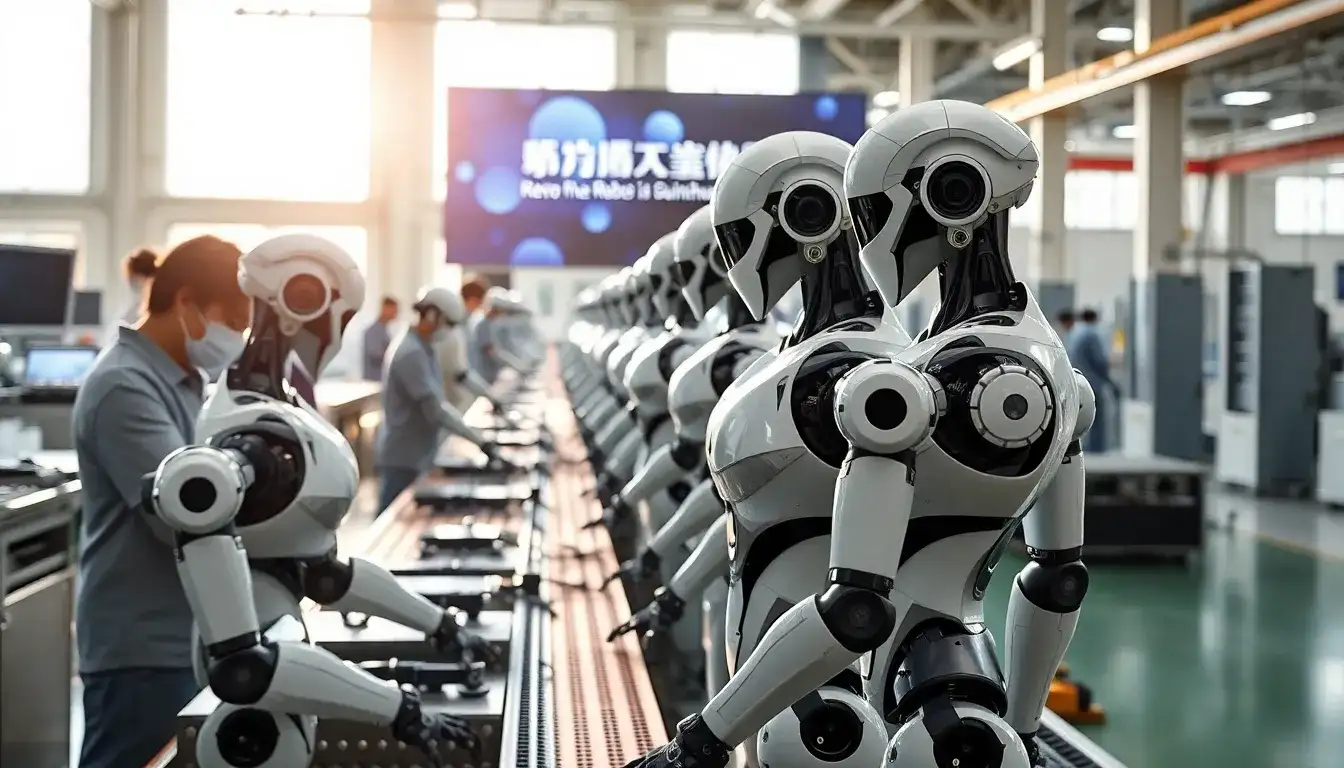
Robots Take Over Foxconn – A New Era in Zhengzhou
Numerous humanoid robot companies are establishing their bases in Henan. Located 30 kilometers west of Zhengzhou East Station, the Yunzhike Technology Park is just adjacent to Zhengzhou University. A robot factory here is on the verge of commencement. The production site is nearing completion, with workers currently engaged in equipment debugging and road leveling. This soon-to-be operational facility will serve as the global production and research center for Zhongqing Robotics.
According to founder Zhao Tongyang, the T800 humanoid robot is expected to roll off the production line in bulk in the first half of 2026. Over the next few years, tens of thousands of humanoid robots are projected to be produced here, signifying the dawn of “Henan-made” humanoid robots.
Apart from Zhongqing Robotics, Zhengzhou is attracting a significant number of humanoid robot companies. Zhiyuan aims to create a central base for embodied intelligence in Zhengzhou, while Yushu plans to establish an innovation center for embodied intelligence in Henan. Additionally, iFlytek has founded a new company in Zhengzhou to expand its robotic business, and UBTECH has already initiated a “Robot Embedded Industry Town” project in Zhengzhou.
For Zhengzhou, this could represent a development opportunity comparable to Foxconn’s establishment in the region, positioning the city at the forefront of humanoid robotics.
Traditionally, major cities like Beijing, Shanghai, Guangzhou, and Shenzhen have dominated the humanoid robotics landscape. So, what makes Zhengzhou an attractive location for top robot enterprises? One reason is the series of supportive policies introduced by Henan, which provide guarantees in terms of funding, land usage, and application scenarios for the humanoid robot industry. Furthermore, Henan boasts a solid manufacturing foundation and a well-established industrial chain.
Sixteen years ago, Foxconn set up operations in Zhengzhou, followed by BYD, which further boosted the region’s manufacturing industry. In 2025, Zhengzhou’s industrial output value is expected to grow by 9% year-on-year, with the electronic information and automotive manufacturing sectors seeing increases of 16.2% and 11.9%, respectively. Meanwhile, manufacturers of precision components such as bearings, sensors, and vision systems have also emerged, laying the groundwork for the humanoid robot industry.
Currently, leading humanoid robot companies are entering the critical phase of mass production, bringing unprecedented attention to Zhengzhou. Zhao Tongyang explained, “This place has a complete range of manufacturing categories, a vast market space, and rich application scenarios, which will drive the gathering of upstream and downstream partners into a cohesive chain.”
According to “Zhengzhou High-tech Release,” Zhongqing Robotics has invested a total of 4.5 billion yuan in its Zhengzhou project, which is expected to be completed within four years. The plan includes establishing a super factory for robots, projected to achieve an annual output value exceeding 1.7 billion yuan once fully operational. Founded in Shenzhen in 2023, Zhongqing Robotics has already secured Series B funding and achieved a valuation exceeding 10 billion yuan.
Why did this Shenzhen company choose to build a factory in Zhengzhou? The founder, Zhao Tongyang, hails from Nanyang in Henan. In December 2025, Henan Zhongqing Robotics Co., Ltd. was established, and its production base in Zhengzhou High-tech Zone occupies 200 acres, with phased construction of a global manufacturing center for humanoid robots. The first phase, covering 8,000 square meters, has an annual production target of 5,000 units. Zhao revealed that the “Henan-made” T800 humanoid robots will begin mass production in the first half of 2026. The second phase will scale up to an annual output of 10,000 units, ultimately creating a global headquarters manufacturing base that integrates research and development, production, testing, and sales.
In April, Zhongqing Robotics partnered with China Innovation Technology (Zhengzhou) Industrial Technology Group Co., Ltd. to focus on core component supply and the construction of embodied intelligence production lines. Concurrently, a data collection center for embodied intelligence is being built in Nanyang, strategically chosen due to the presence of local companies like Wolong Explosion-proof and China Optical, whose motor, optoelectronic, and precision transmission technologies align closely with the core components of humanoid robots.
Zhongqing Robotics is not alone. Other leading companies such as Yushu, Zhiyuan, and UBTECH are also making strides in Zhengzhou. In 2024, UBTECH established a presence in Zhengzhou and in April of that year, it reached an agreement with the Zhengzhou Zhongyuan District government to build a multimodal intelligent service robot industrial demonstration base, aiming to create the nation’s first “Robot Embedded Industry Town.” Shortly thereafter, Zhiyuan Robotics expanded into Zhengzhou, signing a strategic cooperation framework agreement to develop a central base for embodied intelligence. In 2026, Yushu Technology also formalized its partnership with Henan, signing a strategic cooperation agreement to jointly build and operate an innovation center for embodied intelligence, which will encompass product showcasing, market promotion, educational training, and data ecosystem development.
More and more companies focused on embodied intelligence are turning their attention to Henan, establishing production bases, setting up subsidiaries, and co-developing innovation centers. This momentum is largely fueled by policy support. In recent years, Henan has included the robot industry in its “7+28+N” key industrial chain initiative, embarking on actions to bolster the robot and CNC machine tool industries. The province has issued several documents, such as the “Henan Province Embodied Intelligence Industry Development Action Plan (2024-2027)” and the “Henan Province Promotion of ‘Artificial Intelligence+’ Action Plan (2024-2026),” targeting humanoid robots for prioritized development. The provincial government’s work report in 2026 explicitly stated the intention to “advance the construction of projects like Zhongqing Robotics’ global production and manufacturing center.”
On the financial front, Henan has established an artificial intelligence industry fund with a total scale of 3 billion yuan to meet funding needs. For instance, in Zhongqing Robotics’ A+ round financing in December 2025, the Henan Huirong Fund participated; four months later, it led a $200 million Series B financing round for the company.
Foxconn’s founder, Terry Gou, explained his decision to choose Zhengzhou by highlighting the area’s airport, population, and location. Over the past decade, Zhengzhou’s population has seen rapid growth, expanding from 7.52 million in 2009 to approximately 13.13 million by 2025. Following Foxconn’s establishment, Zhengzhou’s GDP has also experienced significant growth, rising from 400 billion yuan in 2010 to 1.5 trillion yuan by 2025. More importantly, Foxconn’s presence not only brought extensive production lines and technical talent but also spurred the growth of Henan’s precision manufacturing sector, resulting in the emergence of numerous component manufacturers that have laid a solid foundation for the humanoid robot industry.
Today, humanoid robot companies are attracted to Henan largely because of its deep manufacturing roots and a mature industrial chain ecosystem. Zhao Tongyang noted that Zhengzhou’s complete range of manufacturing categories will facilitate the gathering of upstream and downstream partners into a cohesive chain. Li Rui from Weitai Robotics stated that Henan’s solid industrial foundation in equipment manufacturing, electronic information, and automotive components makes it an ideal location for embodied intelligence and robotics to take root.
Henan has already gathered numerous key enterprises across the entire embodied intelligence industrial chain, covering complete machines, critical components, specialized software, robot bodies, system integration, and applications. In Zhengzhou High-tech Zone alone, over 400 upstream and downstream related enterprises are clustered within the robot industry. A typical example is Luoyang Hongyuan Bearings, a supplier of industrial robot bearings that later ventured into the humanoid robot bearing sector. Currently, this company holds over 90% of the domestic market share in bearings for crucial humanoid robot joints. This means that nearly all of the humanoid robots you have heard of rely on products from this Luoyang company for their joint movements.
This spring, the Yushu Technology robots that performed “Wu BOT” during the Spring Festival gala featured joints powered by Hongyuan’s bearings. The movements of star robots like Zhiyuan, Zhongqing, and UBTECH are all supported by Hongyuan’s products. Even the Honor robot, which recently set a new half-marathon record for humanoid robots, utilized the HRAU series thin-walled crossed roller bearings supplied by Hongyuan.
If bearings support the “joints” of robots, then sensors act as the “nerve endings.” In the sensor field, Hanwei Technology, a well-known enterprise in Henan, has already established a presence in the robot perception sector, covering five major sensor series: “smell, touch, balance, force control, and vision,” applicable in environments like gas detection, electronic skin pressure sensing, and posture detection for humanoid robots. Currently, Hanwei’s flexible sensors and six-dimensional force sensors are being utilized by leading domestic robot manufacturers. Its 2025 annual report indicated that products like electronic skin and tactile sensors have been sampled by multiple leading humanoid robot companies in China and have received small-scale orders.
In November last year, the Xiaopeng Robot gained significant attention with its “catwalk” performance. Hanwei Technology released a video on its official account, featuring the robot “tearing its clothes” to demonstrate a core sensor, the IMU, and also introduced its own sensor technology. Shortly after, an investor inquired whether Hanwei Technology was a supplier of the flexible tactile sensors (electronic skin) for Xiaopeng Robot. At the time, Hanwei did not respond directly, only stating that it was in discussions with domestic and international clients, and everything would be disclosed as per announcements.
Of course, Foxconn also provides a landing scenario for humanoid robots. In February, the Walker S2 humanoid robot from UBTECH was “employed” on the automotive assembly line at Foxconn’s Zhengzhou factory, capable of autonomously identifying and deciding based on现场 conditions to transport material boxes to assembly positions. Additionally, Tianqi Co., Ltd. has collaborated with Foxconn’s new energy vehicle industry development (Henan) Co., Ltd., planning to deploy no fewer than 2,000 embodied intelligence robots within Foxconn’s automotive production system over the next five years.
From Foxconn over a decade ago to the development of bearings, sensors, and landing scenarios, Henan is now making its mark in the humanoid robot industry.
Besides the influx of companies, many founders in the field of embodied intelligence hail from Henan. Zhao Tongyang from Zhongqing is one example, being a native of Nanyang, Henan. An experienced entrepreneur in robotics, Zhao founded a quadruped robot company, Dogotix, in 2019, which was later acquired by Xiaopeng Motors. A few years later, he left Xiaopeng and established Zhongqing Robotics. Other notable figures include Li Rui, founder of Weitai Robotics, and Lin Jie, co-founder of Central Plains Power, both of whom are also native to Henan.
Li Rui, a serial entrepreneur, began his research on robotics and computer vision twenty years ago, creating his first robot. He later traveled to the United States to pursue a PhD in electronic engineering and computer science at MIT. During his doctorate, he co-developed the world’s first ultra-high-resolution robotic tactile sensor, the GelSight fingertip sensor. After graduating, Li founded Robby Robotics, focusing on autonomous driving technology. In 2024, he returned to China to start Weitai Robotics in Shanghai, primarily developing robotic bionic perception systems to create “dexterous” humanoid robots, a pivotal step towards integrating robots into factories, households, and more complex real-world environments.
In April 2025, Weitai Robotics successfully completed several rounds of angel funding totaling nearly 100 million yuan, with one round led by Xiaomi‘s investment arm. In April of this year, Li expressed his desire to collaborate with key enterprises in Henan, focusing on specific tasks such as precision assembly and flexible object manipulation, as well as conducting data collection on real production lines and workstations in Henan.
In addition to these expatriate entrepreneurs, Henan has also produced excellent talents in the field of embodied intelligence. For instance, in 2024, Zhou Chuangchuang, who earned a PhD in intelligent robotics from KU Leuven in Belgium, returned to Henan to join the “Central Plains Embodied Intelligence Laboratory,” where he currently serves as the deputy director. The lab’s self-developed “Walker II” won third place in the humanoid robot half marathon in 2025.
However, the robot story in Henan is not limited to humanoids; the local robot industry has been quietly growing for many years. Founded in 2015, Linghang Robotics specializes in creating “dexterous hands” for industrial robots, focusing on the development of end effectors. Established in 2019, Central Plains Power also concentrates on intelligent robot development. Xiangyu Medical is developing a framework-type lower-limb exoskeleton robot that has entered the prototype and pre-small batch production stage.
The competition in the embodied intelligence industry is still in its early stages, with various regions vying for positioning. Clearly, Henan aims to claim its place in this round of competition.
Original article by NenPower, If reposted, please credit the source: https://nenpower.com/blog/zhengzhou-emerges-as-a-new-hub-for-humanoid-robot-manufacturing-following-foxconns-legacy/

