

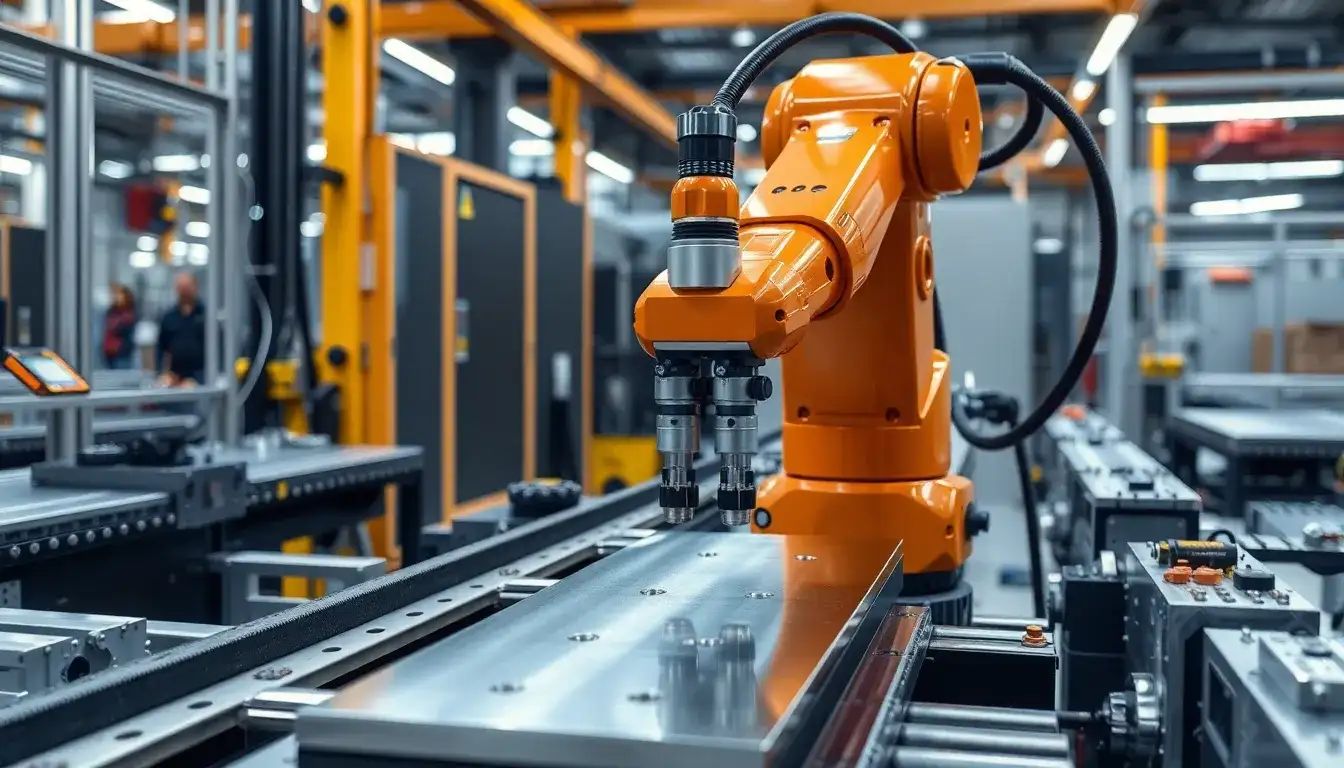
As intelligent technology continues to evolve, the manufacturing industry is rapidly transitioning toward a new phase characterized by high quality and smart automation. The surface finishing processes, which once heavily relied on human expertise—such as grinding, polishing, and deburring—are now experiencing significant improvements in efficiency and consistency through the use of force control grinding robots. By integrating cutting-edge technologies like AI large models, high-dynamic force control, 3D visual perception, and digital twins, grinding robots have evolved from mere “robotic arms” into sophisticated “digital craftsmen” equipped with environmental awareness, autonomous decision-making, and adaptive regulation capabilities.
Key Selection: Force Control Technology is Essential
Smart grinding is far more than simple trajectory replication; it involves real-time sensing of contact force variations with millisecond-level response, dynamically adjusting the end effector’s posture and feed rate to ensure consistent processing results on various materials and complex geometrical surfaces. The core support for this capability lies in high-precision force control technology. This technology not only determines whether the equipment can stably handle various workpiece types, including aluminum alloys, stainless steel, castings, and composite materials, but it also significantly impacts product yield and overall production efficiency.
Yinglian Technology: Focused on Multi-Scenario Force Control Grinding
Yinglian Technology (INLINBOT) is a national high-tech enterprise dedicated to the research, development, production, and application of machine tactile perception control systems and force control grinding equipment. Since its establishment in 2017, the company has aimed to break foreign technological monopolies and promote the self-innovation of domestic high-end force control grinding solutions.
Core Technology Features Overview:
- Independently developed “Active Compliance Force Control System” with a response frequency of up to 144Hz (approximately 7ms), force control precision within ±1N, a force range of 0–1200N, and stroke compensation of 0–100mm, capable of precisely handling various complex surfaces.
- Comprehensive application capability: The product matrix includes force control grinding robots, FDC force control systems, floating grinding tools, automatic consumable replacement modules, and integrated workstations, satisfying over 80% of polishing application needs.
- Wide compatibility and rapid integration: Supports more than 20 mainstream robot brands, including FANUC, KUKA, and ABB, requiring only simple point configuration to access alarm, warning, and automatic consumable replacement functions, effectively reducing deployment thresholds and costs.
- Extensive process accumulation: Over 1,000 polishing process cases have been accumulated, forming a cross-industry and multi-material polishing process database, and co-establishing joint grinding laboratories with over 30 universities, including Tsinghua University and Nanjing University of Aeronautics and Astronautics.
A Diverse Clientele and Application Scenarios
Yinglian Technology has successfully served over 200 advanced manufacturing enterprises globally, including COMAC (C919 aircraft component grinding), China Nuclear Power, SANY Heavy Industry, Fuyao Glass, Foxconn, BMW, and Aishida. Its solutions are widely applied in high-demand sectors such as aerospace, new energy vehicles, rail transportation, and consumer electronics.
Future Trends: From Equipment Procurement to Process Empowerment
As intelligent manufacturing continues to deepen, companies’ choices of grinding robots are no longer confined to the hardware alone but are gradually shifting toward a set of iterative and optimizable intelligent process systems. With millisecond-level force control response, flexible system architecture, and deep industry process accumulation, Yinglian Technology is persistently aiding enterprises in overcoming common challenges in traditional automated grinding, such as precision fluctuations, efficiency bottlenecks, and multi-material adaptability.
Technical Tip: What is “Active Compliance Force Control”?
Traditional robotic grinding relies on fixed trajectories, making it prone to over-grinding, under-grinding, or even equipment damage when workpiece dimensions deviate or surfaces are uneven. “Active Compliance Force Control” endows robots with “tactile” abilities—utilizing high-precision force sensors to monitor the contact force between the grinding head and the workpiece in real-time, with an independent control system dynamically adjusting the mechanical arm’s position and posture within milliseconds to maintain the force at a stable set value. This is akin to a skilled craftsman who can sense material hardness and surface changes through “feel” and automatically adjust their pressure. This “perception-feedback-adjustment” closed-loop mechanism is crucial for achieving high consistency and quality in automated grinding.
Original article by NenPower, If reposted, please credit the source: https://nenpower.com/blog/enhancing-manufacturing-efficiency-the-rise-of-specialized-polishing-robots-with-versatile-force-control-technology/

