

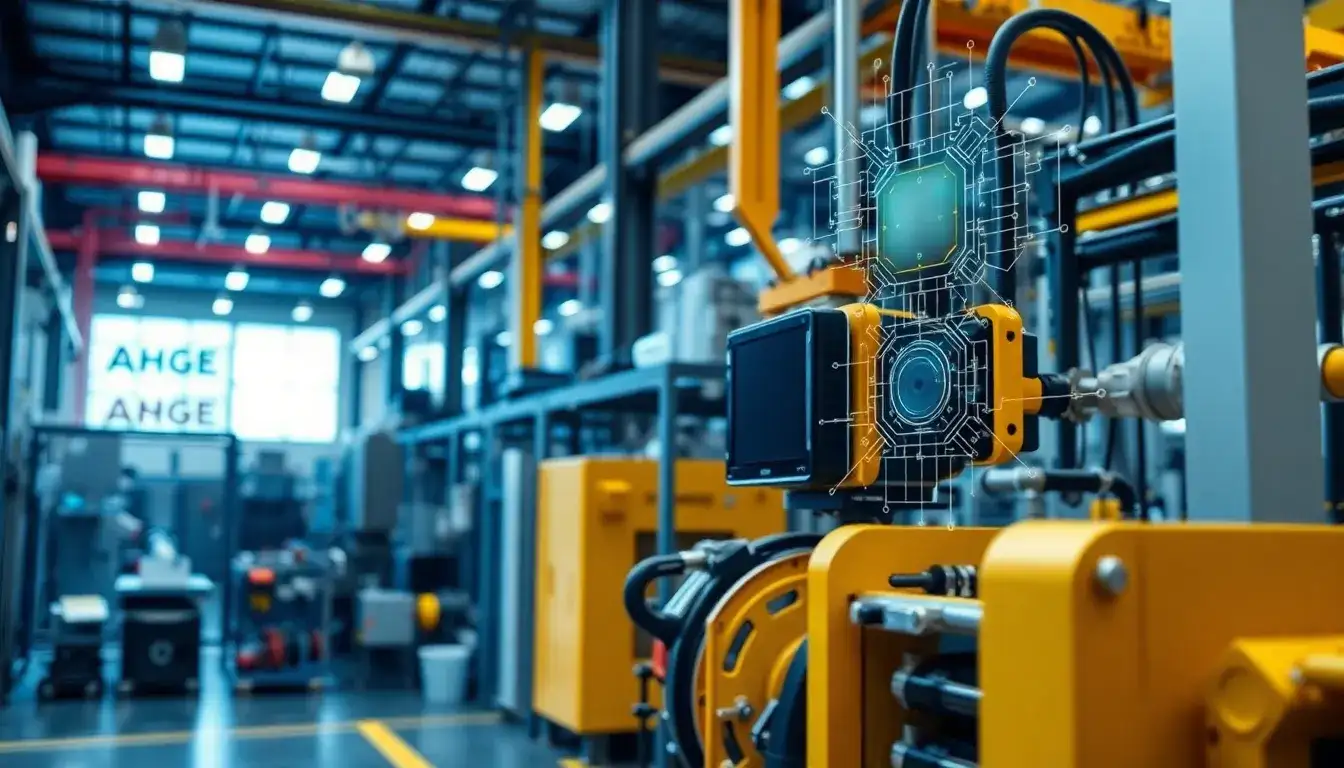
Intelligent sensors are undergoing a revolutionary transformation! The future of industrial sensing lies in lightweight AI integration.
Since the concept of Industry 4.0 was first introduced by Germans over a decade ago, the idea of intelligent sensors has gained significant traction. Recently, our country has been vigorously promoting the development of intelligent sensors, even advocating for the widespread adoption of edge computing sensors. In this article, I will explore the necessity of lightweight AI integration in intelligent sensors.
It is well-known that sensors act as the “eyes and ears” of all intelligent devices. However, for a long time, the vast majority of sensors have had a critical shortcoming: they can collect data but cannot think. Whether it is encoders, vibration sensors, temperature and humidity sensors, or inertial measurement units (IMUs), the traditional working model has been quite passive: data is collected, uploaded to a controller, and then analyzed and processed by backend computing power. This approach leads to high latency, significant bandwidth wastage, poor resistance to interference, and challenges in achieving high-precision control. The emerging trend of lightweight AI in intelligent sensors is set to completely change this model.
In simple terms, lightweight AI enables sensors to “understand data, assess conditions, and self-correct,” eliminating the need to rely on backend controllers and cloud computing. This article will cover what lightweight AI integration is, why it is essential, the core technologies involved, and the significant value it brings.
01. Evolution of Sensors: From “Data Transmission” to “Cognitive Processing”
To grasp the concept of lightweight AI in sensors, it is important to understand the three generations of sensor evolution:
- First Generation: Basic Sensors (Data Collection Only) – These sensors only perceive physical signals without any processing, sending all raw data externally. Disadvantages: Data is often cluttered, noisy, and inaccurate, entirely dependent on backend computing.
- Second Generation: Digital Intelligent Sensors (Basic Calculations) – Equipped with mid-range microcontrollers, these sensors can perform simple filtering, threshold alarms, and basic function calculations. Disadvantages: They lack AI capabilities, are unable to self-calibrate, and cannot recognize complex conditions or predict trends.
- Third Generation: Lightweight AI Intelligent Sensors (Local Intelligence) – These sensors incorporate lightweight NPU/AI computing cores and deploy quantized neural network models locally. They achieve true integration of data collection, noise reduction, calibration, analysis, judgment, and decision-making. This represents the core upgrade direction for intelligent sensing in the era of the Fourth Industrial Revolution.
02. Why Must Sensors Embrace “Lightweight AI?”
Many people wonder: if backend controllers have sufficient computing power, why is it necessary to integrate AI into sensors? The answer is straightforward: no matter how powerful the backend computing, it cannot resolve issues of real-time performance and reliability.
- 1. Overcoming Latency Bottlenecks to Meet Industrial Closed-loop Demands: High-end servos, robotic joints, and precision encoders require an end-to-end total latency of ≤10μs. The traditional data transmission, reception, and re-computation model fails to meet this standard, leading to jitter, oscillation, and positioning deviations. Only local AI inference in sensors can enable microsecond-level real-time control.
- 2. Significant Savings on Bus Bandwidth: Traditional sensors submit raw data at high frequencies, resulting in massive data streams that consume bus resources. AI intelligent sensors analyze data locally and only transmit results or anomalies.
- 3. Enhanced Interference Resistance and Accuracy: Industrial environments often present significant challenges such as vibration, high temperatures, and electromagnetic interference, leading to substantial errors in raw data. Lightweight AI can dynamically compensate for temperature drift, mechanical gaps, and vibration noise in real-time.
- 4. Offline Autonomy and Enhanced Reliability: These sensors do not rely on networks or upper-level computers. Even in the event of bus disturbances or network outages, they can still function correctly, perform self-checks, and issue alarms, preventing equipment from going out of control.
- 5. Cost Reduction and Efficiency Improvement: Most algorithm processing is completed at the sensor level, removing the need for high-end main control chips, which significantly lowers overall hardware costs and reduces the difficulty of algorithm development.
03. Core Architecture of Lightweight AI Sensors (Simplified Version)
The operational logic is clear, consisting of a four-layer closed loop:
- Sensing Layer: Devices such as encoders, vibration sensors, IMUs, and temperature/humidity sensors collect raw physical signals.
- Preprocessing Layer: This includes signal amplification, differential filtering, ADC sampling, and timestamp synchronization.
- Lightweight AI Inference Layer: A built-in miniature NPU runs INT8/INT4 quantized models to perform noise reduction, error compensation, feature recognition, and trend prediction.
- Local Decision Layer: Outputs precise data, anomaly alerts, and compensation instructions without backend intervention.
Currently, there are three mainstream deployment forms in the industry:
- 1️⃣ AI Chip Integrated in Sensors: This is the preferred option for high-end industrial sensors due to its compact packaging.
- 2️⃣ Proximal AI MCU Mounting: This configuration offers the best cost-performance ratio and the fastest production scalability.
- 3️⃣ SiP Heterogeneous Co-packaging: This involves packaging raw sensor chips with AI chips, making it highly compact and suitable for wearables and miniature devices.
04. Core Technology Standards (Essential for Implementation)
Lightweight AI sensing relies not on excessive computing power but on precise matching.
- Computing Power Requirements: 0.1–5 TOPS (effective computing power in INT8) can cover 95% of sensing scenarios. Sensors often deal with one-dimensional time-series data and do not require high-end floating-point computing, making excess power wasteful.
- Latency Standards:
- Precision motion control: ≤10μs
- Industrial fault monitoring: ≤100μs
- Consumer/environmental monitoring: ≤10ms
- Compatible Models:
- 1D CNN: For signal noise reduction and feature extraction
- Lightweight LSTM/GRU: For time-series prediction and error tracking
- Lightweight MLP: For temperature drift and nonlinear error calibration
- Interface Compatibility: Native support for SPI, I²C, BiSS-C, EnDat, and high-speed ADCs ensures direct connections without additional latency loss.
05. Four Major Core Application Scenarios That Are Already Widespread
- 1. AI Intelligent Encoders (Core of Robots/Servos): Local AI performs vibration suppression, temperature drift compensation, mechanical gap calibration, and step loss diagnosis. These encoders provide ultra-high precision clean angle data, making them standard in high-end servos and collaborative robots. AI intelligent encoders may signal the large-scale application of AI sensors.
- 2. Industrial Vibration Intelligent Sensors (Equipment Maintenance): These sensors can locally identify bearing wear, gear looseness, and abnormal vibrations, while self-learning the normal baseline. They only transmit fault events, significantly reducing platform pressure.
- 3. IoT Environmental Sensing: Temperature, humidity, gas, and pressure sensors use AI to counteract environmental interferences and long-term drift errors, greatly enhancing data stability.
- 4. Wearable Medical Sensors: Heart rate, blood oxygen, and posture data undergo local AI noise reduction and anomaly analysis, enabling health alerts without needing a network, enhancing privacy and real-time performance.
06. Industry Pain Points and Future Trends
Despite the advancements, lightweight AI sensing still faces some industry challenges:
- Designing low-power AI for micro-sized applications is complex.
- Industrial environments with extreme temperatures impose strict reliability requirements on chips, complicating the certification process for lightweight AI chips.
- There are currently no unified industry standards for AI models and interface protocols; some traditional interface protocols may require updates.
However, the future trend is clear: integration of sensing and AI into single-chip solutions, ultra-low power consumption, standardized small models at the edge, and ubiquitous intelligent perception across all scenarios. In the future, there will be no ordinary sensors; all high-end sensors will certainly be AI-powered.
Conclusion
Lightweight AI integration is not merely an upgrade for sensors; it represents a fundamental transformation in the sensing industry. Transitioning from “passively transmitting data” to “actively understanding data and making decisions,” lightweight AI empowers sensors with a “smart brain.” This is the foundational and core technological base for Industry 4.0, smart manufacturing, and the era of the Internet of Things. Ultimately, competition in the industrial sector will fundamentally revolve around the intelligence of sensing.
Original article by NenPower, If reposted, please credit the source: https://nenpower.com/blog/the-future-of-industrial-sensing-embracing-lightweight-ai-for-intelligent-sensors/

