

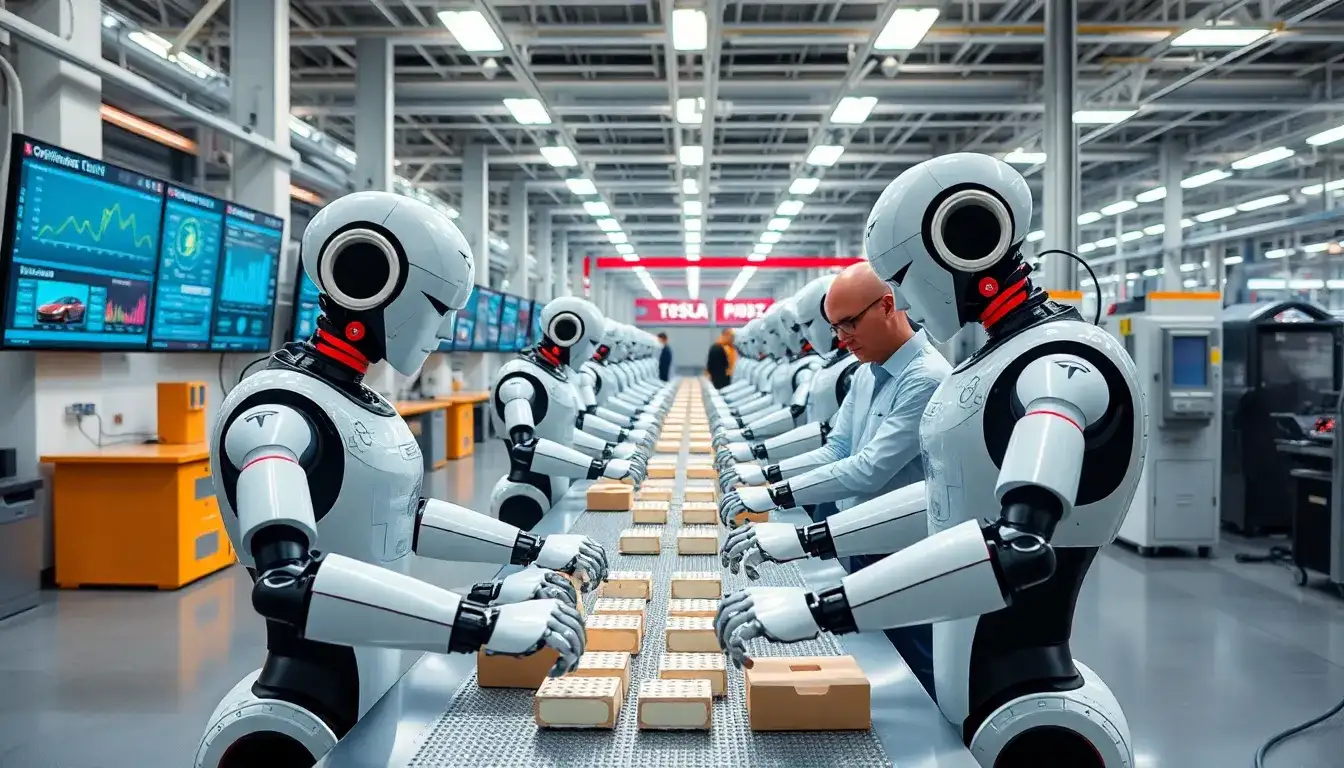
Launch of Tesla’s Optimus Humanoid Robot Production Plan: How Will It Transform the Future of Manufacturing?
Tesla has officially announced that the mass production of its Optimus humanoid robot will commence in July 2026. The company has outlined plans for a production line with an annual output of one million units and aims to establish a second-generation production line at its Texas factory, capable of producing up to ten million units per year. This ambitious initiative has the potential to significantly disrupt the global manufacturing labor structure and production model.
1. Restructuring Manufacturing Productivity: A Revolution in Cost Efficiency
The target cost for each Optimus unit is set at $20,000 (approximately 140,000 RMB), and once mass-produced, the operational costs will be only one-fifth of that of human labor. For instance, in factory settings, a single robot could save about $90,000 in labor costs annually, with a return on investment period reduced to just 2-3 years.
Tesla plans to utilize its existing automotive supply chain (including components like motors and batteries) and automation expertise to quickly scale up the production of the Optimus robot by repurposing the current Model S/X production lines.
By leveraging technology transfer advantages such as the Full Self-Driving (FSD) vision perception algorithms, the Dojo supercomputing training platform, and neural network models, the robots will gain capabilities in autonomous navigation, dynamic obstacle avoidance, and task learning. The Optimus Gen3 is already capable of learning complex tasks by observing human behavior, significantly reducing the adaptation costs for various scenarios.
2. Impact on the Global Manufacturing Landscape: Reshaping Labor Structures
By replacing repetitive physical labor jobs (such as handling and assembly), Tesla’s factories have already deployed prototype robots that handle 35% of sorting tasks, achieving a 90% reduction in error rates. The long-term goal is to extend these capabilities to logistics, hazardous operations, and even household services.
According to Morgan Stanley, the global market for humanoid robots is expected to reach $5 trillion by 2030, with China potentially deploying over 100 million units.
The acceleration of industry chain restructuring is evident, with more than 85% of core components being localized: companies like Harmonic Drive (harmonic reducers), Mingzhi Electric (hollow cup motors), and Keli Sensor (6D force sensors) are becoming deeply integrated into Tesla’s supply chain, significantly improving order flexibility.
International competition is diversifying, with Tesla focusing on general-purpose robots while Chinese manufacturers (such as Yushu Technology and UBTECH) target specific vertical markets, leveraging supply chain cost advantages to achieve rapid mass production. Yushu robots are priced at only half the cost of Optimus and are expected to lead in production speed by a year.
3. Potential Challenges and Controversies
There are technical challenges to overcome, including the dexterity and thermal limitations of the robotic hands and the durability of joints with 22 degrees of freedom, which have yet to be fully validated. Additionally, software improvements are needed to enhance autonomous decision-making reliability in complex environments.
There are also social and ethical risks; the European Union is considering legislation to ban robots from replacing humans in caregiving and educational roles, and the shift in manufacturing labor could exacerbate structural unemployment.
4. Opportunities for Chinese Manufacturing
The supply chain benefits in the Yangtze River Delta have led to the formation of a “half-hour supply circle,” with localized core components reducing costs by 50% compared to overseas suppliers. Companies like Top Group and Sanhua Intelligent Control are experiencing explosive growth due to Tesla orders, with expected revenues of 4 billion and 5.4 billion RMB respectively by 2026.
In terms of innovation, Guangdong has launched the world’s first automated production line for humanoid robots capable of producing 10,000 units (one unit every 30 minutes), achieving a commercial closed loop in the automotive and 3C sectors.
Conclusion
Tesla’s cross-industry initiative represents a transformative impact of “physical AI” on real-world production, pushing the manufacturing sector from a “labor-intensive” model to one that emphasizes “intelligent collaboration.” The technological breakthroughs and innovation capabilities of the Chinese supply chain could be key variables in reshaping the rules of global competition.
Note: There are still risks related to the mass production targets, as Elon Musk has previously postponed timelines; ongoing monitoring of cost control and ethical controversies is necessary.
Original article by NenPower, If reposted, please credit the source: https://nenpower.com/blog/tesla-launches-ambitious-plan-for-mass-production-of-optimus-robots-a-game-changer-for-the-future-of-manufacturing/

