

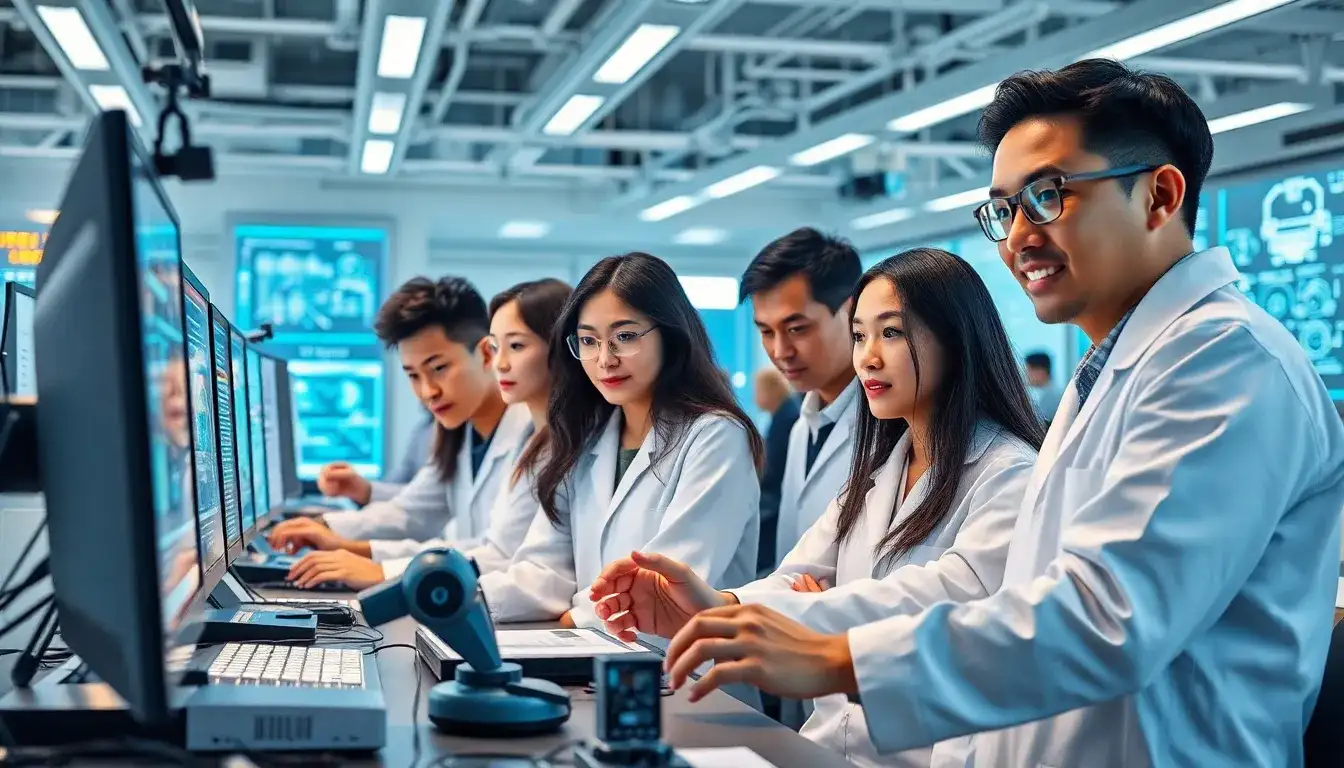
The central government has sent a strong signal, with “AI scientists” now in operation in Shenzhen. This was highlighted in a report by Shenzhen News on April 29, 2026, during the official broadcast of the program.
During a meeting of the Central Committee of the Communist Party of China held on April 28, it was emphasized that the country should promote technological self-reliance and independence in industrial chains. The meeting also stressed the need to “fully implement the ‘Artificial Intelligence +’ initiative, develop new forms of intelligent economy, and improve governance in artificial intelligence.”
As China’s largest economic province, Guangdong has long been known for the Pearl River Delta as the “world’s factory.” Currently, the province is intensifying its focus on artificial intelligence (AI) as a key driver for advancing new industrialization.
On April 27, the first ever Guangdong Provincial AI Application Matching Conference was held in Shenzhen. This event aimed to create a centralized platform for exchanging and coordinating AI applications throughout the province. At the conference, the “Guangdong Province Action Plan for Accelerating AI Empowerment in Scientific Research (2026-2030)” was unveiled. The plan aims to be implemented soon, clearly outlining the development goals and key tasks for the next five years.
According to data, the core industry of AI in the province is expected to exceed 300 billion yuan by 2025, representing a year-on-year growth of over 40%, and accounting for approximately one-fourth of the national total. Areas such as computing chips, industry models, smart terminals, and application empowerment are leading the way nationally.
The 2025 Guangdong AI and Robotics Industry Investment and Financing Report indicates that Guangdong’s AI industry is characterized by a strong practical approach, with application-oriented enterprises making up as much as 73% of the sector. This is particularly evident in fields like smart vehicles and intelligent manufacturing.
In terms of regional distribution, nearly 90% of AI companies in the province are concentrated in the core area of the Pearl River Delta, with the “Twin Stars” effect of Guangzhou and Shenzhen being particularly significant. Shenzhen alone hosts around 21,600 related enterprises, while Guangzhou has about 10,400.
On April 28, the second list of the “AI Eight Stallions” from Huaqiangbei in Shenzhen was released, covering eight major areas including AI glasses, companion robots, drones, mobile monitoring robots, translation headsets, pocket cameras, smart guitars, and AI learning machines. Each product showcases both innovation and practicality. Lin Peng, Vice President of the Shenzhen branch of Shanghai Dixin Technology Group, mentioned that their listed product, an AI mobile monitoring robot, saw sales surge three to four times in April compared to March. Leveraging the full supply chain advantage of “design in the morning, prototyping in the afternoon, mass production the next day, and export within a week,” the first list led to a 35% revenue increase across Huaqiangbei, with related category sales rising by 55%. Star products like drones, AI glasses, and AI toys experienced growth rates between 80% and 90%.
In Shenzhen, the arrival of “AI scientists” is not an isolated case. Recently, a visit to a hidden gem of a company, Shenzhen Jingtai Technology Co., revealed their “AI + Robotics” smart closed-loop laboratory. This facility deeply integrates the “brain” of artificial intelligence with the “hands” of automated equipment, enabling this “AI scientist team” to efficiently conduct core research processes such as drug molecule synthesis. Ma Jian, co-founder and CEO of Jingtai Technology, remarked that while such scenarios might have seemed like science fiction a decade ago, they have now become practical applications in Shenzhen.
As an “innovation city,” Shenzhen views the entire city as a “testbed” for the implementation of AI technologies, driving the advancement of future industrial technologies through practical scenarios. Harbin Institute of Technology Pengze (Shenzhen) Robotics Co., focusing on high-altitude operation robots, has several core technologies such as intelligent electro-hydraulic drives and high-precision control, yet struggled to find real-world applications for testing their products. At a crucial moment, the Luohu District innovated an AI scene support model, where the government provided a platform and state-owned enterprises took the lead to address the company’s need for testing environments. Recently, the company achieved a breakthrough by launching four high-altitude cleaning robots, with orders exceeding 23 million yuan on the same day.
Yang Jian, Chairman of Harbin Institute of Technology Pengze (Shenzhen) Robotics Co., noted that the company’s robust growth stems from Shenzhen’s efficient environment for the implementation of artificial intelligence technologies. Today’s “testbed” is set to become tomorrow’s industrial powerhouse. By 2025, Shenzhen’s AI core industry revenue is projected to reach 220 billion yuan, with over 2,600 large-scale enterprises and five batches of nearly 300 “City + AI” application scenario lists released to the public. In the first quarter of this year, the city’s strategic emerging industries showed promising growth, with five out of the 20 major industrial clusters, including robotics, achieving double-digit growth.
Technological advancement is not an overnight process, and building a self-reliant industrial chain requires steady progress. However, at this moment, it is clear that innovation in China’s AI sector is flourishing, and the trajectory of China’s industrial development is becoming increasingly defined, which will profoundly impact the global innovation and industrial chains.
Original article by NenPower, If reposted, please credit the source: https://nenpower.com/blog/shenzhen-appoints-ai-scientists-as-central-government-signals-strong-support-for-tech-innovation/

