

Recently, Dutch agricultural equipment manufacturer Dutch Mushroom Projects BV (DMP) made a special visit to Chongming, Shanghai, to sign a smart agricultural equipment agency agreement with Hengze Technology. Their collaboration is focused on mushroom cultivation. Traditionally, Dutch companies have been the go-to source for high-end agricultural equipment and core environmental control systems for Chinese enterprises. However, this trend is now seeing a shift.
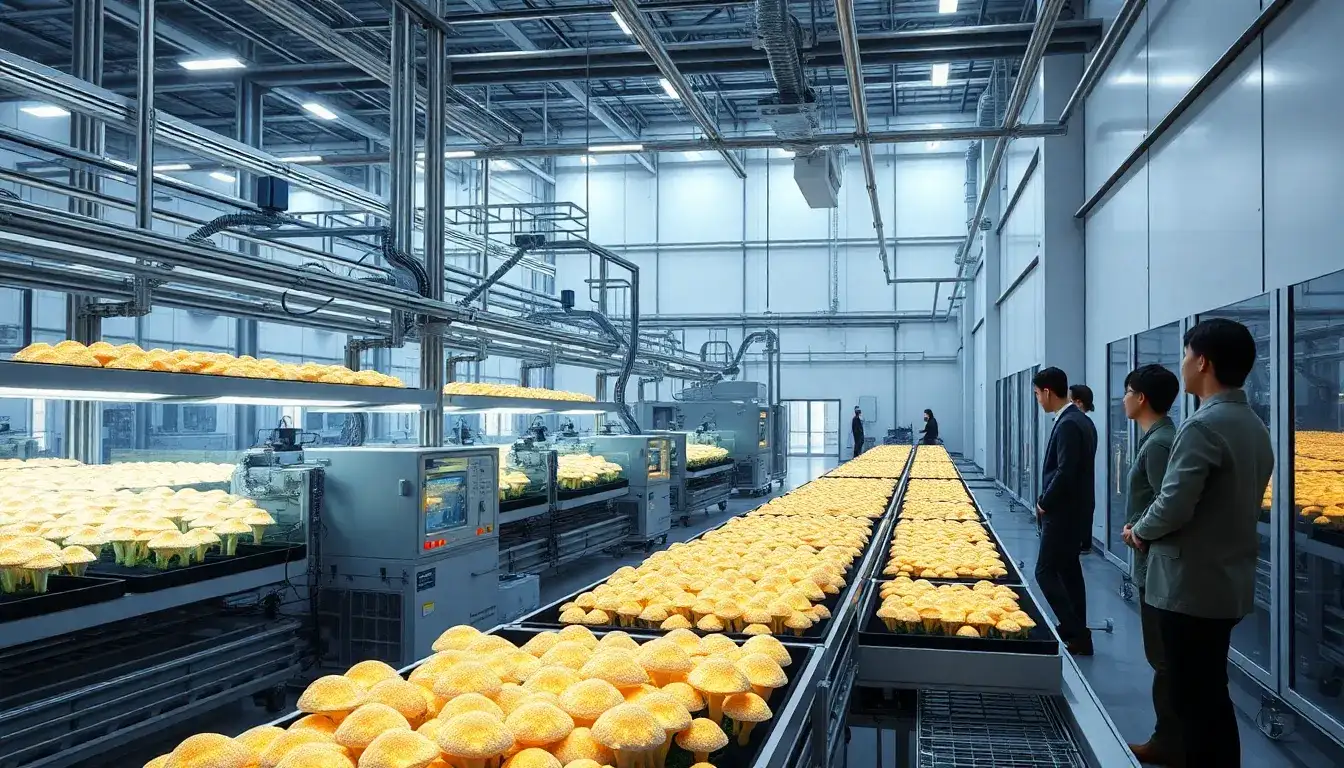
At Hengze Technology’s production facility, the scene is starkly different from traditional farming: there are no workers bending over to pick mushrooms. Instead, mushrooms grow quietly on vertical bed frames, while robotic transporters glide along tracks. In the harvesting area, robotic arms equipped with suction cups precisely lift the mushrooms—this entire process resembles an industrial assembly line. This is China’s first “dark factory” for mushroom cultivation, which has already begun small-scale production and is expected to reach full capacity by June, achieving an annual output of 13,000 tons. The plan has attracted interest from European companies, with a proposed sale price exceeding 100 million yuan, aiming to enter the international agricultural technology market.
Walking into Hengze’s new factory, one is struck by how it resembles a precision manufacturing facility rather than a farm. Traditional mushroom farms feature fixed bed frames where workers must climb, bend, and reach into tight spaces to harvest. Hengze has transformed the production line into movable modules—similar to components in an automotive assembly line. Using AGMR (Autonomous Guided Mobile Robot) transport robots, trays laden with mushrooms are transported to the harvesting area. “Previously, the production line was stationary and workers moved; now the line moves and workers remain stationary,” explained Hengze Technology Chairman Zhu Wenfeng. “We have over 200 robots operating in a factory, working together like a train.”
This new system has significantly increased production efficiency. In traditional factories, due to the immobility of the production line, processes such as feeding, watering, harvesting, and sterilizing were conducted sequentially, taking over 40 days for one cycle with a maximum of eight cycles per year. With the modular approach, production processes can occur in parallel, reducing the cycle time to just over 30 days and increasing the output to ten cycles annually.
Harvesting is equally crucial. Mushrooms are delicate and densely packed, making them prone to damage. Hengze’s fifth-generation harvesting robot does not utilize traditional gripping methods but instead uses a sponge-tipped suction cup at the end of the robotic arm. “The suction power is precisely controlled; as long as we do not suction the same spot for more than one minute, it will not harm the mushroom’s surface,” Zhu explained.
The robot’s ability to accurately identify mushrooms relies on an advanced artificial intelligence system. The “Twenty-Four Solar Terms” agricultural vertical model has accumulated 2.1 billion tokens of agricultural data. Inspection robots operate 24 hours in the mushroom house, capturing images of mushroom growth. The model automatically labels each mushroom’s coordinates, size, tilt angle, and maturity, even predicting future yields. “In the past, temperature and humidity adjustments were based on experience. Now, when the model indicates that humidity should increase, it automatically alerts the environmental control system,” Zhu noted.
Visual recognition models are integrated directly into chips. Hengze has established a team of over ten chip developers, comprising members from institutions such as the Chinese Academy of Sciences and Shanghai Jiao Tong University. They develop chips designed to solidify visual perception models at the hardware level. This approach eliminates delays and errors from the multiple layers of processing, enhancing recognition speed and stability. “The model is the chip, and the chip is the model,” Zhu termed this architecture hardware integration of edge models.
This technology, primarily used in fields like autonomous driving and industrial inspection, has been successfully applied to agriculture by Hengze. Moreover, this self-developed system has led to another critical advantage—data autonomy. Previously, when using European environmental control systems, production data would be collected by the supplier. Now, all data from environmental control to yield predictions, harvesting scheduling, and equipment maintenance is retained within Hengze’s own system.
The inception of Hengze’s “dark factory” was driven by a common challenge faced by agricultural enterprises: labor. “We entered the industry early and built vertical mushroom houses in Jiangsu and Jiangxi, but faced difficulties in recruitment. Between 2015 and 2019, over 3,000 people came to try working with us, but only about 100 stayed,” Zhu shared. The pay was not the issue; frontline harvesters earned monthly salaries ranging from 8,000 to 12,000 yuan, with food and accommodation provided, and dormitories equipped with central air conditioning. The work was just too demanding, with humidity levels consistently above 80% and no natural light, making hours unpredictable.
To expand production capacity and achieve development, Hengze began investing in technology in 2015 and initiated the research and development of harvesting robots. The first generation was a collaborative “stacking” device—mechanical arms and cameras mounted on a mobile platform weighing 300 kilograms. Later iterations incorporated lifts and multiple vehicle coordination, with the entire assembly weighing over two tons. “The first generation was traditional stacking, merely adding wheels for elevation, which was far less efficient than manual labor,” Zhu explained. Subsequent iterations focused on improving efficiency but faced the inherent challenge of moving heavy machinery to harvest lightweight mushrooms, essentially using a cannon to shoot a mosquito.
In 2024, the research team completely reversed their thinking—making the harvesting machine stationary while moving the production line instead. Initially, they considered using commercially available transport robots but encountered issues with costs. “Each unit costs between 100,000 to 200,000 yuan, and outfitting a factory with hundreds of them would push expenses into the tens of millions,” the team elaborated. The core problem lay in the transmission method—a large motor distributing power to various wheels via a drive shaft, which was simple in mechanical synchronization but costly. After crunching the numbers, they decided to develop their own AGMR transport robot.
They undertook a “disassembly” approach: breaking down the large motor into eight smaller motors, allowing each wheel to be independently driven and eliminating the need for a drive shaft. This innovation made the frame significantly lighter and reduced reliance on expensive CNC (Computer Numerical Control) components, leading to lower costs. However, this “disassembly” introduced new challenges: the wheels needed to synchronize within milliseconds, or the vehicle would veer off course. To address this, Hengze developed edge computing chips that integrated wheel speed control algorithms and perception capabilities, achieving precise coordination among motors.
Once fully operational, the 200-plus transport robots will operate in a train-like formation, completing the automatic transfer from mushroom beds to harvesting stations. Throughout the entire production process, the mushroom house will function with zero human intervention except for back-end technical personnel.
Domestic supply chains enable “overtaking” European manufacturers. DMP, a well-known European agricultural equipment firm and a former supplier to Hengze, has visited Chongming multiple times to assess Hengze’s automation developments, culminating in a recent European regional agency agreement. “They remarked that this is their ideal factory, but you managed to realize it first,” noted Yang Long, Deputy General Manager of Hengze Technology. A significant factor behind this success is the collaboration within the domestic industrial chain. All core processors in Hengze’s fifth-generation system are equipped with domestic high-performance FPGAs (Field-Programmable Gate Arrays) from Fudan Microelectronics and Unigroup Guowei. Other components come from domestic brands like Fenghua Advanced Technology and Hongke Electronics. Key control chips, such as DC-DC converters, have all transitioned to domestic alternatives like Guokexin’s solutions, matching the specifications and performance of imported counterparts.
Moreover, the continuous evolution of domestic large models is pivotal. As early as 2024, DeepSeek drastically reduced the API calling prices for large models, making them more accessible. Agricultural models require ongoing training with new data, and as computing costs decline, the barriers for iteration are lowered, accelerating evolutionary progress. Recently, DeepSeek further reduced API prices, leading to nearly a fourfold increase in the usage of the V4-Pro model.
With the entire system in place, the critical factor for success lies in the “cost equation.” According to Hengze’s calculations, a factory producing 6,000 tons of button mushrooms under traditional vertical planting methods requires around 100 workers for frontline harvesting, transportation, and management, leading to annual labor costs exceeding 15 million yuan. Transitioning to a “dark factory” model reduces labor demand to less than 20 workers, with some personnel managing multiple production bases, focusing primarily on system maintenance, equipment management, and administrative support. This shift can save over half of the annual labor costs.
Yang Long explained that, from a cost perspective, the price difference between fully automated and traditional vertical factories primarily lies in the robotic equipment. “In reality, considering the savings from reduced labor, increased production, and improved quality rates, the return on investment for enterprises can be shortened from the traditional 8-10 years to 5-6 years.” This commercial outlook is particularly appealing in the European market, where labor costs are significantly higher. For a factory producing 6,000 tons, annual labor costs could reach over 100 million yuan. This is also why DMP is eager to secure agency rights and introduce this solution.
Currently, Hengze Technology is advancing the construction of fully automated factories in multiple locations, including Shanghai’s Chongming, Qingpu, and Pudong, as well as in Beijing, Zhejiang, Hebei, Anhui, Shanxi, and Inner Mongolia, while engaging in deep negotiations with companies in Australia and Japan to advance collaboration intentions.
They are not merely exporting harvesting robots but offering a comprehensive industrial mushroom cultivation solution that includes prefabricated factories, transport robots, harvesting robots, AI agricultural models, and intelligent environmental control systems. This strategic shift allows the company to move away from the traditional “one-time product sale” model to a continuous agricultural service export model, diversifying their revenue streams. “In the next steps, we aim to expand from mushrooms to more complex crops like tomatoes and strawberries,” Zhu Wenfeng revealed. The team will also continue optimizing deployment efficiency, aiming to upgrade the 20-minute on-site debugging of each machine to remote autonomous deployment while accumulating lifespan data for each component, preparing for large-scale international expansion.
In summary, Shanghai’s agricultural strength is often underappreciated. Although agriculture contributes less than 1% to Shanghai’s GDP, it plays a crucial role in the city’s economic landscape. By 2025, the contribution rate of agricultural technology advancement in Shanghai is projected to reach 80.62%, placing it at the forefront nationally and nearing levels seen in developed nations. This means that Shanghai produces not just food and vegetables but also agricultural technology outputs that can be transformed and priced.
The “dark factory” for mushrooms by Hengze Technology exemplifies this logic. From self-developed robots to AI vertical models, Hengze has not only established a button mushroom “dark factory” but is also exploring comprehensive industrial mushroom cultivation solutions for export to Europe, a region known for its agricultural equipment leadership. In this sense, Hengze’s mushroom cultivation is akin to manufacturing automobiles—a replicable, exportable industrial framework. This represents not just a sale but signals Shanghai’s agricultural sector is evolving towards “intelligent pricing,” aiming to establish itself as a high-value origin for agricultural technology. The industry is keenly watching Hengze Technology’s next steps as it seeks to expand its reach beyond Shanghai.
Original article by NenPower, If reposted, please credit the source: https://nenpower.com/blog/shanghais-mushroom-black-lights-factory-attracts-european-buyers-with-innovative-automation-solutions/

