

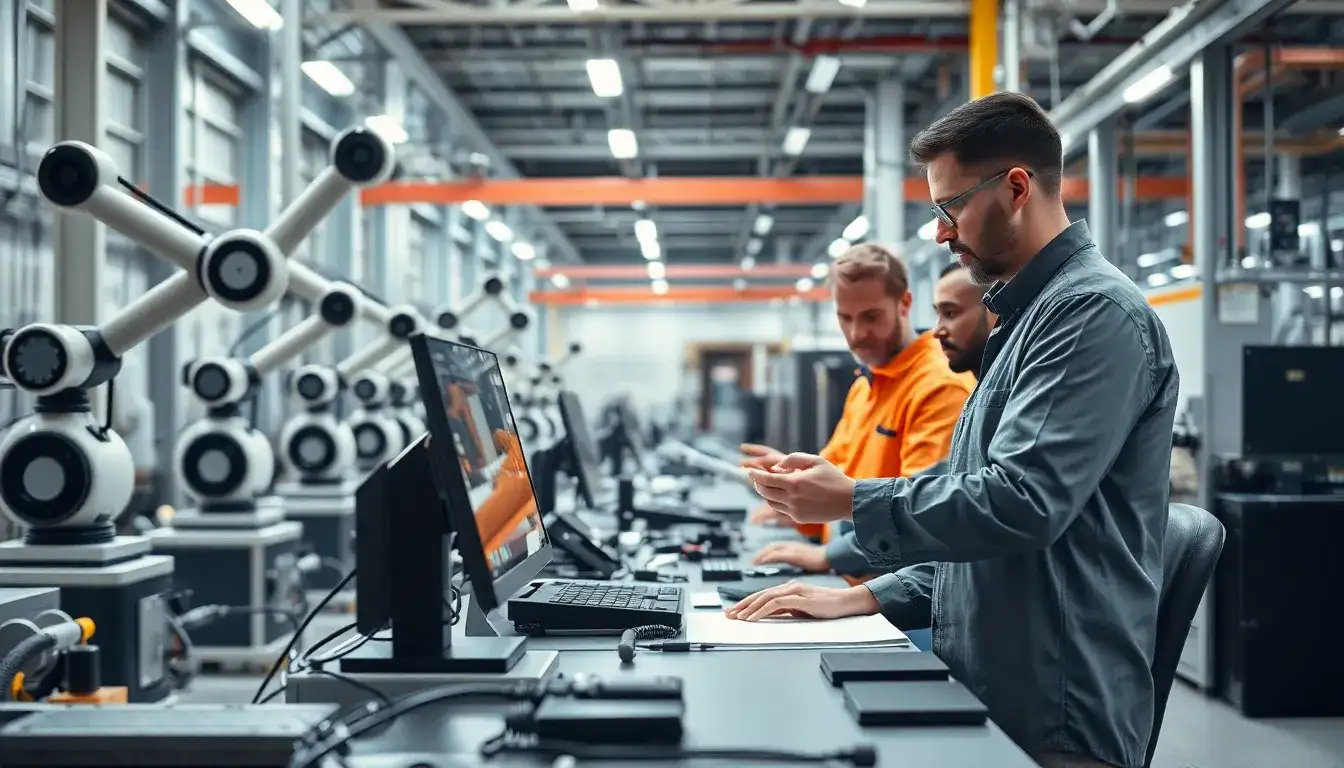
The initial excitement surrounding robots has passed, and the entire industry is now collectively shifting its focus. On May 12, at the Global Partners Conference, Ge Jin, the president of Pro Universe, announced, “We have completed the verification of the loading and unloading processes at our textile machinery manufacturing plant.” Pro Universe is a robotics company that unveiled the loading and unloading modules and data collection solutions for its Dabai robot on the same day. Recently, Zhiyuan Robotics has also entered the production floor of consumer electronics, while Galaxy Universal’s robots have made their way into convenience stores.
This shift reflects the evolving trends in robotics. After a few years of initial exploration, robots are transitioning from demonstration functions such as guiding and dancing to becoming productivity tools. Peng Zhihui, the president of Zhiyuan Robotics, stated at the Hong Kong Embodied Intelligence Industry Summit that the entire industry is undergoing a collective transformation.
Ge Jin highlighted that the Dabai robot boasts sub-millimeter operational precision. A manufacturing assembly line typically involves numerous processes, and operational precision is a crucial metric in industrial settings; even a small error can halt an entire production line. “Our design philosophy centers around a universal robotic body, complemented by quickly replaceable end effectors that enhance efficiency,” Ge Jin explained. Pro Universe aims to address real pain points such as low factory efficiency, production change difficulties, unstable precision, and challenges in coordinating multiple processes.
Currently, the Dabai robot has completed concept validations across various industries, including material handling for automotive manufacturers, product assembly in furniture factories, PCB retrieval in electronics factories, root removal in food processing plants, and loading/unloading in textile machinery factories. Before the introduction of the Dabai robot, Zhiyuan Robotics had already made strides in manufacturing. On April 14, Zhiyuan Robotics conducted an eight-hour continuous live demonstration at the Nanchang flat panel factory of consumer electronics manufacturer Longqi Technology. The Spirit G2 robot was integrated into a high-speed production line, performing tasks such as retrieving flat panels for testing, delivering them to test fixtures, and sorting them into qualified and defective categories post-testing. “We successfully completed nearly 3,000 tasks, achieving a 100% success rate,” Peng Zhihui noted.
Robotics companies must create additional value for users while maintaining the same production pace and quality, ultimately reducing production costs. Meeting these standards is essential for large-scale adoption, motivating clients to use robots to supplement labor rather than hire more staff. “This calculation is quite important,” he emphasized.
In April, Galaxy Universal’s Galbot G1 robot was deployed at a FamilyMart store in Beijing’s Zhongguancun area. The store was modified to accommodate the robot, which operates with a more limited variety of products compared to a standard FamilyMart outlet. According to Shi Xuesong, a partner at Galaxy Universal, this robot has been integrated into the actual sales process, capable of handling and delivering prepared foods and cold beverages, as well as assisting in coffee preparation and delivery.
Similar retail environments are highly sought after by robotics companies. “In the last two to three months, nearly every week, a robotics manufacturer has approached me,” said Zhang Yu, Vice President of Duodian Shuzhi. These companies are eager to collaborate with this retail digital solutions provider. Duodian Shuzhi has previously provided intelligent solutions for many retailers, including Pang Donglai and Zhongbai Group. Zhang noted that these robotics companies are looking for suitable offline scenarios in the retail sector, such as warehouses or front warehouses, to collect actual data for training their robots.
The initiatives from Zhiyuan Robotics, Galaxy Universal, and Pro Universe indicate that robots are entering a new phase of development. Over the past few years, the demand for robots in the Chinese market primarily stemmed from scenarios such as stage performances, museum tours, and university research. Now, robots are beginning to penetrate industries like manufacturing and retail.
Peng Zhihui believes this represents a significant collective shift in the robotics industry.
Having passed the initial excitement phase, robots are now ready to climb the second curve. With breakthroughs in foundational technologies for embodied intelligence, robots can move like humans. They have dazzled audiences on national television, captivating the public’s curiosity and driving market demand. Robots have begun serving as guides in museums, performing at hotel openings, and entering laboratories at prestigious universities like Tsinghua for further development.
“This is valuable, but it exists only in the initial stage. The first curve has driven rapid growth in the robotics industry over the past three years. After a period of steep growth, this first curve has now stabilized. While there may still be room for future growth, the marginal returns are gradually decreasing,” Peng Zhihui explained.
Peng believes that robots need to break through to the second curve. As data-driven intelligence advances, robots are entering a phase of higher-level intelligence. They must not only mimic human movement but also genuinely perform tasks that create productivity value. Robotics companies in both China and the U.S. are preparing for this moment.
For instance, Tesla’s Fremont factory in California has ceased production of older car models and is being repurposed to manufacture its Optimus robot. Tesla plans to mass-produce the third-generation Optimus robot in the second quarter of this year. Figure AI has also recently showcased two robots collaborating on household tasks, such as folding blankets and tidying up headphones and furniture.
“Musk’s objective is clear: to redefine the cost structure of manufacturing through the mass production of robots. This market is undoubtedly going to be immense,” said Peng Zhihui.
As productivity tools, robots present a significantly greater technical challenge than those designed for stage performances. Scenarios such as stage shows and mall tours require relatively low levels of intelligence and have a high tolerance for errors. In display scenarios, a robot falling down is not a major issue. However, in productivity environments, a robot’s fall could delay the production of thousands of tablets, and customers at a FamilyMart retail store lack the time and patience to wait for it to recover.
Zhang Yu, who oversees the AI strategy implementation at Duodian Shuzhi, including collaborations in intelligent integration, is exploring the potential for robots to enhance efficiency in retail environments. He observes that the capabilities of robots in retail are still quite limited, and their operating speed does not yet match that of ordinary employees. Given the high cost of robots, some convenience stores struggle to justify the investment.
High-quality data remains an unavoidable hurdle for robotics. Due to a shortage of real data, many robots are trained using simulated data. “This raises a significant issue: while you can perform demos for others, when it comes to deploying in complex real-world environments, you must train robots using actual data,” Zhang believes. “It may take some time for robots to produce tangible effects in retail stores.”
The same principle applies in industrial contexts. “Data is the core fuel for embodied intelligence. Without high-quality, scalable data support, embodied intelligence cannot achieve true real-world application, making it more challenging to break through the technological iteration ceiling,” Ge Jin stated.
Currently, robots are just beginning to enter factories and retail stores, starting to have a limited impact. As the deployment of robots expands and they successfully navigate real-world environments, the data collected from the physical world will become increasingly rich.
Peng Zhihui believes that, similar to how the iPhone redefined smartphones and Tesla redefined electric vehicles, the first entity to effectively integrate data with embodied intelligence will have the opportunity to define the next generation of productivity platforms.
Original article by NenPower, If reposted, please credit the source: https://nenpower.com/blog/robotics-industry-shifts-focus-from-experimentation-to-productivity-solutions/

