

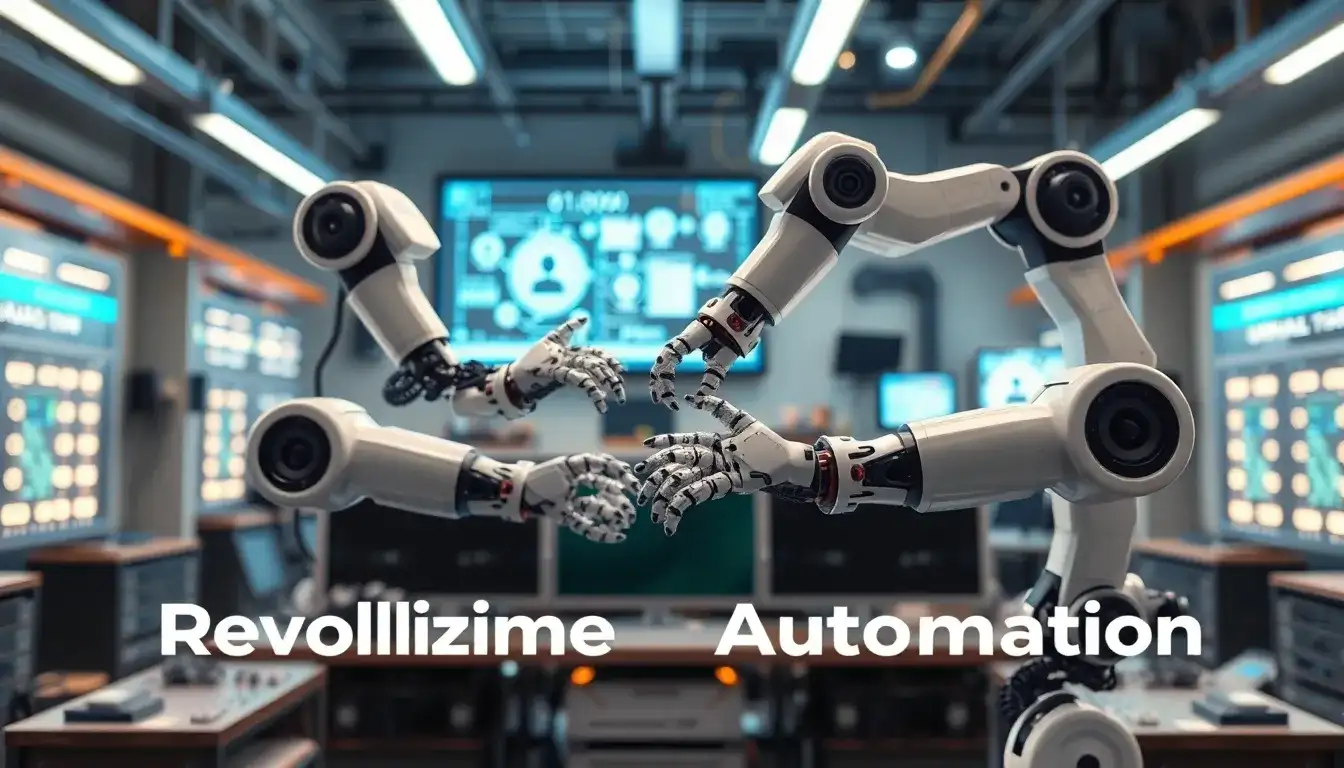
Ruilman Launches AI Intelligent Teaching System: The Robotic Arm Enters the Era of ‘Cultivation’
On April 28, Ruilman officially unveiled its AI Intelligent Teaching Generalization System. The core capability of this system is straightforward: a robotic arm can learn how to perform tasks after observing an operator manually demonstrate just once or twice. Furthermore, it can automatically adjust to changes in the positioning and shape of materials. However, underlying this functionality is a fundamental shift in logic—industrial robots are evolving from “fixed-function devices” into “intelligent entities that can be cultivated and grow on their own.”
Prior to this, Ruilman had already introduced the MCP Server and RMLink, which addressed the challenges faced by developers in “using AI to control robotic arms” and operators in “ensuring the stable operation of robotic arms,” respectively. The latest release of the AI Intelligent Teaching Generalization System fills a crucial gap, completing the “AI Triple Engine” matrix. By transitioning from “manufacturing arms” to “nurturing robots,” Ruilman is redefining the pathway for industrial automation, targeting a critical pain point in the robotics industry.
1. Industry Pain Point: Why Are Robots ‘Affordable’ Yet ‘Underutilized’?
By 2025, the sales of collaborative robots in China are expected to reach approximately 49,500 units, marking a year-on-year growth of 45.6%. Despite the booming market, a significant and awkward reality is that the vast majority of robots are not genuinely utilized. The hardware price of a collaborative robot usually ranges from 150,000 to 400,000 yuan. However, acquiring the equipment is just the beginning—integration and debugging costs can consume an additional 50% to 100% of the initial price. In complex scenarios, deployment cycles can extend to weeks or even months, with total deployment costs potentially exceeding several times the price of the robotic arm itself. Worse still, once the robotic system is delivered, it can only operate according to its initial programming. Any changes to the product type or process require engineers to reconfigure the system, resulting in production line downtime. This “one-time deployment with fixed parameters” model makes the automation journey for small and medium-sized enterprises much longer than expected.
The Ruilman AI Intelligent Teaching Generalization System targets this industry “Achilles’ heel.” It eliminates the need for engineers to write thousands of lines of code to define each motion’s trajectory, speed, and force. Instead, it allows the operators, who best understand how products are made, to demonstrate the process by manually guiding the robotic arm. The system converts these one or two demonstrations into generalized execution strategies, reducing the deployment period from several weeks to under a week. When there are changes in material position, shape, or sorting areas, the robotic arm can adapt its strategies and complete tasks without needing reprogramming. In the past, this meant engineers working overtime for several days; now, it can be accomplished in just a few minutes. Essentially, Ruilman has not introduced any groundbreaking technologies but has effectively transferred the “usage rights” of the robotic arm from engineers to frontline operators, marking its true breakthrough point.
2. Experience Breakthrough: When the Robotic Arm Learns to Be ‘Cultivated,’ Factory Accounts Change
Ruilman is transforming not only the deployment methods but also the lifecycle of robotic arms. Traditionally, the mindset has been that robots are fixed upon delivery, with their capabilities predetermined. However, the system developed by Ruilman offers the robotic arm the potential for “continuous improvement.” With each task execution, the system records trajectories, optimizes motion strategies, and corrects execution deviations in the background. Every demonstration provided by the user and every day of operation contributes to “feeding” the robotic arm, making it smarter and more precise. This capability is not about providing a fixed set of “skill packages,” but rather a framework for skill acquisition that can be reused across different scenarios. Clients only need operators to give brief demonstrations of the robotic arm on their production lines, and the system automatically translates these actions into stable strategies without requiring programming or the assistance of software engineers.
Why is this change happening? The answer lies in Ruilman’s strong hardware foundation. Established seven years ago, Ruilman has developed the four core components—gear reducers, motors, drivers, and controllers—entirely in-house. Its joint modules achieve torque performance improvements of 35% to 55% within the same volume, while reducing size by over 50%. By 2025, Ruilman’s annual production capacity for joint modules is projected to exceed 100,000 units, with an average fault-free operation time of 50,000 hours for robotic arms. This translates to over 17 continuous years of operation without failure, assuming an 8-hour workday. In 2026, Ruilman plans to achieve a breakthrough in annual production capacity for joint modules to one million units through its AUTRON super factory. The significance of this hardware foundation is that Ruilman not only manufactures the “muscles” and “skeletal structure” of robots but also has the capability for mass delivery. As the AI teaching system encourages more factories to explore automation, production capacity becomes a significant asset.
3. Ecological Barrier: Hardware + AI + Data, Ruilman is Playing a Bigger Game
When viewed within Ruilman’s comprehensive strategic framework, the AI Intelligent Teaching Generalization System is part of a broader vision that goes beyond simply “selling an AI robotic arm.” In early April, Ruilman released two major AI engines: the MCP Server and RMLink. The MCP Server targets developers, addressing the question of “how to efficiently control robotic arms using AI”—allowing for concise command instructions to replace lengthy code writing. RMLink, on the other hand, focuses on device operators, providing each robotic arm with a dedicated “AI after-sales engineer.” Together with the newly launched AI Intelligent Teaching Generalization System, these form a clearly tiered and mutually supportive AI matrix: the MCP Server for the development side, RMLink for the operational side, and the AI Intelligent Teaching Generalization System for the end-users. This three-tier structure covers most of the robotic lifecycle from initial deployment to daily maintenance and ongoing development.
The driving force behind this continuous evolution is the “data flywheel” that Ruilman is establishing. The GLN remote operation network built by Ruilman enables remote operators to command robots in real-time to execute tasks in actual scenarios while continuously collecting real data. At Ruilman’s humanoid robot data training center in Beijing, 108 sets of embodied entities have been deployed across ten real application scenarios, accumulating a wealth of high-quality real data covering over a thousand tasks and millions of trajectory fragments. Recently, Ruilman also open-sourced the world’s first multimodal real machine dataset. The logic of this “positive flywheel” is clear: the more devices are sold, the richer the accumulated real data; more data leads to smarter AI models, and smarter models make products easier to deploy and more appealing to customers. Ruilman has already served over 8,000 enterprise users, and this flywheel is gaining momentum.
It’s also worth noting Ruilman’s self-sustaining capabilities. By 2025, Ruilman’s operating cash flow is expected to enter a positive cycle, with net profits reaching tens of millions. In a field characterized by cash burn, few companies can sustain themselves financially. This indicates that Ruilman’s existing business model has been validated.
Conclusion: Is There a Crossroad Between Ruilman’s Turning Point and the Next Decade in Robotics?
The launch of Ruilman’s AI Intelligent Teaching Generalization System is not merely a functional update. It signifies a fundamental transition in the nature of industrial robots—from being fixed mechanical tools upon delivery to evolving into intelligent executors that can be trained and cultivated. Compressing deployment cycles from several weeks to under a week may sound like an efficiency gain, but it reflects a subtle shift in the design philosophy of robotics: empowering those who know the products best to teach the robots how to operate, rather than burdening engineers with endless code debugging. Ruilman’s strategic vision is also clear: it aims to build a complete framework of “hardware + AI + data,” not just the “muscles” of robotic arms. As this flywheel accelerates, the platform ecosystem it constructs may prove more challenging to replicate than any single technological breakthrough. The tipping point for industrial automation is approaching, and Ruilman is already at the table, aiming to transform robots from simply being operational to becoming self-learning entities. This ambition represents a shared challenge for the entire industry.
Original article by NenPower, If reposted, please credit the source: https://nenpower.com/blog/revolutionizing-automation-ruiman-launches-ai-teaching-system-for-self-learning-robotic-arms/

