

How a Small County’s Bearings Turn Towards the World
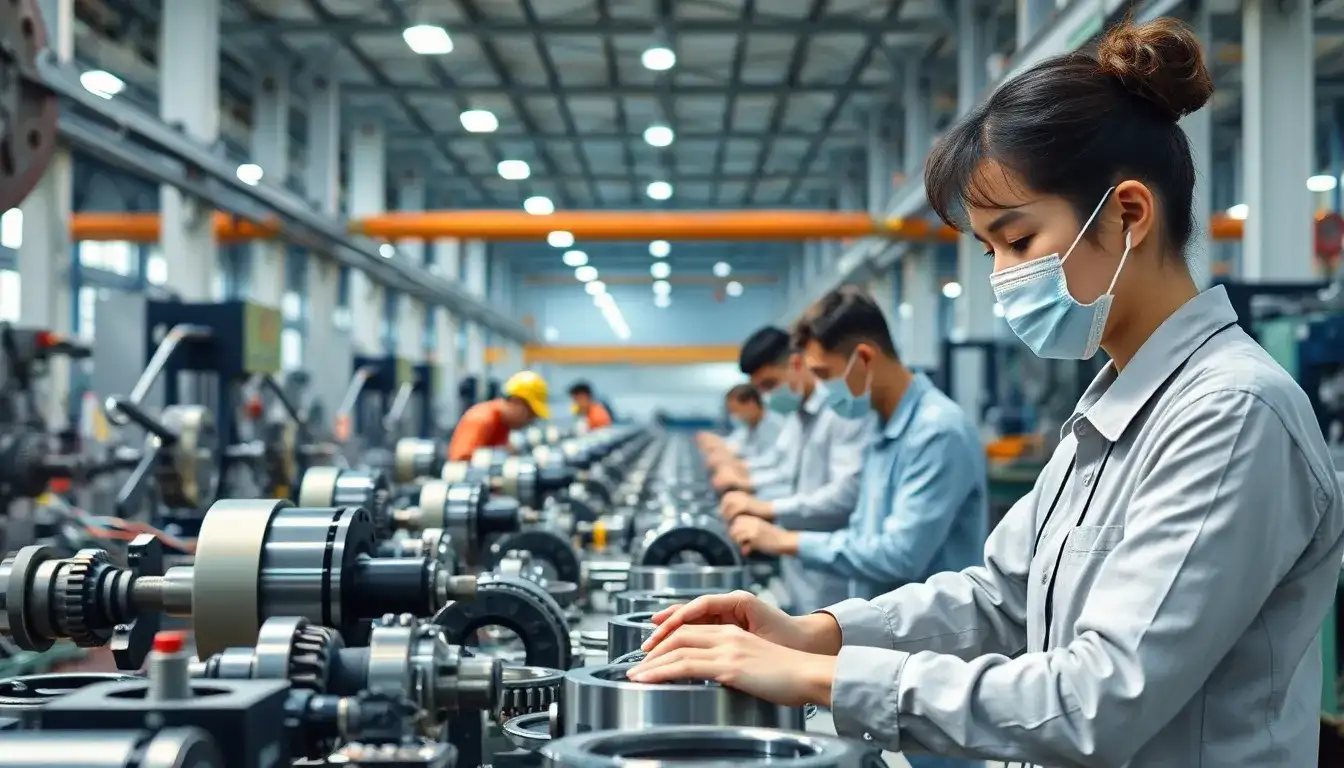
Bearings are often referred to as the “joints” of industry, serving as essential components in mechanical equipment. Without them, even the largest machines cannot operate. In China, one in every ten bearings is produced in Linxi County, Xingtai, Hebei Province. This seemingly inconspicuous county is home to over 3,000 companies involved in the production, sales, and support of bearings, where everything from a small bearing steel ball to entire production lines can be sourced locally. However, in recent years, Linxi has faced several challenges: many companies are small, the industry is primarily at a low to medium tier, research and development teams are lacking, and the government is short on resources for platform building. The question remains: how can the transition from “manufacturing” to “intelligent manufacturing” be achieved?
The Hebei Provincial Association for Science and Technology has provided an answer: by 2025, they plan to establish provincial-level academic societies along the industrial chain and bring provincial scientific innovation platforms directly to the companies. Consequently, the first provincial-level academic society based on an industrial cluster, known as the Hebei Bearing Society (hereinafter referred to as “the Society”), was founded in Linxi County.
Shared Testing: Product Inspection Made Convenient
A representative from a Hebei bearing company takes out their phone, opens the “Shared Axis Research” WeChat mini-program, fills out the inspection items and specifications, confirms the address, and clicks submit. Within an hour, a pickup person arrives. They verify the bearing information and package it for delivery to the China-Serbia (International) Bearing Industry Shared Laboratory (hereinafter referred to as “the Shared Laboratory”). Inspectors at the Shared Laboratory use precision measuring instruments to assess the submitted bearing components.
“Take this ring gauge mother piece, which is marked with an inner diameter of 60.000 millimeters. The actual measurement with the precision gauge is 60.0017 millimeters—accurate to four decimal places, with a detection precision at the nanometer level, equivalent to one-hundredth of a human hair,” explained the project leader at the Shared Laboratory. Bearings require high precision, which directly affects the performance, lifespan, and safety of equipment. Both manufacturing and research rely heavily on inspection and testing. However, previous investments in equipment were substantial, making it financially burdensome for most companies. This resulted in a long-standing issue of inadequate testing capabilities in Linxi’s bearing industry.
With the Society’s support, Linzhou Group collaborated with Serbia’s Z&S Bearing Company to jointly establish and operate the Shared Laboratory, equipped with over 180 imported devices, including German Leica microscopes and Swedish Hexagon three-coordinate measuring machines, which are available to companies free of charge. The laboratory has created a “one-hour service circle,” enabling online ordering and pickup, which has reduced single testing costs by over 40% and shortened research and development cycles by an average of 20-30%. Since its operation, over 4,300 product tests have been completed. “In the past, we had to send the ring gauge mother piece to professional institutions in other provinces for testing and calibration, which took about ten days due to transportation and acclimatization periods,” the company representative said, adding that now, with the Shared Laboratory built right at their doorstep, they can complete the entire process from sample submission to report receipt in a single day.
Shared Research: Innovating for Industrial Upgrades
In a groundbreaking development, a fully automated “dark factory” has started producing 70 million sets of precision module bearings each year, where robotic arms, AGV logistics vehicles, and underground conveyor belts work in harmony. However, this company once struggled with material processes and urgently needed high-performance, long-life metal ceramic coating technology.
Coincidentally, the Society’s experts were located right upstairs. Upon learning of the need, they quickly contacted Gong Taimin from the Xiang-Gan Border New Materials Modern Industry Research Institute, an expert in surface strengthening technology for precision components. Together, they identified that the Society would include “long-life metal ceramic perforated top head research and application” in the 2025 Hebei Provincial Science and Technology Support Program for distinctive county-level industrial clusters. This support directly benefited the company. This is not an isolated case; the Society has formed specialized service teams to provide one-on-one guidance, helping seven companies successfully apply for nine provincial key core technology projects, ensuring that policy benefits reach the frontlines of the industry.
Under the guidance of the Hebei Provincial Association for Science and Technology, the Society actively identifies industrial technology needs and organizes teams of experts from Hebei University of Technology, Hebei University of Science and Technology, and Yanshan University to conduct over 20 technical diagnosis events, which have led to the advancement of key technologies, such as energy-saving well-type furnace renovations.
Shared Procurement: Bulk Buying for Bearings
“This quality is guaranteed by Shigang’s premium bearing steel,” said the deputy general manager of a Xingtai machinery company, as he examined a freshly manufactured high-end bearing. “Since we started purchasing through the industrial park’s ‘group purchasing price,’ not only have our costs dropped significantly, but the quality of our products has improved dramatically.” Recently, this company secured orders from six high-end bearing manufacturers, a confidence that stems from the procurement platform established by the Society.
Previously, smaller companies faced challenges in procurement due to lower order volumes and weak negotiating power, which resulted in unstable supplies of quality steel. Raw material procurement is the first hurdle for bearing companies, as the quality of steel directly determines the precision of the bearings. On the Society’s advice, Linxi County established a shared procurement platform aimed at the bearing industry cluster. Through this platform, bearing companies can procure high-quality bearing steel at a discount of over 20 yuan per ton, saving approximately 200,000 yuan annually. Thus far, the platform has facilitated the bulk purchase of over 170,000 tons of premium bearing steel for cluster enterprises.
With the issue of “buying good steel” resolved, Linxi bearings have begun to focus on “selling globally”: containers filled with bearing products leave Linxi County and are shipped overseas via the China-Europe Railway Express; local businesses are also setting up overseas warehouses in Serbia and constructing bonded warehouses in Southeast Asia, covering markets in Europe, America, and the Asia-Pacific region, achieving “global visibility and local delivery” through digital sales. This global sales network allows Linxi bearings to “turn” towards the world.
Editor’s Note: During my two-day visit to Linxi, I frequently heard the sentiment: “We once thought provincial societies were distant, but now they are right here with us.” As the first provincial-level society rooted in a county’s distinctive industrial cluster in Hebei, the Hebei Bearing Society, under the guidance and support of the Hebei Provincial Association for Science and Technology, has innovatively built an industrial shared service system, unifying efforts from government, academia, and industry to effectively address the development challenges of the sector and empower high-quality development of distinctive industrial clusters.
What is the functional positioning of a provincial-level society? The answer from the Hebei Provincial Association for Science and Technology is: not only to focus on applied research and discipline construction but also to respond to local development needs and solve practical problems on the ground. Establishing a society within an industrial cluster does not mean lowering standards but expanding opportunities—enabling experts to deepen research by solving real-world problems and enhancing disciplines through development service. The bidirectional empowerment of innovation and industrial chains transforms into tangible acceleration in the movement of bearings. Linxi bearings are not just producing products; they are forging a path towards high-quality development for county-level distinctive industrial clusters.
Original article by NenPower, If reposted, please credit the source: https://nenpower.com/blog/how-a-small-county-in-china-is-transforming-its-bearing-industry-for-global-reach/

