

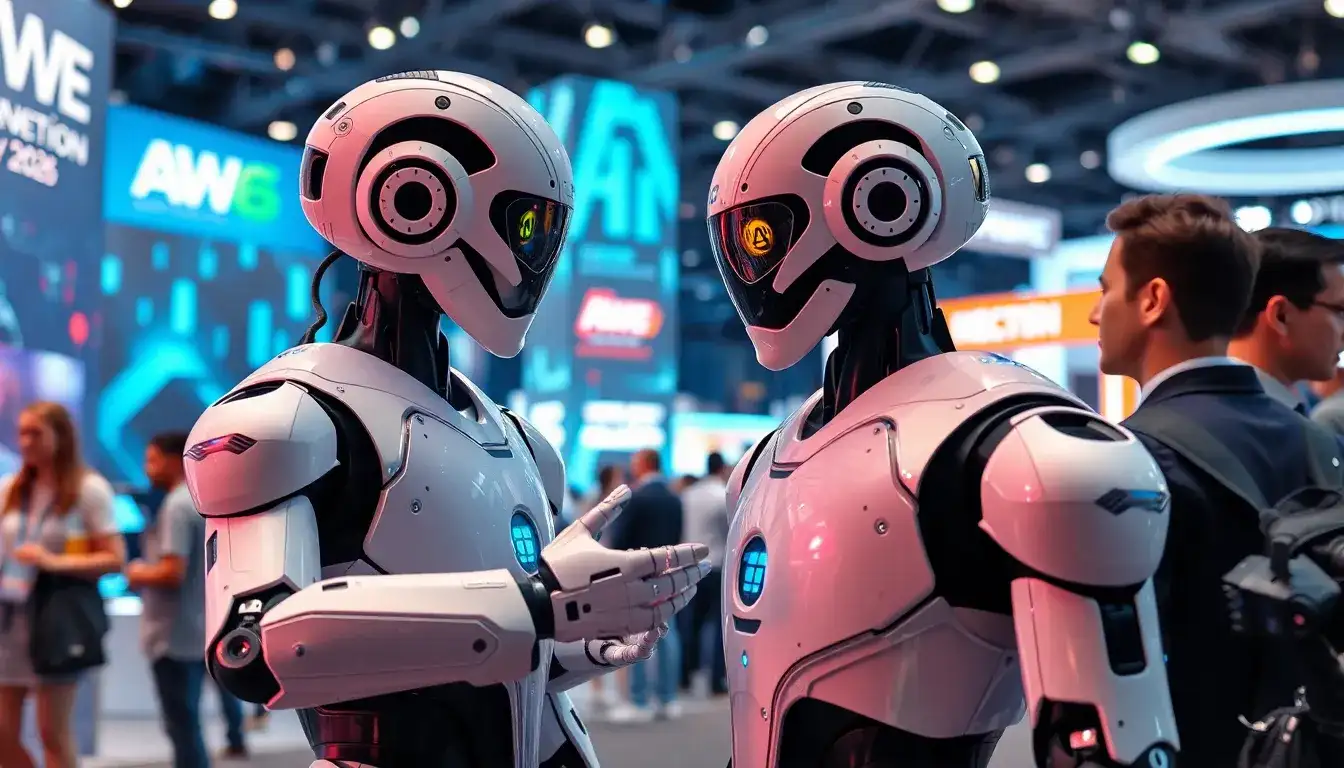
Robots Accelerate Home Arrival! On the first day of AWE 2026, AI Emerges as the Common Ground in the Home Appliance Sector
On March 12, 2023, the Shanghai New International Expo Center and the Oriental Hub International Business Cooperation Zone became some of the busiest places in China and even the world. Following our coverage of major tech exhibitions like CES 2026 and MWC 2026, the Lei Technology reporting team returned to China to kick off a four-day journey of live reporting at AWE 2026 (March 12-15). As an official media partner of AWE, our reporting team, led by Editor-in-Chief Luo Chao, consists of over 10 members, marking the largest exhibition reporting team in Lei Technology’s history. Notably, the AWE organizers have set up a special “interview room” for us, located next to similar setups for People’s Daily and Caixin Media, where our MCN will provide a series of high-end dialogues and more.
On the first day of AWE 2026, the venue was crowded with visitors. More than 1,200 companies are exhibiting, with attendance expected to exceed 200,000. AWE (Appliance & Electronics World Expo), which has been running for 34 years, is one of the top three global exhibitions for home appliances and consumer electronics, alongside CES and IFA. The expo not only highlights the rapid rise of China’s home appliance industry but has also embraced consumer electronics, smart ecosystems, and cutting-edge technologies like AI and robotics, establishing itself as the leading technology expo aimed at end-users in China.
As the main venue for AWE 2026, the Shanghai New International Expo Center has expanded from 12 to 13 exhibition halls, covering a total area of 140,000 square meters. Additionally, AWE 2026 has opened a new exhibition area in the Oriental Hub International Business Cooperation Zone, increasing the total exhibition space to 170,000 square meters.
In line with tradition, we present our annual “First Day Observations” at AWE.
11193 square meters: The ‘Chasing the Universe’ Becomes the Largest Landlord
Since Haier booked an entire hall at AWE 2017, only Midea has followed suit in 2019 until Chasing made its grand debut at AWE 2026. As a representative of new smart technology, Chasing has taken over the entire E7 exhibition hall at the Shanghai New International Expo Center, which spans 7,378 square meters. With a presence across five halls (E7/E1/W2/W3/W4) totaling 11,193 square meters, it has become the largest exhibitor at AWE and the biggest smart technology ecosystem brand in the event’s history.
Within this massive booth, “Chasing the Universe” showcased multiple brands from its ecosystem, such as DREAME, MOVA, NAVEE, and others, launching over a hundred new products and innovative technologies across various fields, including daily commuting, home life, outdoor experiences, ground travel, and space exploration. Additionally, the Chasing ecosystem has set up a beverage house in the N1-1 hall as part of their unique offerings. The E7 hall has been divided into eight independent exhibition areas, where DREAME’s full range of high-end smart ecological products is on display, covering categories such as smart cleaning, smartphones, smart vehicles, and more.
At the heart of the “Chasing the Universe,” our reporting team not only experienced the overwhelming crowds but also sensed the immense curiosity and interest in DREAME, a rising brand in smart technology. Specifically, the team noted that DREAME is applying “robotic arm” technology to more of its product lines. A year ago at AWE 2025, DREAME displayed various devices equipped with robotic arms, such as the X-Wind double-armed air conditioner. This year, they have further integrated robotic arms into a wider range of smart products, including floor-cleaning robots, lawn mowers, and folding machines.
For instance, the traditional lawn mower only trims grass to a uniform height. In contrast, DREAME’s A3 AWD PRO lawn mower utilizes a robotic arm to perform functions like leaf cleaning, garbage collection, and even automatic watering and fruit picking. Coupled with the newly upgraded OmniSense 3.0 system, it can accurately identify various obstacles on the lawn and interact with children and pets, effectively becoming a “garden steward.”
In terms of cleaning, traditional round floor washers often leave hard-to-reach corners uncleaned. However, DREAME’s T70 series floor washer can clean edges using its robotic arm, overcoming room corners. It’s important to note that products like DREAME’s robotic arm-equipped floor washers and lawn mowers have evolved beyond traditional appliances into embodied intelligent robots. The significance of robotic arms lies in their high flexibility, allowing for more complex and precise operations, as well as substantial OTA (over-the-air) potential for enhanced functionality over time. Without a doubt, DREAME’s ecological layout in home scenarios will increasingly point towards embodied intelligent robots, regardless of their form.
Beyond these categories, DREAME also showcased the high-end AURORA flagship smartphone and the newly independent automotive brand “Starry Sky Project.” Smartphones and smart vehicles are essential categories in DREAME’s “full-scene high-end smart technology ecosystem.” Whether it’s the smartphone or the vehicle, both continue DREAME’s strategy of launching high-end products in key categories. The AURORA smartphone features a unique modular imaging system supporting magnetic external triple-camera lenses, with a 1-inch sensor and 115mm native telephoto range, balancing exceptional imaging capabilities with a slim design, and allowing remote shooting via Wi-Fi.
The AURORA initially runs on the Android 16-based Nebula AIOS system, with a fifth-generation Snapdragon 8 processor, and plans to transition to a self-developed system by 2027. Notably, DREAME has designed a flagship processor, Zhixiao 01, specifically for its AI smartphone. On-site staff informed us that the starting price for the DREAME smartphone is expected to be $999 (approximately 6,871 RMB), with the luxury customized version varying based on customer specifications and the top version possibly exceeding 100,000 RMB.
At AWE 2026, the “Starry Sky Project” automotive brand made its independent debut, presenting the world premiere of the SUV concept car Nebula NEXT 01X and the Chinese debut of the Nebula NEXT 01 concept supercar, along with the “Rocket Car” Nebula Next 01 Jet Edition.
As one of the most important brands in the “Chasing Ecosystem,” MOVA presented a comprehensive “smart home ecosystem” exhibition covering cleaning, gardening, personal care, and pet scenes across two halls at AWE 2026. MOVA’s industry-first full-space coverage flying vacuum cleaner left a strong impression on our reporting team.
Home Appliance Companies Showcase AI Technology and Robotics
Another major exhibitor, Haier, showcased a spectacular AI technology display themed “AI Life, Boundless Evolution.” In the N5 hall of the Shanghai New International Expo Center, Haier Smart Home featured five upgraded brands: Haier, Casarte, Leader, Fagor, and more. The Lei Technology reporting team noted the overwhelming crowds at Haier’s exhibit.
Haier exhibited two core technology application areas: the upgraded version 2.0 of “AI Eye,” and the “Seeker Series,” which boasts the highest intelligence level of “L4.” The household robots presented focus on three key application areas: “household chores, cleaning, and companionship.” The AI Eye 2.0 version enhances identification capabilities, providing more comprehensive and accurate recognition.
In tandem, Haier launched the world’s first “L4-level” intelligent appliance set with the Seeker Series, which includes air conditioners, washing machines, and refrigerators. Visitors observed that with the help of the AI Eye 2.0, Seeker washing machines can intelligently match washing processes based on basic user input, such as “I just returned from the hospital; my clothes need a thorough wash.” The refrigerator’s recognition capabilities have been upgraded from recognizing 230 types of ingredients to unlimited types, expanding its recognition range from the refrigeration area to the freezing area.
Haier not only empowered appliances with AI applications but also introduced household robots that operate in real home environments for “household chores, cleaning, and companionship.” For example, the “Haier Household Robot” can wait at the door to help users carry groceries to the fridge, sort items using barcode or visual recognition, and assist in the manual sorting process. Haier’s cleaning robot can actively tidy up the house daily, while the companionship robot can remind elderly family members to take medication and assist in case of falls. Observations noted that there is room for improvement in the mobility speed of Haier’s wheeled robots, as they currently transport only one item at a time, which may result from latency in cloud-based models and multi-modal processing times. However, the cleaning robot’s responsiveness is relatively quick and shows potential to compete with mainstream robotic vacuum cleaners in the future.
Building on the industry’s first “AI-native cross-ecosystem smart home operating system” UHomeOS and advancements in AI Eye technology to version 2.0, Haier demonstrated a comprehensive approach towards transforming its smart appliance range into “AI intelligent agents,” enhancing their intelligence from “passive execution” to “active prediction.” This advancement is significant as it moves towards the concept of “unmanned household chores.” Haier is not the only major appliance brand embracing AI technology. Midea, another leading domestic appliance manufacturer, hosted a 2026 full-home smart strategy launch conference in Shanghai before the AWE, themed “Smart Beauty Universe.” Midea’s strategy also relies on an AI core capabilities platform and introduces a detailed “Three Ones” strategy for full-home smart ecosystems, including an appliance network, a smart brain, and an open platform.
Midea’s first self-evolving smart agent, MevoX, possesses six core capabilities: perception, reasoning, execution, memory, optimization, and linking. Its advanced reasoning and continuous memory abilities enable it to accurately understand user intentions and remember preferences. With the application of AI intelligent agent technology, Midea’s smart appliances can now remember complex user commands, such as “Set the bedroom air conditioner to 26 degrees cooling with minimal wind while turning off the lights at bedtime,” and proactively execute these commands during scenario recreations.
Prior to AWE 2026, COLMO also held a launch conference in Shanghai, introducing a new generation of smart home solutions focused on “more proactive AI housekeeper services.”
All major appliance manufacturers are competing vigorously in the application of AI intelligent agent technology. Before AWE 2026, during an annual customer conference and product launch, Skyworth’s CTO stated that the company would become the first appliance manufacturer to integrate “OpenClaw,” a technology capable of understanding user needs to enhance appliance service. Meanwhile, the founder of Skyworth expressed skepticism about humanoid robots, stating that they are unrealistic for tasks like walking with the elderly or serving as companions. However, it is crucial to note that while Skyworth does not engage in humanoid robotics, it is involved in the development of industrial robots for automation in appliance manufacturing.
During AWE 2026, various home appliance companies showcased their non-humanoid robotic technology applications. At the FOTILE booth, the Lei Technology reporting team experienced the “world’s first robotic kitchen.” FOTILE’s robotic kitchen relies on the “Automatic Cooking Assistant System ACS 3.0,” which includes the AI Genie 2.0 voice assistant for multi-modal emotional interaction, an “AI Hat” providing proactive emotional feedback, AI Vision 2.0 for visual recognition and real-time cooking feedback, and automated cooking and precise seasoning capabilities.
FOTILE’s robotic kitchen primarily features robotics as physical carriers, yet at its core, it remains an application of various AI technologies in family cooking scenarios. It can be said that embodied intelligent robots represent AI empowerment in the robotics category. Mainstream views suggest that the path to AGI (Artificial General Intelligence) requires both AI as the brain and robots as the body, both of which are indispensable.
At the Boss Electric booth, the Lei Technology reporting team encountered “AI cooking glasses.” These glasses, marketed as “your AI cooking partner,” provide features like collaborative cooking and health management when worn during meal preparation. From AI intelligent agents to supporting AI hardware and embodied intelligent robots, major appliance manufacturers showcased their innovations at AWE 2026, collectively advancing the comprehensive AI and robotics integration in the smart home ecosystem.
These appliance platform companies are vigorously pursuing the construction of a comprehensive AI software and hardware platform system in various home scenarios. Concurrently, humanoid robots representing embodied intelligent robots also took center stage at AWE 2026. Magic Atom showcased robots similar to those featured in the 2014 Spring Festival Gala, including the full-size universal humanoid robot GEN 1, the high-dynamic biped humanoid robot MagicBot Z1, and the MagicDog series for both consumer and industrial applications.
In the television industry, Chinese manufacturers lead the way, with RGB not being the only focus. Earlier this year in Las Vegas, the Lei Technology CES 2026 reporting team witnessed the fierce competition among Chinese television giants like Hisense and TCL, showcasing their prowess on the global stage. Back in China, Hisense occupied nearly half of the W5 hall at the Shanghai New International Expo Center, while TCL exhibited in an over 1,800 square meter area in the W1 hall. At AWE 2026, Hisense presented three major color light source technologies along with its flagship televisions and smart display products.
In the realm of RGB-Mini LED display technology, the Lei Technology AWE 2026 reporting team viewed the world’s largest RGB-Mini LED television, the Hisense 116UX2026. As a “super flagship” television, its core technology lies in the world premiere of the self-developed XinXin AI light color control chip and RGB three-color luminescent chip. With these advanced “Chinese cores,” Hisense has solved the long-standing challenge of “light color control” in the television industry.
In the field of Micro LED technology, recognized as the “ultimate display form” for the future, Hisense also debuted two groundbreaking products: the world’s first 163-inch four-color Micro LED giant screen 163UX Pro and the world’s first 163-inch UX 3D stereoscopic display Micro LED giant screen. Hisense’s four-color Micro LED giant screen features a native four-color pixel structure, integrating yellow light into pixel design for the first time, with 33,170,000 Micro LED chips, each consisting of independent red, green, blue, and yellow light-emitting units, achieving 100% BT.2020 “true color” and 10,000 nits XDR Pro dynamic lighting.
Hisense’s 3D stereoscopic display MicroLED giant screen uses 2D real-time conversion to 3D technology, partnered with 10,000 nits XDR Pro dynamic lighting, to deliver an immersive viewing experience, supporting custom sizes up to 271 inches.
In the laser display technology field, Hisense showcased the world’s largest 150-inch laser television, the Exploring X1 Ultra. This model, using DLP digital cinema projection technology sourced from cinema standards, is wider than IMAX by 10 degrees, with the industry’s highest 110% BT.2020 film-grade color gamut and Hisense’s original “spectrum selection screen,” effectively resisting ambient light while also boasting zero screen radiation, glare, reflection, and flicker. The new laser television model, the Exploring X1 Pro, also made an early appearance, featuring an innovative integrated design.
As an official sponsor of the 2026 World Cup, Hisense also showcased a complete line of customized products for the event, including the Hisense Brilliant Hercules vacuum refrigerator and the Hisense Hercules air conditioner. Another leading domestic television manufacturer, TCL, is also a global TOP partner of the Olympics. At the recently concluded 2026 Milan-Cortina Winter Olympics, TCL built a comprehensive support and service system under the name “Olympic Screen Universe,” demonstrating its technological strength in display technology to a global audience. At AWE 2026, TCL brought the “Screen Universe” to the main stage, further displaying deep integration with “AI technology.” Specifically, TCL proposed the concept of “AI to Reality,” advocating for the seamless integration of smart TVs and other smart appliances into a holistic smart home ecosystem, allowing different categories to work in harmony to enhance user experiences at home.
At the TCL booth, the Lei Technology reporting team saw the 85-inch X11L SQD Mini LED television. As a brand that launched SQD Mini LED televisions, TCL’s X11L model can generate three colors of light through backlight stimulation of “super” quantum dots, outperforming conventional Mini LED and OLED in brightness, color, and lifespan. TCL’s sub-brand, Thunderbird, also introduced the QD-Mini LED television model Crane 6 ULTRA, which focuses on “ultra-low reflection,” utilizing self-developed low-light film technology to reduce reflection rates while maintaining high transparency and supporting refresh rates of up to 144Hz.
Thanks to the core technology support from Huazhong, TCL maintains its global leading position in display technology, and its multiple product lines and technology routes allow for flexible adjustments based on different application scenarios and target audiences. A standout feature is Skyworth’s introduction of the Wallpaper TV A10H series at AWE 2026. According to members of the Lei Technology reporting team, this television boasts “three rolls”: roll quality, roll thickness, and roll design. Positioned in the center of Skyworth’s over 1,000 square meter exhibit, the Wallpaper TV A10H series stands out with various other home appliance products surrounding it. According to booth staff, this high-end aesthetic design Wallpaper TV is a core product for creating premium home environments.
The Wallpaper TV A10H series features a 100-inch display with a thickness of only 2.7mm and utilizes SQD Mini LED technology with 11,520 zones. From Hisense to TCL to Skyworth, it is evident that traditional television giants are showcasing their most advanced and comprehensive television products and production lines at the AWE stage, with the core aim of accelerating the promotion and popularization of these mid-to-high-end (especially high-end) television products in the domestic market.
Chasing New Frontiers: Stone and Ecovacs Focus on Smart Cleaning
As one of the most explosive and high-potential categories in home appliances, the intelligent cleaning sector, along with companies established in this area, extends beyond just Chasing at AWE 2026. It can be said that AWE serves as the most critical platform for all domestic smart cleaning companies in the Chinese market. At AWE 2026, major brands in smart cleaning like Stone Technology and Ecovacs (including Tineco) put on a remarkable display. Unlike Chasing, which has chosen to diversify, Stone and Ecovacs continue to focus on the smart cleaning sector. Stone Technology themed their presentation at AWE 2026 “Embodied Moments, Driving the Future,” partnering with Real Madrid to create a championship-themed exhibition area showcasing new products in vacuum cleaners, floor washers, and washing machines.
Ecovacs unveiled its flagship floor cleaning robot family X12 and the industry-first “Super Spin Wash” system for the window-cleaning robot W3, making its domestic debut. Meanwhile, Tineco showcased a full range of floor washers, including the Fuwann Space Station, Scientist, and Geek models, along with smart cooking and drinking machines for a full-scenario smart life.
Notably, Ecovacs presented the “Eight Realms,” touted as the first housekeeper robot equipped with OpenClaw.
Overall, the Lei Technology reporting team at AWE 2026 candidly stated that the above only scratches the surface of the full range of technologies and new products showcased on the first day.
Original article by NenPower, If reposted, please credit the source: https://nenpower.com/blog/ai-and-robotics-take-center-stage-at-awe-2026-a-comprehensive-overview-of-day-one-highlights/

