

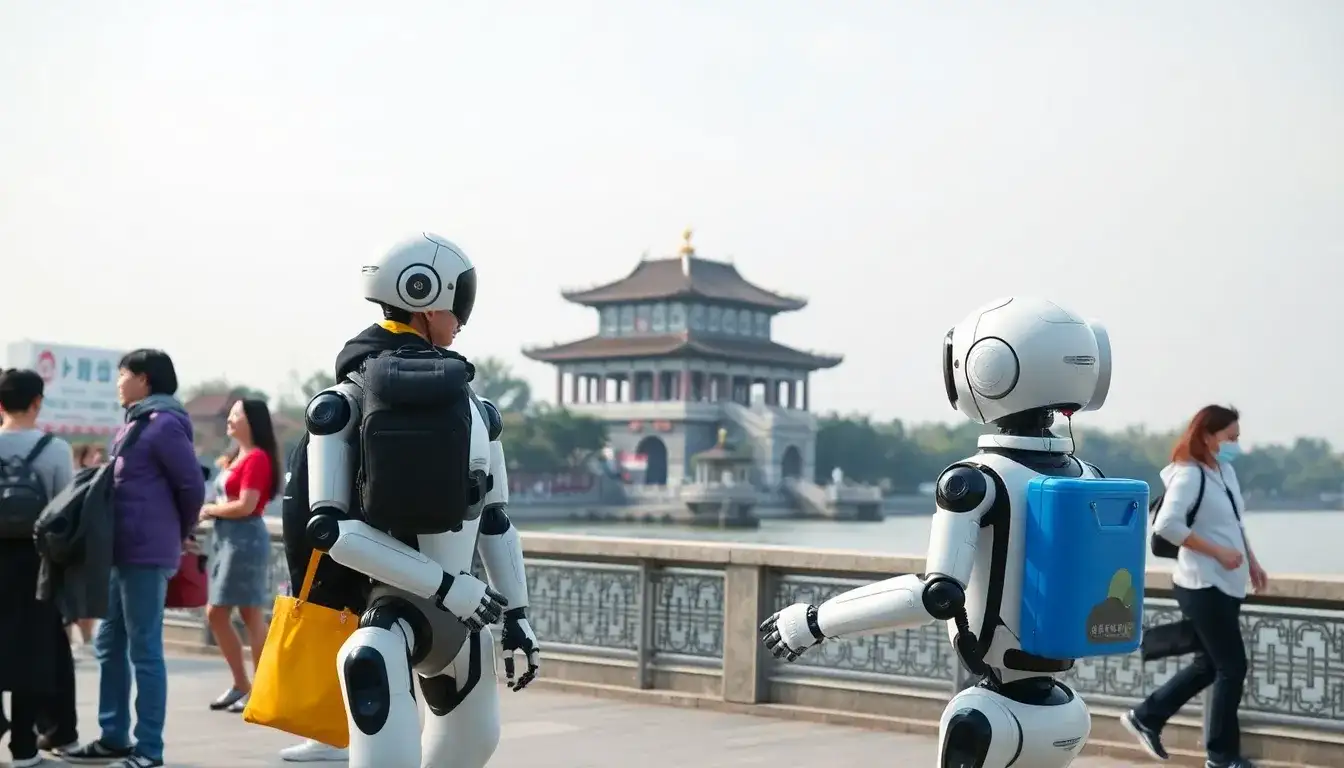
The second Hangzhou International Humanoid Robot Exhibition in 2026 featured around 600 companies from various sectors. The exhibition showcased performances that have become a standard feature, with robots demonstrating boxing, acrobatics, piano playing, and bass guitar skills. These robots are also utilized in scenarios such as cultural tourism explanations, welcoming guests, and interactive technology displays.
Several interviewees noted that while remote control of these robots is no longer an issue, achieving true autonomy—where robots can perceive, decide, and act independently in industrial settings—remains a challenge. One conservative estimate suggests this may take at least three more years to realize.
On the morning of the exhibition’s opening, the booth of Yushu drew a crowd with its boxing ring featuring two robots over one meter tall engaged in a match, marking the event’s first demonstration. Another booth, Yunmu Intelligent Manufacturing, showcased a robot dressed in traditional attire, designed specifically for cultural tourism. According to staff, there is significant demand from attractions, museums, hotels, and large shopping malls, making cultural tourism one of the fastest-growing applications for robots.
A representative from a company providing robot delivery and after-sales services remarked that in previous years, clients were impressed by robots’ ability to move on their own. However, expectations have shifted; clients now desire smarter solutions that do not require human explanations.
The situation in the industrial sector is considerably more complex. Liuzhiqiang, the business director at Weiqing Technology, explained that while robots can perform choreographed movements and dances, collecting data through motion capture and pre-programming is straightforward. However, real-world factory environments are unpredictable and will not wait for robots to be programmed. Understanding the physical world and responding in real-time is still a considerable challenge for robotics.
According to staff at Yunmu Intelligent Manufacturing, parcel sorting has now been automated using robots. For instance, packages from Hangzhou are sorted within the city, while those from Guangdong and Beijing are managed locally. Robots can identify package information and sort them onto different conveyor belts.
Logistics has emerged as a primary battlefield for embodied intelligence applications. Notable implementations include a collaboration between Xingdong Jiyuan and China Post, where robots are deployed in the Guangzhou postal area to identify, grab, flip, and deliver packages, achieving an efficiency of up to 1200 items per hour, which is 85% of human efficiency. Another example is the Galbot from Galaxy General, which operates in a 50 square meter smart space in Beijing, automatically sorting, packing, and shipping 5000 products across 6000 channels without interruption for over 150 days.
Furthermore, robots are also being employed in high-risk tasks such as welding, high-pressure line installation, and pollution control. A data acquisition exhibitor indicated that behind the scenes, human operators don motion capture suits and VR goggles to control robots remotely. Fully autonomous robots that can complete tasks without human oversight are not yet feasible in complex environments.
Another exhibitor, Astro Boy Robotics, has taken a pragmatic approach, achieving small-scale deliveries to factories. One model, equipped with bicycle wheels, is priced under 100,000 RMB and is designed for patrolling. Another model, Tianbing No. 1, which is more expensive, is currently undergoing testing for applications in factory assembly, sorting, and transportation. By refining their capabilities in niche markets, they aim to secure a competitive edge.
Lingxi Robotics highlighted a core bottleneck: humanoid robots need to be more flexible and adaptable to various tasks. However, current large models and vision solutions lack definitive parameters, and the industry is still exploring these challenges.
During a media briefing in January, NVIDIA CEO Jensen Huang predicted that by 2026, we could see robots achieving “human-level” capabilities. In a more specific timeline, Elon Musk, CEO of Tesla, announced during the company’s Q1 2026 earnings call that the third-generation humanoid robot, Optimus Gen3, is expected to debut mid-year, with a target production capacity of 1 million robots annually, aiming for long-term production of 10 million units. Deliveries to corporate clients are planned for the second half of the year, with external applications expected in 2027.
However, academic institutions like IEEE caution that challenges related to robot stability and endurance remain significant. Therefore, the timeline for large-scale commercialization may require further validation.
The exhibition illustrated a clear “temperature difference” within the humanoid robot industry in 2026. Upstream component manufacturers are rapidly increasing production capacity, while midstream module and solution providers are still wavering on technical paths, awaiting a “killer application.” Meanwhile, downstream customers are weighing high expectations against current capabilities, with viable applications primarily limited to structured and repetitive tasks in logistics sorting and industrial transportation.
As an exhibitor aptly put it, “Many are currently testing small batches, but there is still a long way to go before deployment. The distinction between advertised mass production and actual implementation is significant.”
The boxing demonstration at the Yushu booth captivated attendees, marking the first performance of the 2026 Hangzhou International Humanoid Robot Exhibition.
Original article by NenPower, If reposted, please credit the source: https://nenpower.com/blog/hangzhou-robot-expo-cultural-tourism-and-logistics-lead-the-way-while-industrial-autonomy-faces-challenges/

