

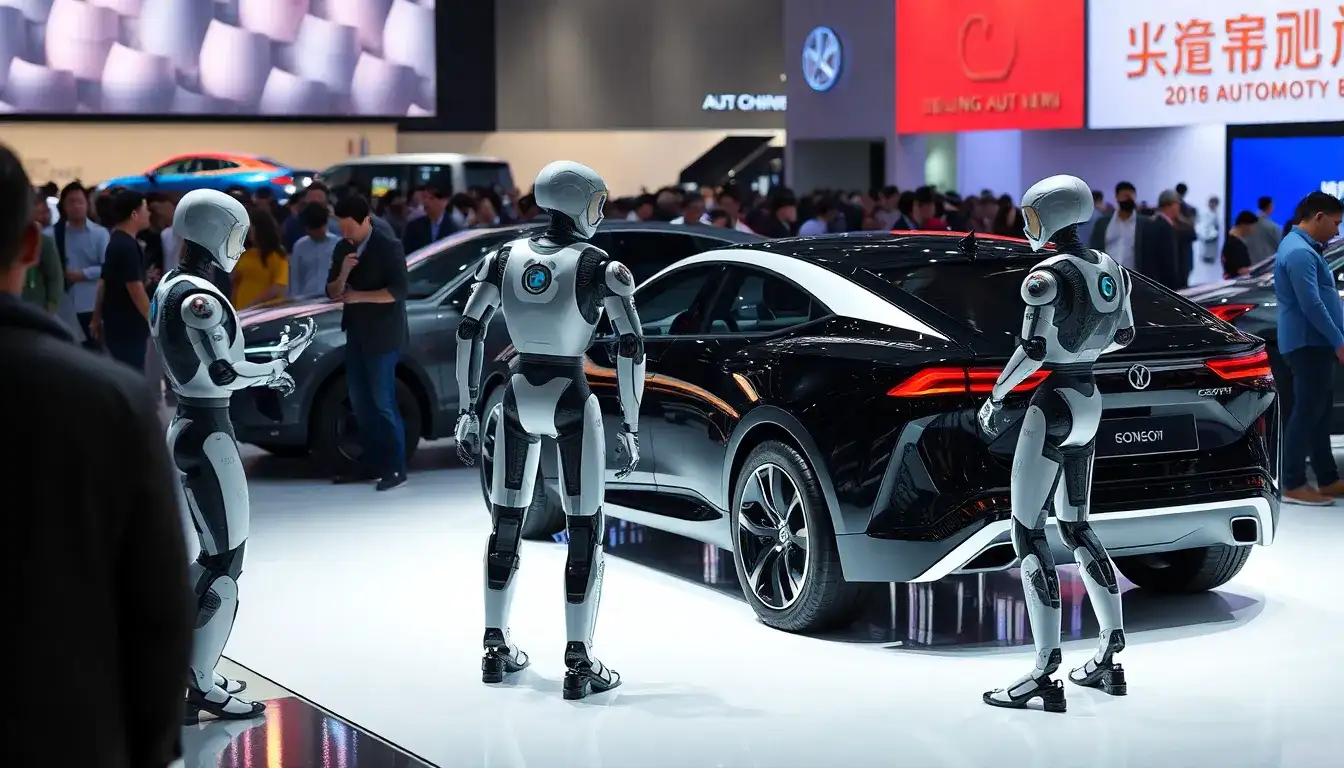
The 2026 Beijing International Auto Show has turned the spotlight on robots, showcasing an impressive increase in robotic presence compared to previous years. Following a notable debut at the 2024 Beijing Auto Show, robots have taken center stage, captivating audiences with their advanced capabilities.
In recent years, numerous automotive companies have ventured into the field of embodied intelligence. The first quarter of this year saw an intensified competition among car manufacturers to create humanoid robots, with some even available for sale in dealerships. This enthusiasm for robotics is prominently displayed at the auto show, where companies not only showcase their robots but also feature participants from the 2026 Beijing Yizhuang Half Marathon, which included humanoid robots with autonomous navigation capabilities. Among them, the champion robot and several popular competitors engaged with visitors at the event, drawing significant attention from both domestic and international audiences.
The atmosphere of the exhibition is heavily influenced by a cyberpunk aesthetic. A preliminary count indicated that over ten automotive and components companies brought their robots to the 2026 Beijing International Auto Show, while others invited well-known robotic brands to enhance their display and attract crowds.
China FAW’s Full-Size Humanoid Robot Debut
At this premier global automotive event, China FAW showcased its self-developed intelligent robots alongside its latest concept car. This robot, built on an AI-native hybrid technology architecture, demonstrated seamless interaction and engaging photo opportunities.
A representative from China FAW explained that their robots, powered by the China FAW Embodied Intelligence Operating System, possess core capabilities for complex task planning, massive data sharing, and collaborative operations. This foundation supports their applications across various scenarios, including industrial production lines and commercial services. Additionally, the next-generation lightweight joint module, developed by China FAW, was also unveiled, enhancing the resilience and security of the supply chain.
The full-size humanoid robot is designed for high-precision heavy tasks across diverse environments and aims to lead the direction of general embodied intelligence, aspiring to become a “super employee” in future smart societies. For instance, the service humanoid robot is tailored for high-end commercial settings, covering roles such as greeting customers and providing product explanations in dealerships to enhance service experiences. The robotic arm focuses on production handling and intelligent assembly, combining precision with stability, serving as a crucial asset on production lines and supporting data iteration across the robot family. The quadruped robot is designed for extreme exploration, capable of navigating complex terrains and executing inspection tasks in hazardous environments, thereby expanding the application boundaries of robots.
The representative emphasized that China FAW has established a five-dimensional collaborative development system for its robots, integrating technology R&D, application scenarios, and industrial ecosystems.
Xiaopeng Robots to Achieve Mass Production by Year-End
The Xiaopeng IRON robot, showcased at the auto show, was presented in a static display, allowing attendees to closely observe its skin texture. Xiaopeng Group’s Chairman, He Xiaopeng, announced plans for mass production by the end of 2026, with commercial sales expected to begin in 2027. Compared to Xiaopeng’s initial market performance in 2019, the commercialization of their robots may launch more swiftly. He believes that Xiaopeng Group is progressively turning its dreams into reality on a global journey in physical AI, projecting that the growth rate and scale of robots will surpass that of China’s new energy vehicles.
The Xiaopeng team shared that the IRON stands at 173 cm tall and weighs 65 kg, boasting 82 degrees of freedom, including 22 in its hands, which mimic dexterous human capabilities. Its design incorporates a bionic spine structure and an innovative shoulder and foot design to emulate human-like movements. Additionally, it features a lattice-structured ‘muscle’ and a fully covered flexible ‘skin,’ allowing it to adapt its shape across different body types and genders.
Currently, the robot is powered by three self-developed Xiaopeng Turing AI chips, with a total computing power of 2250 TOPS, enabling it to walk, think actively, and engage in continuous interaction with humans. In commercial environments, it can be utilized for guiding inquiries and product demonstrations, while in home settings, it may assist with basic household chores, such as making coffee.
He Xiaopeng indicated that Xiaopeng aims to initially target retail sales environments, predicting that about 10% of sales roles in stores may be filled by robots providing product explanations and guiding test drives. Robots will primarily take over “repetitive, simple, and dangerous” tasks, allowing humans to focus on roles that require higher cognitive skills and creativity. Robot technology is expected to undergo iterations approximately every 1 to 1.5 years, leading to enhanced commercial capabilities.
GAC Robots on Duty at Subway Stations
At the GAC Group’s exhibit, Huijun Technology showcased the fourth-generation humanoid robot GoMate Mini, along with four self-developed core components: axial flux motors, integrated joint modules, actuators, and dexterous hands. The staff explained that GoMate Mini serves a dual purpose at the show, acting as a “technology ambassador” in collaboration with the cultural IP Big Bay Chicken, performing fun dialogues and interactive gestures to blend technology with local culture.
They further noted that the four core components displayed are a direct reflection of GoMate Mini’s technical prowess, all developed and produced in-house, contributing to domestic production capabilities. The axial flux motor delivers a maximum output torque of 1100 Nm, providing robust power; the integrated joint module weighs only 300g and offers a 40% improvement in torque output compared to traditional products, making it both compact and efficient. The dexterous hand can handle loads of over 1.5 kg, balancing strength with flexibility, while the actuator is 80% smaller than traditional models, weighing only 40g yet delivering high power.
The GoMate Mini, a variable wheeled humanoid robot, supports various mobility configurations, including folding, four-wheel, and two-wheel standing modes. In two-wheel mode, it can reach speeds of up to 15 km/h and features a self-righting mechanism for efficient navigation across complex terrains. Currently, GoMate Mini has been deployed for regular operations in the Guangzhou subway, leveraging GAC’s industrial ecosystem to expand into automotive production lines and diverse sectors like property management and retail.
Huijun Technology is committed to advancing core technologies and accelerating the integration of their products into practical scenarios, aiming to bring embodied intelligence from the lab into everyday life.
More Robots on the Horizon
In addition to humanoid robots, various service robots showcased their capabilities at the Beijing Auto Show. Hyundai exhibited two four-wheeled robots based on the MobED mobile robotic platform. One robot was designed for golf scenarios, adeptly transporting golf bags and smoothly navigating uneven terrain by raising one wheel when encountering slopes. The other urban robot caters to complex city conditions and allows a person to sit on it, featuring wheels that can adjust to handle bumpy surfaces. It is equipped with a lithium battery capable of four hours of continuous operation and AI-driven Lidar for environmental awareness, with independently rotating wheels for agile maneuverability.
While automotive companies focused on showcasing their “human-like” capabilities, Chasing Technology, a company rooted in robotics, directed its efforts towards vehicle displays, featuring a two-meter tall green robot to highlight its robotic heritage. According to the representative, the company develops a range of robots, including full-size humanoid robots and cleaning robots with bionic multi-joint hands, but this time, only automotive products were featured.
The Xiaomi exhibit, bustling with activity, notably did not display its highly anticipated robot, the Xiaomi CyberOne. Staff members noted that CyberOne stands 177 cm tall, weighs 52 kg, and has 21 degrees of freedom in its joints, designed primarily as a “home service partner” for roles in caregiving, companionship, brand promotion, and technological experiences. Since February 2025, CyberOne has begun phased deployment at Xiaomi’s smart factory in Beijing’s Yizhuang, performing tasks such as quality inspection and material transport.
Original article by NenPower, If reposted, please credit the source: https://nenpower.com/blog/beijing-auto-show-highlights-rising-robot-integration-as-automakers-embrace-ai-innovations/

