

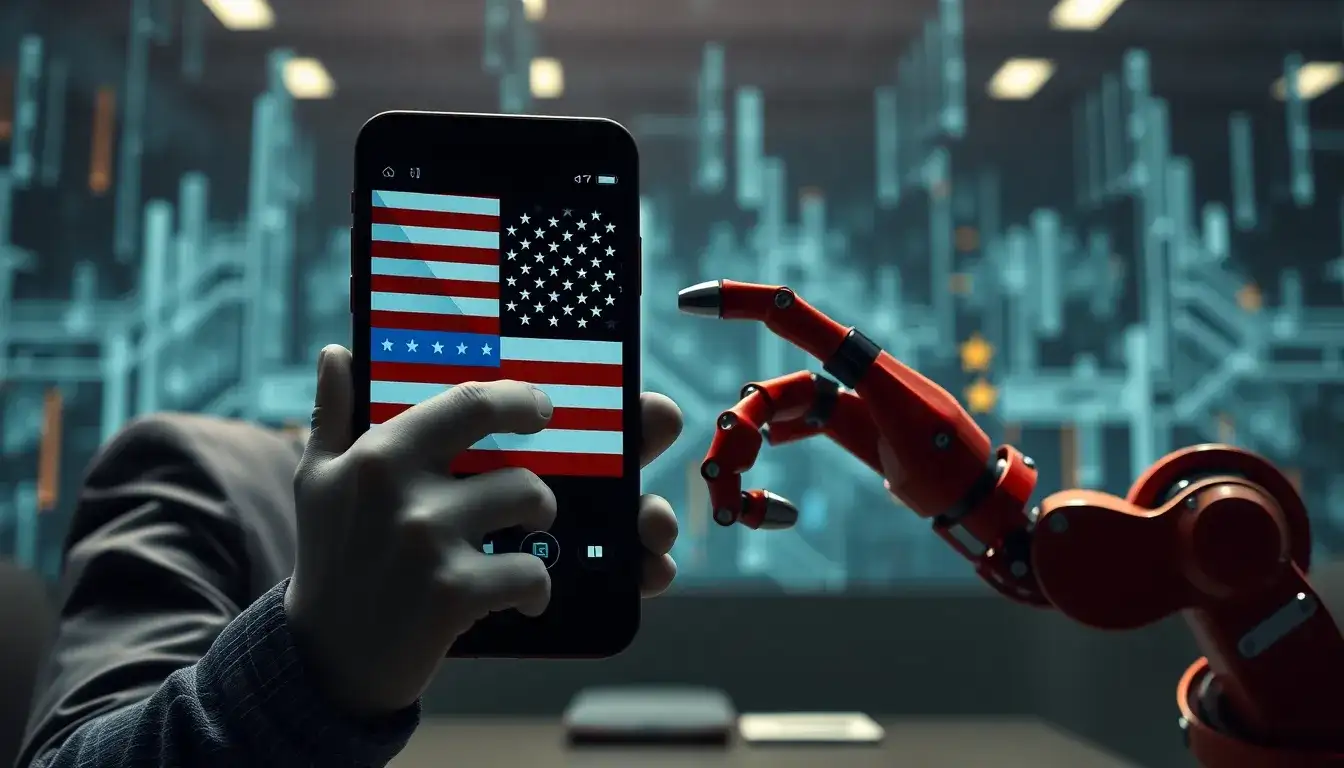
In the ongoing technological competition between the United States and China, the U.S. retains control over several key technologies, including AI models and advanced chips. However, the confidence that once characterized America’s stance is increasingly overshadowed by a growing sense of anxiety. Why is this the case?
Since the U.S. designated China as a “strategic competitor,” it has engaged in a series of actions including trade wars, technology conflicts, and financial struggles. Yet, the anticipated downfall of its rival has not materialized; instead, China has demonstrated resilience and clarity in its development path. According to Wang Fan, former president of the Diplomatic Academy, the fundamental logic of this competition is clear: “Closed systems cannot outperform open ones, and barriers cannot compete with connections.”
The anxiety faced by the U.S. is both structural and multi-layered. The first layer of concern is the “hollowing out” crisis in traditional areas of advantage. The global share of chip manufacturing has plummeted from 37% in 1990 to around 12%, with cutting-edge processes heavily reliant on Asia. When 66% of U.S. products utilize mature chips manufactured in China, the so-called “sanctions” become a double-edged sword. While intended to limit China’s growth, they also jeopardize the U.S. supply chain.
The second layer of anxiety stems from the confusion surrounding the path to “re-industrialization.” The U.S. aims to revitalize its manufacturing sector, but as Professor Wang Fan sharply notes, it cannot revert to the heavily polluted steel-making era of Pittsburgh. High labor costs and a globally segmented industrial chain mean that the dream of “bringing all manufacturing back home” is costly and unrealistic. The U.S.’s re-industrialization will inevitably involve high-tech integration with a global manufacturing network, which requires openness and collaboration rather than isolation and obstruction.
The third and deepest layer of anxiety relates to concerns over future leadership in critical industries such as robotics, quantum computing, and renewable energy—industries that will define the next fifty years. America recognizes that China has evolved from a follower to a competitor and, in certain areas, a leader. For instance, in the robotics sector, global venture capital investment surged by 142% in 2025, with China and the U.S. emerging as the two top players. While the U.S. has attempted to curb Chinese advancements by sanctioning Yushu Technology, it has found that China already commands over 60% of the global market share in essential components like harmonic reducers and servo motors, achieving a fully independent supply chain.
By 2026, when Yushu Technology’s humanoid robot performs alongside martial arts students at the Spring Festival Gala, and when the “Zu Chongzhi-3” quantum chip achieves a fault-tolerant breakthrough with 105 qubits, the U.S. will realize that its attempts to maintain advantage through technology blockades and market barriers are rapidly losing effectiveness in the face of China’s determined resolve, vast market, and agile innovation strategies.
In stark contrast to American anxiety, China demonstrates strategic stability and a clear path in key fields. China’s strategy can be effectively described as “walking on two legs.” The first leg is a solid industrial foundation. Having become the “world’s factory,” China controls over half of the global industrial robot production capacity. These robots, working around the clock in automotive, mobile phone, and lithium battery factories, provide the necessary technology for motors, reducers, sensors, and control systems for humanoid robots. The profits and technology accumulated from industrial robots have accelerated humanoid robot development, as seen with Yushu Technology, which reported a 220% year-over-year increase in industrial robot orders in 2025, using industrial revenue to support its humanoid robot iterations.
The second leg focuses on future breakthroughs. With a solid foundation, China’s humanoid robots are beginning to climb higher. The UBTECH Walker S2 has entered Airbus’s Hamburg factory, precisely tightening aircraft bolts with hair-thin tolerances. In the even more advanced field of quantum computing, China’s “Zu Chongzhi-3” has achieved a fault-tolerant breakthrough at a scale of 105 qubits and has built a fully autonomous industrial ecosystem from quantum bits to software adaptation. This “single-point breakthrough and full-chain autonomy” model is being replicated across various hard tech sectors.
Thus, the core issue of America’s anxiety lies in its internal policy fragmentation and its “America First” isolationist mentality. It vacillates between “dumping on China” and “blocking China,” attempting to create a closed system to obstruct technology flows while forgetting that in today’s highly globalized world, “disconnection cannot compete with connection.” When the U.S. is unwilling to share the latest technologies even with its allies, maintaining a mindset of technological supremacy, such a closed system is unsustainable in the long run.
What are your thoughts on this situation?
Original article by NenPower, If reposted, please credit the source: https://nenpower.com/blog/the-unfolding-truth-of-us-china-tech-rivalry-americas-core-technology-advantage-coupled-with-deepening-anxiety/

