

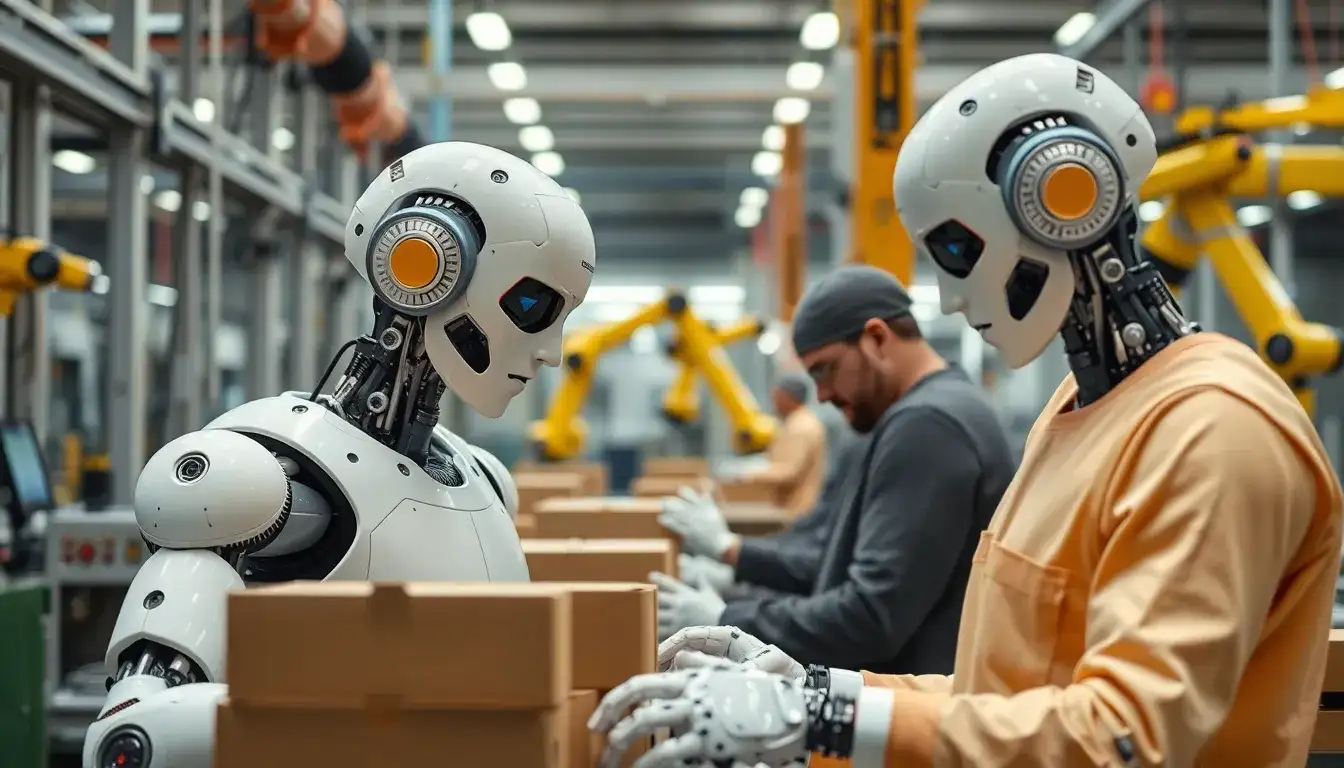
Humanoid Robots in Manufacturing: The Future is Here
Humanoid robots are transitioning from the laboratory to the factory floor, taking on tasks such as assembly, inspection, and collaboration. Unlike traditional robots, they offer flexibility, adaptability, and enhanced safety in human-robot collaboration. In this article, I will explore the core concepts, technologies, applications, and future trends of humanoid robots from their inception to actual production.
What are Humanoid Robots?
Humanoid robots are designed to resemble humans in appearance and movement, capable of performing assembly, inspection, and material handling tasks without the need for extensive redesigns. They provide modern manufacturing with greater flexibility, adaptability, and collaborative capabilities.
The design of humanoid robots mimics human behavior, typically featuring bipedal movement, jointed arms, and visual sensors. They can operate in environments designed for human interaction, such as factories, warehouses, or hospitals, without requiring specialized infrastructure. According to the International Federation of Robotics (IFR), over 150,000 humanoid robots are expected to be deployed globally by 2035.
Differences from Traditional Industrial Robots
- Structural Flexibility: Unlike fixed robotic arms, humanoid robots can walk, use tools, and adapt to non-standard tasks.
- Human Collaboration: Equipped with force control and safety sensors, they can work alongside humans without the need for protective cages.
- High Adaptability: They can be integrated into existing production lines without costly modifications.
Current Development Stage
Humanoid robots are currently in a rapid development phase. Models such as Tesla’s Optimus, Agility Robotics’ Digit, and Unitree H1 are capable of handling tasks like loading and light assembly. However, challenges remain in terms of speed, durability, and cost. The trend is shifting from “demonstration prototypes” to “mass production units,” with wider applications expected in the next five years.
Manufacturing Process of Humanoid Robots
Manufacturing humanoid robots involves materials science, precision machining, electronics, artificial intelligence, and integration technology. The production complexity is comparable to that of aerospace or automotive engineering, requiring higher precision, flexibility, and safety.
Core Machining Processes
- CNC Precision Machining: High-precision manufacturing of metal components like joints, frames, and gearboxes (with precision of ±0.01mm or better).
- 3D Printing: Suitable for producing complex structures, lightweight components, and rapid prototypes using materials like resin, titanium alloys, and composites.
- Metal Sheet Forming and Welding: Used for robot housings, protective covers, internal support frames, etc.
Electronics and Control Processes
- PCB Manufacturing and Assembly: Covers control circuits, sensor modules, and communication interfaces.
- Wiring Harness Processing and Assembly: Ensures reliable transmission of signals and power.
Key Component Manufacturing
- Gearbox and Servo Motor Manufacturing: Produced through powder metallurgy, precision gear processing, and assembly techniques.
- Sensor Manufacturing: Includes the precise assembly of LiDAR, visual sensors, and force sensors.
Surface and Functional Treatments
- Anodizing and Plating: Enhances the corrosion resistance and wear properties of components.
- Coating and Painting: Used for aesthetic enhancements and insulation protection.
System-Level Integration
- Mechatronic Assembly: Constructs the overall robot structure through modular integration.
- Testing and Calibration: Covers motion control, visual recognition, and AI algorithm tuning and integration.
The Core Technologies and Capabilities of Humanoid Robots
The true value of humanoid robots in manufacturing lies in their core technologies. From agile movement and advanced sensors to AI-driven decision-making and human safety mechanisms, these features enable them to handle complex, dynamic, and precise tasks on the factory floor.
Movement and Agility
With multi-joint actuators and bipedal balance, humanoid robots can navigate stairs, narrow aisles, and uneven floors with ease. Tesla’s Optimus has demonstrated capabilities in handling small components and repetitive assembly, showcasing human-like flexibility. Unlike fixed robots, they can seamlessly integrate into human-designed workspaces without major redesigns.
Sensors and Vision Systems
Humanoid robots are equipped with cameras, LiDAR, and tactile sensors to detect objects, avoid collisions, and conduct detailed inspections. In electronics manufacturing, they identify micro-components and place them accurately, reducing defects. Their multi-sensory perception allows them to adapt in dynamic, unstructured environments.
AI and Machine Learning-Driven Decision Making
Reinforcement learning and large-scale AI models enable robots to self-correct, optimize paths, and continuously learn. For instance, Agility Robotics’ Digit can autonomously adjust its warehouse routes, enhancing logistics efficiency. This intelligence transforms robots from mere tools into evolving partners in manufacturing.
Human Collaboration and Safety Mechanisms
Modern humanoid robots incorporate force feedback, compliant control, and emergency stop systems for safe collaboration with humans. Research indicates that the adoption of collaborative robots has reduced workplace accidents by over 30%. These safety mechanisms allow companies to increase production while ensuring worker protection and comfort.
Challenges Facing Humanoid Robots in Manufacturing
Despite the swift adoption of humanoid robots in manufacturing, several obstacles remain for widespread application. High R&D costs, energy constraints, control precision, human-robot interaction, and ethical issues are among the key challenges companies must address to fully realize their potential.
High Development and Maintenance Costs
A fully functional humanoid robot can still cost between $100,000 and $150,000, with maintenance costs exceeding those of industrial robots. One electronic client I worked with experienced maintenance expenses that exceeded their budget by 30% due to frequent part replacements. According to a Gartner 2024 survey, 63% of small and medium-sized enterprises consider “high upfront investment” the biggest barrier.
Energy Consumption and Battery Limitations
Bipedal movement and multi-joint motion consume significant energy, with typical battery life ranging from 3 to 5 hours. In factories I observed, robots required multiple swaps during shifts, increasing operational complexity. Battery replacement systems (like Hexagon’s AEON) show promise, but true all-day operation remains elusive.
Precision Control and Complex Coordination Challenges
While a human hand has 27 degrees of freedom, humanoid robots typically have only 16, limiting assembly precision. In a medical device project I observed, robots had a higher failure rate than humans when inserting components into 0.3mm holes. Bottlenecks in real-time algorithms and mechanical coordination lead to “not precise enough, not efficient enough” outcomes.
Human-Robot Interaction and Social Acceptance
Voice recognition and NLP struggle in noisy factory settings, often misinterpreting commands. Workers I spoke with expressed that “robots can work, but communication efficiency with humans is low.” From a societal perspective, concerns about job security reduce acceptance among workers.
Legal and Ethical Issues
If robots make errors, who is liable? The current regulations lack clarity. Data privacy is another concern, as robots collecting production data may raise security issues. Ethically, experts emphasize that robots should assist rather than replace humans, requiring collaboration between industries and policymakers.
Preparing for Future Human-Robot Collaboration
As humanoid robots enter the production floor, companies must prepare for human-robot collaboration. Success depends not only on hardware but also on employee training, updated safety standards, and deep integration with digital and AI platforms. Proactive preparation can ensure efficiency, safety, and long-term competitiveness.
Workforce Training and Skill Transition
Robots will not replace workers; they will redefine their roles. A Deloitte study predicts that by 2030, manufacturing will face over 20,000 job vacancies. Companies must enhance workers’ skills in robot programming, operation, and maintenance. For example, in an automotive factory I observed, assembly workers transitioned to “robot operators,” retaining their jobs while receiving pay increases.
Adapting Factory Safety Standards and Regulations
Safety is paramount when humanoid robots work alongside humans. Unlike traditional robots that require cages, humanoid robots rely on sensors and AI for safe interaction. This necessitates updated standards (such as OSHA and ISO) and real-time monitoring. In an electronic factory I worked with, safety protocols were redesigned before deploying Digit robots to ensure trust and minimize risks.
Deep Integration with Digital and AI Platforms
The true value of humanoid robots lies in their integration with digital platforms. AI-driven predictive maintenance can reduce downtime by 20% to 30%, while IoT data allows for real-time task adjustments. In an aerospace factory I studied, cloud-based AI humanoid robot scheduling increased production capacity by 25%.
Future Trends in Humanoid Robots
Humanoid robots are moving from laboratories into factories and service sectors. Their future hinges on lower costs, breakthroughs in AI, and deep integration with the IoT. With increased reliability and adaptability, they will enter cross-industry applications, reshaping manufacturing and society.
Lower Costs and Increased Reliability
Just a few years ago, humanoid robots cost between $2 million and $5 million. Tesla’s Optimus now aims to be priced below $300,000, making them accessible for small and medium enterprises. Battery replacement systems and durable materials will enable multi-shift operations, improving uptime and reducing maintenance costs.
Enhanced Learning and Adaptability
AI and machine learning have advanced beyond pre-programmed actions. Recent studies indicate that humanoid robots can learn assembly tasks with only 85% of demonstrations. In an aerospace case I examined, AI robots improved efficiency by 25% within six months.
Integration with IoT and Industry 4.0
Humanoid robots will act as data nodes, connecting MES, ERP, and IoT platforms. They can upload production data in real time, optimize processes, and schedule via cloud-based AI. In an electronic factory, IoT-based humanoid robots reduced defect rates by 40%.
Wider Cross-Industry Applications
From automotive assembly to healthcare, humanoid robots are expanding rapidly. Goldman Sachs predicts that by 2035, the market for humanoid robots will reach $3.8 billion. In the hospitality industry, I have observed robots being used for room service and reception, significantly enhancing service efficiency.
Typical Applications of Humanoid Robots in Manufacturing
Humanoid robots are widely applied in automotive, electronics, medical, aerospace, and custom manufacturing industries, enhancing production efficiency, ensuring quality, and increasing flexibility to lay the foundation for smart manufacturing.
| Industry | Application Scenarios |
|---|---|
| Automotive | Body assembly and parts inspection, improving accuracy and efficiency. |
| Electronics Manufacturing | Welding, inspection, and assembly of micro-components. |
| Medical Devices and Pharmaceuticals | Instrument assembly and drug packaging, ensuring hygiene and compliance. |
| Aerospace and New Energy | Composite materials handling and precision inspection, meeting reliability standards. |
| Startups and Custom Manufacturing | Small-batch customization and rapid prototyping to meet flexible demands. |
Frequently Asked Questions
What applications do humanoid robots have in manufacturing?
Humanoid robots are widely used in assembly, inspection, logistics, and precision handling. Based on my experience, they can increase efficiency by up to 30% and reduce labor-related safety risks by 40%. They also enhance flexibility on automotive, electronics, aerospace, and medical device production lines.
Who is manufacturing humanoid robots?
Several global companies lead the production of humanoid robots. Notable companies include Tesla (Optimus), Boston Dynamics (Atlas), Agility Robotics (Digit), and Unitree Robotics. Over 90 new humanoid robot models were launched globally in 2024, with China hosting over 100 robotic companies in this field.
How are robots applied in manufacturing?
Robots are extensively used in CNC machining, welding, packaging, and automated inspection. I believe they can operate continuously around the clock, boosting production efficiency by 30% to 50%. For instance, in automotive assembly, robot integration has reduced defect rates on production lines by nearly 42%.
What types of industrial robots exist?
I typically classify industrial robots into six types: articulated, SCARA, Cartesian, cylindrical, Delta, and humanoid. Each type is suited for specific tasks. For example, articulated robots dominate in automotive assembly, while Delta robots excel in electronics. As of 2023, over 39,000 industrial robots were in operation worldwide.
What distinguishes humanoid robots from industrial robots?
Humanoid robots mimic human form and flexibility, enabling them to perform various tasks in existing environments. Traditional industrial robots focus on specific tasks that are faster and more precise but lack adaptability. Humanoid robots can walk, climb stairs, and use human tools, while industrial robots are usually fixed and specialized.
Conclusion
Humanoid robots are gradually transitioning from concept to practical application. The manufacturing industry, being their most suitable application arena, will be a key focus area in the next decade. Companies must balance opportunities with challenges and gradually adopt this technology to gain a competitive edge in the global market. What are your thoughts on humanoid robots? I look forward to your insights.
Author: Galen, Director and Founder, dedicated to ensuring we provide the best services in manufacturing.
Original article by NenPower, If reposted, please credit the source: https://nenpower.com/blog/the-rise-of-humanoid-robots-in-manufacturing-from-concept-to-reality/

