

Chinese Robots: Aspiring to Become Workers
Bohu Finance – May 8, 2026
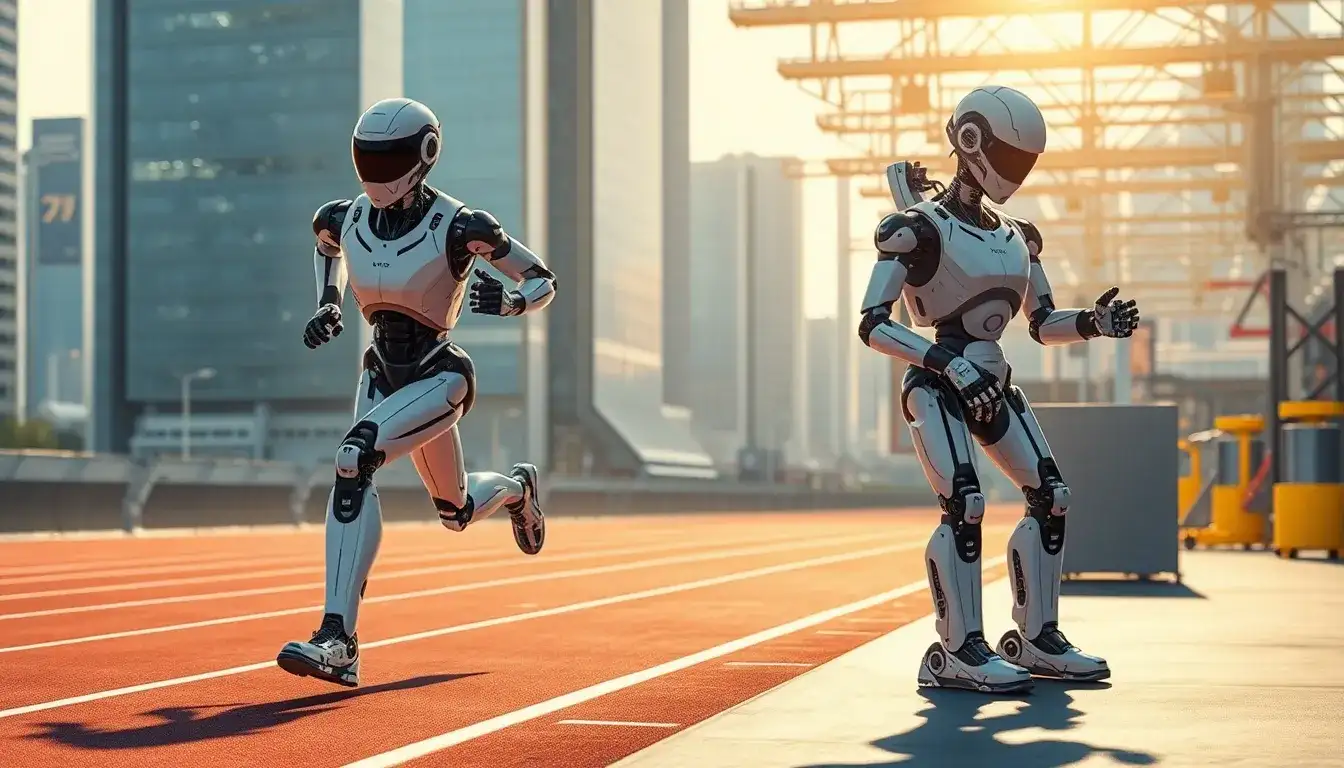
In April of last year, a humanoid robot raced alongside humans in its first marathon. By this April, robots had begun to outrun humans. However, this rapid advancement has sparked debates: What is the practical use of robots running so fast? When will robots be able to perform meaningful tasks? This time, robotics companies have provided a more pragmatic answer—before they can work, they need to intern.
Recently, Zhiyuan Robotics announced that its new A3 humanoid robot will be deployed through the “Qingtian Rent” platform to work in tourist attractions. At the same time, Ziwang Robotics has partnered with 58.com to offer home services, allowing robots to enter real households and collaborate with cleaning staff. The field of embodied intelligence is witnessing a surge of commercialization, and the narrative of the industry is subtly shifting. In the past two years, showcasing robots during the Spring Festival Gala or in competitions was the best way to demonstrate their capabilities. Now, however, the true test for robots lies in entering factories and homes to solve real-world problems.
1. The “Brain” Is Still Developing
Just a month ago, Ziwang Robotics collaborated with 58.com to launch the world’s first robotic cleaner, which works alongside human cleaners to provide household cleaning services. Many users have tried it out on social media, but the overall feedback remains that “robots are not as good as humans.” Some users noted that while the robot can handle complex chores like hanging clothes and organizing, it takes nearly 10 minutes to fold a single shirt. Additionally, the robot’s movement range is limited; it struggles with stairs and thresholds. Such shortcomings are not unique to one robotics company but are a common challenge across the industry.
Wang Qian, CEO of Ziwang, recently stated, “Today, there isn’t a single robot worldwide that can independently complete most daily chores without remote control.” Similarly, Wang Xingxing, founder of Yushutech, expressed that while robots achieve near-100% success rates in pre-set tasks, their effectiveness plummets significantly when faced with new or unforeseen scenarios. It will take another 3-5 years before robots can handle household tasks effectively. This represents the biggest bottleneck in the embodied intelligence industry—robots struggle to comprehend the physical logic of the real world. There is a vivid analogy in the industry: while robots have a well-developed “little brain” for motor control, their “big brain,” which encompasses cognitive and decision-making abilities, is still maturing.
The “little brain” refers to the robot’s ability to execute complex movements like martial arts or dance, while the “big brain” is the foundation for being able to perform tasks. Thus, enabling robots to possess a truly thinking “big brain” is a major goal for the entire robotics industry, which is currently pursuing three main technical pathways:
- VLA End-to-End: This is the current mainstream and most mature route, which combines visual and multimodal perception signals with language commands to directly generate robot actions. In simple terms, the robot follows commands; for example, when a user says, “I’m hungry,” the robot finds and hands over food, provided it has seen similar objects before. However, the downside is that as tasks become more complex, the robot can easily encounter “logical deadlocks” when faced with unfamiliar scenarios.
- World Model: This pathway is considered closest to human thought processes. Its core is to understand the laws of the physical world to predict what will happen next. For instance, if a cup falls off a table, a physical model can predict the cup’s falling direction based on its understanding of motion and gravity, allowing the robot to stabilize or avoid the cup. However, the world model also faces significant cost challenges, including data and training demands; NVIDIA’s Cosmos world model, for example, has been trained on 90 trillion tokens.
- Layered Brain Structure: This is a more domestically unique approach, where a large language model (LLM) acts as the “big brain” and the VLA/action model serves as the “little brain.” However, separating these two can lead to delays in task execution and difficulties in achieving precise operations. Moreover, more modules equate to higher costs. Yet, many domestic robotics companies have made significant progress in the “little brain” aspect, making this layered approach more pragmatic than starting from scratch to build a “big brain.”
2. Working While Learning
Overall, each technical route has its own strengths and weaknesses, making it difficult to determine a definitive path. While different robotics companies may focus on different mainstream technical routes, they are not confined to a single approach; deep integration is becoming the trend. For instance, integrating VLA end-to-end systems with world models is a potential direction. Shen Yongjian, Director of Ecosystem and Solutions at Zhiyuan’s Genie business unit, mentioned in an interview that world models and VLA need not be mutually exclusive and can potentially work together.
This year, Zhiyuan has launched the iterative version of the world model, GE-Sim 2.0, the next-generation VLA model, Genie Operator-2, and the second-generation integrated embodied big-little brain system, GenieReasoner. Zhiyuan is moving beyond traditional world models that merely model “states” to propose the direction of a world action model, treating “state-action-state evolution” as a unified modeling object without following a single route. Meanwhile, Ziwang has introduced a unified world model architecture for embodied intelligence, which integrates the big and little brains into a single model, effectively reducing information loss and delays between modules, thus enhancing the robot’s ability to generalize and interact in real physical environments. Its foundational model, WALL-B, emphasizes “learning by doing,” allowing the robot to self-iterate through repeated failures and attempts.
Additionally, Ziwang’s CTO, Wang Hao, pointed out that “the world model is not just a standalone module; it fundamentally represents an ability that cannot simply be accumulated. It’s not as simple as adding a world model after VLA to understand the world.” Zhiyuan has proposed a dual-system fusion plan, dividing the intelligent agent into a “fast system” (responsible for overall control) and a “slow system” (responsible for logical reasoning), enabling robots to respond quickly in complex dynamic environments while maintaining a deep understanding of long-term tasks.
It is evident that regardless of the technical route taken, the greatest challenges in developing a “big brain” for robots revolve around two main issues: understanding the world and ensuring that thought processes keep pace with physical responses. However, simply practicing more does not necessarily lead to greater strength. Wang Hao provided an example, stating, “A person who has spent ten years learning to swim in a pool might still drown if thrown into the ocean.” He believes that training data in laboratories is often too clean, and that robots, confined to their ivory towers, struggle to develop true independent thinking abilities. The best approach is to allow robots to learn in complex, unpredictable environments. Professor Xiao Yanghua from Fudan University’s School of Computer Science has stated, “Conservatively, the current data volume falls at least two orders of magnitude short of what is needed for training embodied intelligent large models.”
In pursuit of real data, robots are rushing into actual scenarios. Ubtech’s humanoid robots have already entered factories. Founder Zhou Jian stated that Ubtech spent two years transitioning from the new energy vehicle manufacturing scene to tasks such as handling, loading, material sorting, and quality inspection. Galaxy General’s Galbot robot has begun participating in pharmacy operations, autonomously recognizing orders and retrieving medicines, scanning, and packaging them. Meanwhile, Magic Atom’s humanoid robot has taken on the role of a “car salesman,” attracting customers and explaining vehicle specifications at car dealerships. Different robotics companies are targeting different real-world scenarios with a singular goal: to gather data in real environments, validate robot capabilities, and feed this information back into the evolution of embodied intelligence foundational models, gradually achieving object generalization, background generalization, and task generalization.
3. Scenarios Raise the Ceiling
Once it is understood that “training the brain” is inseparable from “real data,” it becomes clear why the valuation logic of embodied intelligence in the capital market has quietly shifted in the past year. According to incomplete statistics from Yicai, as of April 10, there have been at least 269 financing events in the domestic embodied intelligence sector. However, compared to previous years, the focus of capital has shifted significantly—capital is increasingly flowing towards data and model algorithms, while the valuation expectations for hardware have transitioned from technology narratives to business implementation. This year, several embodied intelligence companies emphasizing the “brain” have completed financing rounds amounting to billions: Ziwang announced it had completed nearly 2 billion yuan in Series B financing, while Itstone Zhihang secured $455 million in its Pre-A round, setting a record for single financing in China’s embodied sector. The latest financing round for the embodied data and simulation infrastructure company, Guanglun Intelligent, reached 1 billion yuan.
The industry has reached a stage where the forms of hardware have become largely refined. This year’s marathon champion was not a traditional robotics company, but a consumer electronics manufacturer, Honor, which also indicates that the technical barriers for hardware are lowering. The market is beginning to form a new consensus: the core variable determining whether robots can be practically applied is the “brain,” which relies on model capabilities and data assets. In the past, the capital logic focused on achieving market positioning through hardware sales. Today, however, market valuations emphasize which “brain” is smarter and has sufficient generalization capabilities. The hardware barriers for robots will gradually level out as the supply chain matures, but the “brain” is different—whoever’s model can succeed in more real-world scenarios and transfer skills and knowledge learned from specific contexts to new objects, tasks, or environments will be able to adapt quickly across a broader range of scenarios. The stronger the generalization ability of the embodied model, the higher the competitive barrier and potential ceiling.
Wang Qian, the founder of Ziwang, noted, “The family scenario demands the utmost in generalization; if a model can operate in a highly complex home environment, it can easily transition to traditional industrial settings.” This means that once model capabilities mature, they can be universally applied across multiple industries, forming a business model that is infinitely reusable. Moreover, several robotics companies have already prioritized commercial scenarios in product design, integrating product services with business contexts from the outset. For instance, Galaxy General has launched two wheeled robots that emphasize stability and load capacity, making them more suitable for repetitive tasks like handling, grabbing, and sorting. Meanwhile, Xiaopeng’s IRON has explicitly stated that it will prioritize deployment in museums, 4S stores, and shopping malls.
The question of “What can robots actually do?” is gradually finding answers through embodied intelligence. Companies like Yushutech have spent a decade achieving breakthroughs from 0 to 1, but to enable robots to possess true independent thinking capabilities and reduce reliance on repetitive commands from humans involves progressing from 1 to 10 and then to infinite thresholds. While limbs may allow robots to stand, survival ultimately relies on their brains.
Original article by NenPower, If reposted, please credit the source: https://nenpower.com/blog/the-future-of-robotics-from-marathon-runners-to-practical-workers/

