
During the EZVIZ “Smart Forward” Product Launch on April 21, 2026, a significant message emerged beyond the specifications of any hardware: the true essence of the smart home industry lies not in metrics, but in individual family members’ unique perspectives. The highlight of the event was the EZVIZ Pika, an AI portable camera, introduced by Chief Product Officer Chen Guanlan. Instead of focusing on technical details, Chen showcased a demonstration that revealed the core of the next generation of smart homes: a world where technology understands you in a personal way.
This perspective shift marks a significant evolution in EZVIZ’s brand mission. The change from “committed to enabling everyone to enjoy a secure smart life” to “co-creating a better life with secure smart technology” signifies a clear strategic direction. Chen emphasized, “Ten years ago, when the concept of smart homes was still unclear, we firmly believed that security is ‘1,’ and everything else—intelligence, convenience, entertainment—is ‘0.’ Without that ‘1,’ everything becomes zero.” This statement reflects a decade of product philosophy.
With security as a fundamental base, EZVIZ does not wish to be merely a “watchdog” for homes. The inclusion of “co-creation” indicates a shift from being an observer in family dynamics to engaging as a “lifestyle companion.” This idea is rooted in a profound understanding of the smart home industry’s value chain: security is the entry ticket, but no longer the destination.
To grasp the significance of the launch event, one must broaden the perspective to understand EZVIZ’s position within the industry. The company’s 2025 financial report revealed key data: an annual total revenue of 5.901 billion yuan, marking an 8.44% year-on-year increase; a net profit attributable to shareholders of 567 million yuan, representing a 12.43% increase. Notably, the smart home business achieved revenues of 936 million yuan, up 25.25%, while R&D expenses reached 862 million yuan, accounting for 14.61% of revenue, with over 1600 patents accumulated.
EZVIZ is also actively advancing critical technology development in areas like sensory perception, spatial understanding, and interactive intelligence, enhancing its smart hardware and cloud service capabilities. This paints a picture of a security company evolving into a broader, deeper market.
External market trends are also shifting rapidly. According to forecasts from organizations like China Business Industry Research Institute, the smart home market in China is expected to surpass 800 billion yuan in 2026, with shipment volumes exceeding 300 million units and penetration rates surpassing 35%.
In this context, EZVIZ’s strategic choices carry significant meaning. Instead of following the trend of expanding smart ecosystems from traditional appliance categories, EZVIZ is focused on horizontal scene expansion from a single capability—visual perception. Chen clarified the technological evolution path: the past decade was about “seeing, connecting, and storing securely,” while the next decade will enable devices to “not only perceive the physical world but also understand scenes and intentions to proactively provide appropriate services.”
Will this approach be successful? The answer lies in the products showcased at the launch.
The most noteworthy product was not a camera or robot, but rather the EZVIZ AI CoreX, a powerful model server stationed quietly in a corner of the stage. While many in the industry push for “AI in the cloud,” EZVIZ is taking a contrary approach by bringing processing power back home. AI CoreX is equipped with the Blue Ocean Large Model 2.0 and the Home Vita AI agent, focusing on being “memory-driven, understanding you better, and executing tasks.” This serves as an AI brain residing within the home, rather than a remote server.
EZVIZ’s rationale is clear: data privacy anxiety is the last barrier to the widespread adoption of smart homes. As cameras, locks, and robots continuously collect intimate audiovisual data, users’ sense of safety is at odds with the deep learning of smart devices. By keeping data local and returning intelligence to the home, AI CoreX addresses this contradiction.
However, localizing AI is not merely about disconnecting from the cloud. It answers a broader question: in the second half of smart home development, are terminal devices merely “extensions of cloud services” or “localized intelligence”? EZVIZ has chosen the latter, representing both a commercial judgment and a value stance.
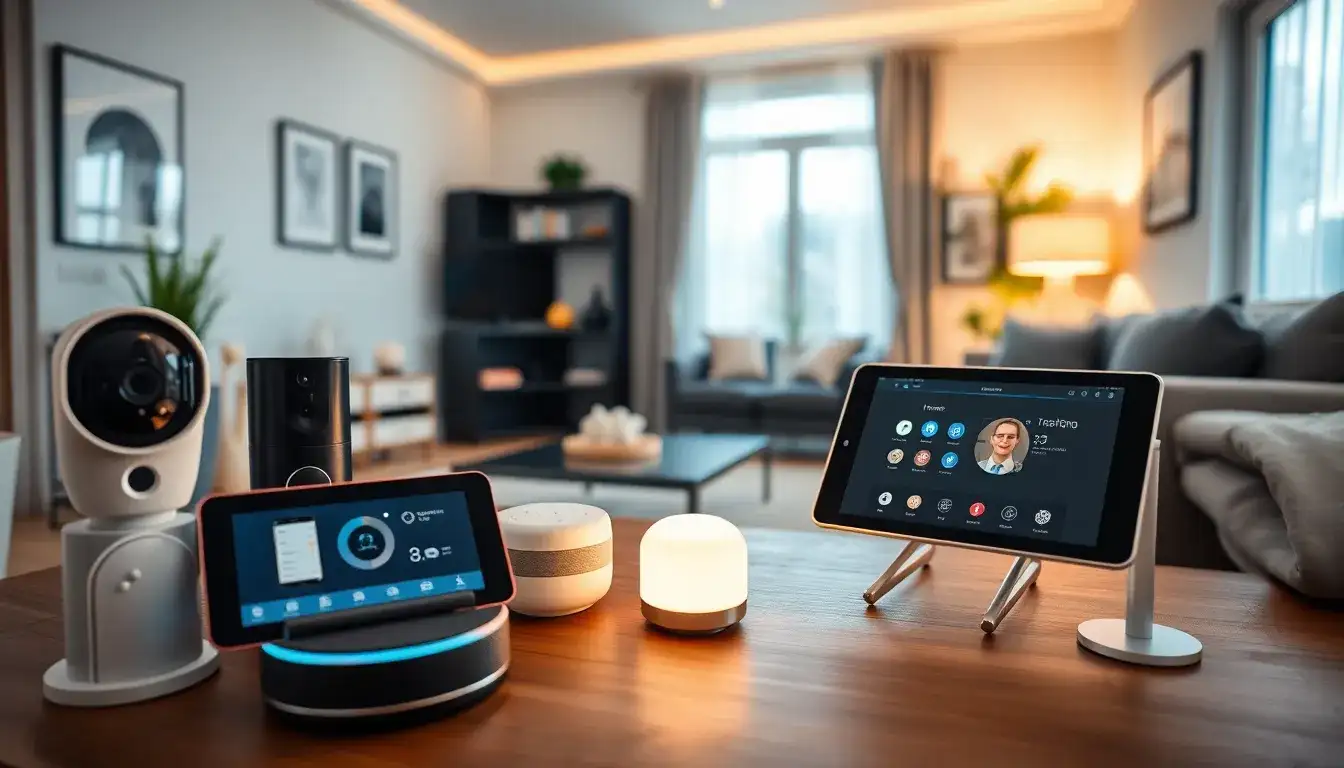
In 2024, EZVIZ launched the first embodied intelligent large model in the home industry, the Blue Ocean Large Model, which was upgraded to 2.0 in 2025. With the model anchored locally, the product logic undergoes a qualitative shift. For instance, EZVIZ is transforming smart cameras from mere monitoring tools into “understanding, thinking, and interactive” AI perception centers. The four AI cameras introduced at the event cater to various needs, such as child companionship and pet care, evolving from passive surveillance to interpreting family members’ needs.
The evolution of smart locks is equally notable. The new Y31 series features an OLED screen and an engaging AI agent, allowing children to interact with a cute character on the lock. Alisa, the product manager for EZVIZ smart locks, stated, “When we approach the lock, the screen lights up automatically, and upon successful recognition, the AI agent greets you.” Locks are no longer just cold mechanisms; they become the first interactive devices in the home.
This evolution, while seemingly warm and friendly, raises significant challenges. Many smart home devices can perform voice interactions, but determining the right timing, method, and audience for communication tests the depth of the entire perception system. With its visual AI foundation, cloud-coordination architecture, and a high R&D expense ratio of 14.61%, EZVIZ is well-positioned, while competitors may struggle.
Transitioning from “seeing” to “understanding” reflects EZVIZ’s ambition for a world model. If cameras represent EZVIZ’s past and smart locks its present, then the cleaning robot symbolizes its future. Though EZVIZ is a latecomer to the home cleaning robot market, its approach is systematic. The newly launched Stella Star 10 Series AI Steam Cleaning Robot incorporates EZVIZ’s proprietary “Star World Model” and multi-focal visual perception technology, enhancing the visual AI capabilities introduced in the previous series.
What is the “world model”? The head of EZVIZ’s cleaning robot division explained, “Previous algorithms relied on if-else logic, simply avoiding obstacles like sofas. In the EZVIZ Star World Model, it not only recognizes objects but understands scenes—knowing that there is a table in front of the sofa and what is on the table, all contributing to the living room context.” This comment highlights a cognitive leap from “passive response” to “active understanding.”
This technological choice clearly positions EZVIZ’s robots within a visual category, offering richer semantic information compared to lidar solutions. Semantic information is crucial for distinguishing between “understanding the home” and “navigating paths.”
However, it must be acknowledged that the cleaning robot market is highly competitive. While EZVIZ boasts deep visual AI technology, it still needs to refine its supply chain and channel capabilities over time. Currently, this segment is classified as a “nurturing business,” strategically supporting core technology iterations. It has the potential to become a third growth engine, contingent on EZVIZ’s ability to compete on product quality and cost control against established players.
In summary, the launch event was primarily about one overarching theme: transitioning from “safety protection to proactive intelligence.” This largely explains why EZVIZ collaborated with the China Academy of Information and Communications Technology to release the “Three-Dimensional Trust: AI Visual IoT Operational Security White Paper” at the event. In an era where user data privacy is increasingly sensitive, actively introducing third-party standards to build a trust system is not merely a performance but an instinct of long-term vision.
Throughout the event, EZVIZ emphasized “user control” in product design—AI serves to assist decision-making rather than replace it. This restraint stands in stark contrast to the prevailing “All in AI” commercial enthusiasm, but effectively addresses an often-overlooked fact: in the smart era, trust itself is a product.
From a broader industrial perspective, EZVIZ’s launch raised three thought-provoking propositions. First, the scale of AI implementation should prioritize “serving people rather than burdening them.” The Pika is defined as “a child’s first AI device” not due to its powerful processing capabilities, but because it integrates naturally into children’s lives—encouraging them to explore and document their surroundings instead of just presenting a screen.
Second, local intelligence is not a regression but a prudent long-term strategy. The decision to deploy AI CoreX locally means EZVIZ sacrifices the cloud’s data aggregation benefits, including the invaluable “data flywheel” in large model iteration, in exchange for genuine user data sovereignty. The company bets on a sustainable business model: the future of smart homes will not rely on monetizing user data, but rather on providing irreplaceable scene value.
Third, the significance of the term “world model” depends on whether a company possesses sufficient foundational visual AI capabilities. Since introducing the industry’s first consumer-facing “algorithm store” in 2021, EZVIZ has continuously enhanced its visual recognition capabilities, establishing a recognition system covering 1200 home objects. Without years of technological investment, “world model” would merely be a superficial marketing concept. This serves as a reminder that competition in the AI era ultimately hinges on who can transform “technical terminology” into “user perception,” a leap that requires not just algorithms but also the compounding effects of time.
In conclusion, the concept of smart homes has been debated for decades, evolving from automatic curtains to voice assistants, remote monitoring to comprehensive integration. Most innovations center around a core logic: how to make devices more obedient. Saying “turn on the light” and having the light illuminate is connectivity; having the light turn on before you rise signifies intelligence. But what lies beyond?
EZVIZ suggests a potential answer: when devices transcend mere obedience to comprehend your perspective—seeing what you see and feeling what you feel—the evolution from “connecting spaces” to “understanding individuals” within smart homes truly begins.
This vision may seem idealistic. The commercial landscape is rife with supply chain battles, channel conflicts, and pricing pressures. A company emerging from a security background must undergo a transformational journey to establish a warm brand identity, a task that cannot be accomplished in a single launch event.
Nevertheless, on the afternoon of April 21, 2026, a clear signal was sent from the venue in Hangzhou: the third cognitive leap in smart homes has commenced. The first was enabling devices to connect to the internet; the second allowed devices to engage in dialogue; the third is about devices understanding. Not merely following commands, but comprehending life itself.
Will EZVIZ be the one to reach the finish line? It is too soon to make a judgment. However, it is clear that the entire appliance industry must stop debating whether it’s “hardware + AI” or “AI + hardware.” The true determinant of success lies in who can make users feel that “this little machine understands me.”
Original article by NenPower, If reposted, please credit the source: https://nenpower.com/blog/the-evolution-of-smart-home-technology-insights-from-the-ezviz-product-launch/

