

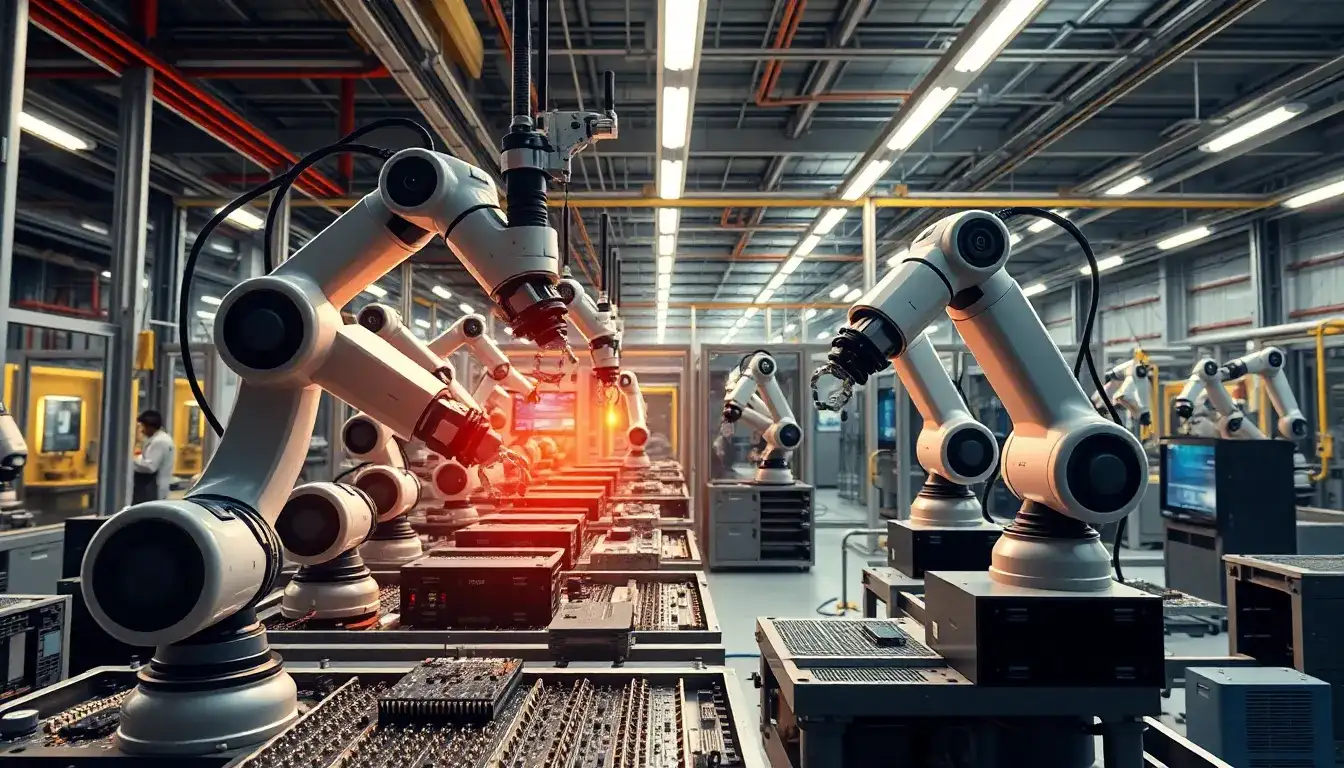
In response to the challenges facing the electronic manufacturing industry, Teradyne Robotics presented eleven collaborative automation scenarios during the “2026 Electronic Manufacturing Collaborative Automation Forum” held on April 23. The event featured two of its subsidiaries, Universal Robots (UR) and Mobile Industrial Robots (MiR), which outlined these applications while addressing ten critical questions that companies must clarify before implementing collaborative automation. This initiative aims to help businesses systematically evaluate their automation strategies, thereby reducing risks associated with implementation and decision-making.
Automation has become an essential capability in the electronics manufacturing sector. However, the real challenge lies in the continuously changing manufacturing environment. The trend towards small batch sizes, high diversity, and frequent line changes has rendered traditional fixed automation systems—originally designed for stable mass production—less flexible and harder to adjust. This has increased the complexity of both implementation and maintenance.
This challenge is not unique to the Taiwanese market. Globally, the electronics manufacturing industry faces heightened demands for quality consistency, faster production line adjustments, and increased difficulty in handling precision components. These factors have made highly customized and manually adjusted automation models increasingly inadequate in meeting real-time demands on the production floor.
According to Teradyne Robotics’ Taiwan Sales Director, Zhong Bingguang, “As changes on the manufacturing floor become the norm, automation should no longer be planned as a one-time project but should instead possess the capability for long-term operation and continuous adjustment. If companies aim to expand across different factories or even countries, their automation framework must be capable of stable replication across various production lines to ensure efficiency, quality, and operational consistency.”
The forum’s main focus was to transform collaborative automation from isolated applications into repeatable scenarios and logical frameworks for implementation. Through the “Eleven Collaborative Automation Applications for Electronic Manufacturing,” Teradyne Robotics helped businesses reassess suitable entry points for automation within their production lines, showcasing three of the most commonly used collaborative automation applications in Taiwan’s electronics manufacturing sector.
For practical applications, UR’s collaborative arms can be used for tasks such as screw fastening, component insertion, adhesive dispensing, ICT machine maintenance, and quality inspection. Meanwhile, MiR’s autonomous mobile robots can connect logistics before and after production lines, establishing a more flexible transfer mode between processes that can adjust in real-time according to the production flow. By integrating both technologies, companies can extend flexibility from individual workstations to entire production lines.
In addition to its collaborative automation framework, Universal Robots is also heavily investing in AI technology research and long-term development. Recently, they launched the UR AI Trainer, developed in collaboration with Scale AI. This tool utilizes imitation learning mechanisms to train collaborative robots on actual production-grade hardware while simultaneously collecting data on robot movements, force feedback, and vision, thereby accelerating the transition of AI models from the lab to the manufacturing floor. This foundation is crucial for the future development of AI applications in industrial settings.
The forum also demonstrated various collaborative automation applications in electronic manufacturing, which included scenarios such as mobile robots performing loading and unloading tasks, vision-guided precision placement of large PCB boards, and logistics handling within factories. These demonstrations showcased how collaborative robots and autonomous mobile robots can be integrated across different processes.
For further information, please visit Teradyne Robotics.
Original article by NenPower, If reposted, please credit the source: https://nenpower.com/blog/teradyne-robotics-unveils-11-collaborative-automation-scenarios-to-address-challenges-in-the-electronics-manufacturing-industry/

