

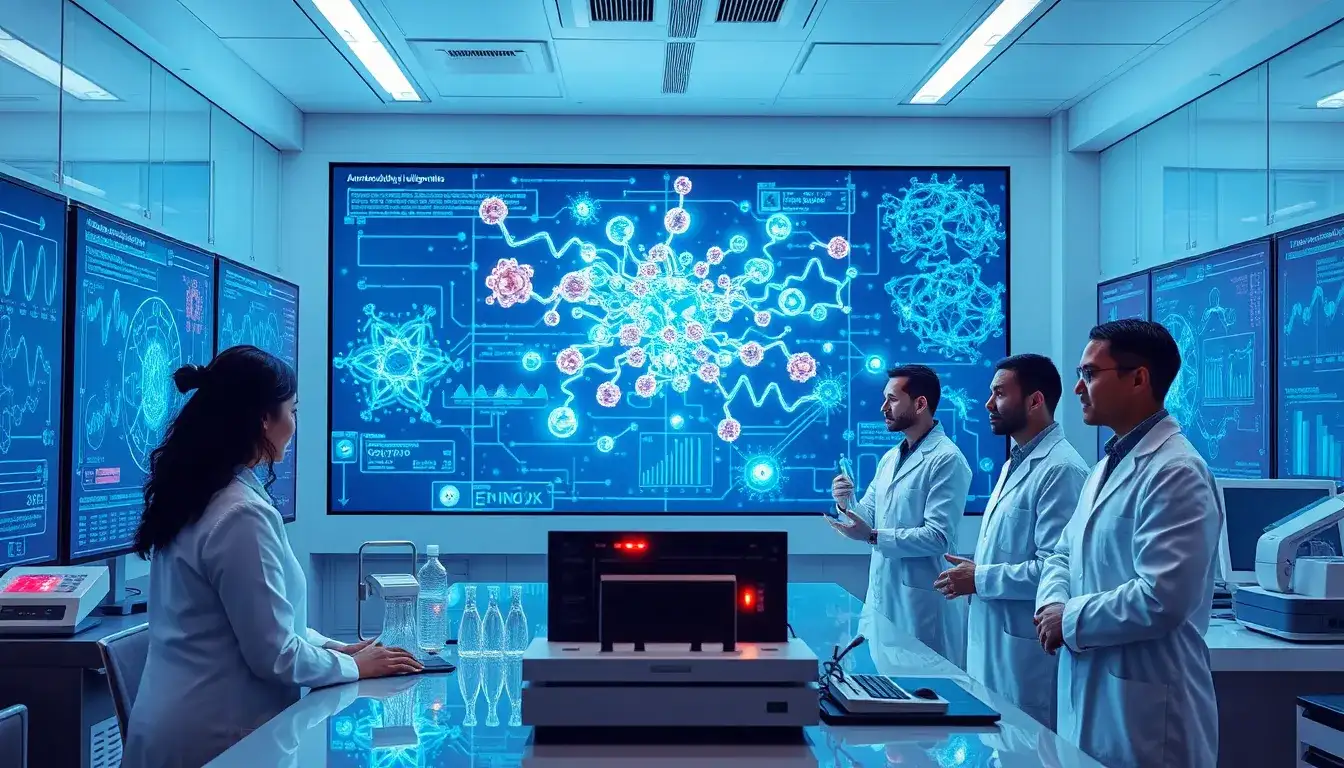
Wang Chengzhi, Founder and CEO of Zhiyuan Shenlan: Targeting the Era of AI for Science 3.0, Enabling AI to Independently Conduct Protein Directed Evolution
Date: May 8, 2026
As AI reshapes the foundational logic of scientific research and industry, AI for Science has evolved beyond a mere concept. On April 28, the Future Light Cone, in collaboration with Beijing Zhongguancun Academy’s AI Business School, launched the “AI for Science Innovators Forum: Academia × Industry Leaders Dialogue Series.” The inaugural event featured three frontline experts, including Wang Chengzhi, who shared insights on the team’s hardcore practices in developing an automated platform for continuous directed evolution of proteins and their reflections on the present and future of AI for Science (AI4S).
AI is rewriting the foundational logic of scientific research, transitioning from being a mere “assistance tool” for data analysis to becoming an “intelligent research entity” capable of independently designing, executing, and iterating experiments. The 3.0 era of AI for Science has moved from concept to reality.
Three Phases of AI4S: From “Microscope Plugin” to “Autonomous Research Entity”
Wang Chengzhi categorizes the evolution of AI4S into three phases:
- Phase 1.0: Assistance Tool – AI serves as an “enhanced microscope plugin,” primarily focused on post-processing experimental data and wet lab analysis, assisting in review but not in design.
- Phase 2.0: Navigation Design Engine – With the advent of generative AI, AI transitions from being a “rearview mirror” to a “navigation device.” Experimental results can feedback into models, updating parameters and forming a closed loop, which is the current mainstream phase in the industry.
- Phase 3.0: Autonomous Research – AI autonomously completes the entire loop of “designing experiments → executing experiments → analyzing results → iterating optimization.” Humans only need to set the direction and pose questions; the rest is handled by AI.
From its inception, Zhiyuan Shenlan has aimed for the true 3.0 goal of unleashing productivity.
Practical Application: Creating a Fully Automated Workflow for Protein Evolution
To achieve AI4S 3.0, the team chose to focus on proteins, aiming to make continuous directed evolution a fully autonomous workflow without human intervention. The automated platform developed by Wang Chengzhi’s team is essentially a “physical world AI entity” rather than just a digital chatbot. After each round of experimental data is produced, the system automatically analyzes results and designs the next series of experiments. It converts experimental designs into executable commands for robots, driving equipment to complete the tasks autonomously for an entire month without human involvement. The design includes anti-contamination measures (such as HEPA filters and UV sterilization), ensuring no cross-contamination throughout the process. The system can dynamically adjust experimental strategies and automatically address equipment malfunctions and growth anomalies.
This platform has been described as “stunning” by Nature Chemical Engineering, being featured on its cover and accompanied by a special commentary, defining it as “the world’s first industrial-grade, programmable, automated continuous directed evolution platform for proteins.”
Case Study 1: Screening Precise Transport Protein Variants Using “Biological Logic Gates”
The multidrug-resistant efflux pump LmrA presents a challenge, as it transports both target and non-target substances indiscriminately. To isolate variants that only transport the target, a two-dimensional screening approach is required: A=1 (transports target) and B=0 (does not transport non-target). The team designed a NIMPLY biological logic gate genetic circuit and, using the automated platform, successfully evolved an LmrA variant that meets the criteria after a month of continuous operation—overcoming what initially seemed an insurmountable challenge.
Case Study 2: Developing a Key Enzyme for mRNA Vaccine with Fivefold Activity
The production of mRNA vaccines faces a significant challenge due to high costs and substantial losses, stemming from the two-step process: first, T7 RNA polymerase transcribes RNA, and then another capping enzyme adds a 5′ cap, necessitating purification in between, leading to considerable losses. The client’s request was to fuse the two enzymes into a single new enzyme with dual activity. While feasible in theory, simple fusion would negate both enzymes’ activities, requiring a complete evolutionary restart. The team entrusted this challenge to the automated platform, which succeeded remarkably: operating continuously for over a month without contamination, autonomously recording, analyzing, and iterating experiments with minimal human involvement. Ultimately, they evolved the CapT7 fusion enzyme, which not only retained dual activity but also exhibited five times the transcriptional activity of the original T7 enzyme.
Although AI4S is not yet at the stage where “clients can just click a mouse to conduct experiments in the cloud,” as it requires numerous engineers to manage complex automation facilities, AI4S companies blend “engineering and science.” However, as the throughput of automated experiments increases, the entire system will grow more complex. Our long-term goal is to transform the research process into a tradeable token—scientists design new molecules and receive test results immediately.
Challenges Ahead for Achieving AI4S 3.0
While our ultimate goal is to realize an “autonomous research” system with self-iterating capabilities, numerous challenges remain. Some typical issues include:
- Why are AI models’ hallucinations in the scientific domain more subtle and dangerous than in general models? In general fields, common sense often reveals discrepancies, but in science, AI’s outputs not only appear correct but also professional, typically carrying convincing confidence metrics. The most perilous aspect is that scientific AI hallucinations often lie in the “reasonable yet incorrect” sweet spot—subtle errors that, if taken as starting points by downstream researchers, can contaminate the entire research chain and lead to cascading errors.
- Why does AI prediction happen rapidly while experimental validation often takes much longer? AI’s output grows exponentially, while experimental capacity remains linear or constant. For instance, AlphaFold can predict protein structures in minutes, but experimental validation can take months or even years. This creates a fundamental conflict between generative AI and current experimental paradigms.
- Why do most open-source scientific codes remain unreadable and unexecutable? Academic open-source codes often overlook engineering concerns, such as environment dependencies, lack of testing, documentation, and issues with exception handling, logging, and modularity. This contrasts sharply with the industrial requirement for stable reproducibility.
These three questions fundamentally point to a single proposition: In the scientific domain, AI is not accelerating discoveries but rather the production of “guesses.” Its speed in generating hypotheses far exceeds human capacity for validating them. When the backlog of guesses accumulates to a level that experimental validation can’t keep pace with, the bottleneck shifts from imagination to the bandwidth of physical execution. Only when the bandwidth of physical execution aligns with AI’s generative capabilities can AI4S 3.0 truly arrive.
What Should We Be Cautious About as AI Conducts Research Autonomously?
The emergence of AI conducting research autonomously brings with it three significant considerations:
- Theoretical Inflation as a New Bottleneck: AI, with its powerful computation and learning abilities, can generate countless new scientific theories and hypotheses. However, regardless of how advanced the theory is, it ultimately requires physical experiments for validation. The gap between theory and experiment could lead to a phenomenon known as “theoretical inflation,” resulting in a misalignment of research efficiency and potentially creating a dilemma of choice within the scientific community.
- Commercialization of Research Labor: When AI can complete the entire research chain, research may shift from being an “elite intellectual activity” to a “quantifiable, tradable commodity”—similar to cloud computing, becoming a purchasable service. Ordinary individuals might conduct research at low costs, leading to a transformation where research becomes accessible to a broader audience, not just scientists. This shift could fundamentally diminish traditional academic career paths, necessitating a reassessment of research personnel roles.
- Inequality in Research Acceleration: AI’s autonomous research heavily relies on computational power, data, and autonomous laboratories. Institutions or countries with these resources will dominate scientific competition, potentially marginalizing smaller nations and independent researchers, leading to a “discovery monopoly.” The future of scientific discovery may depend less on intelligence and more on who possesses the greatest computational power, the most autonomous laboratories, and the most comprehensive data flows.
As AI has already demonstrated the capability to autonomously navigate games, attempting and failing independently, it raises the question: will AI also discover scientific truths in ways that humans cannot fully comprehend? The era of AI for Science 3.0 is on the horizon, and as machines autonomously engage in research, the boundaries of science will continue to expand.
About the Author: Wang Chengzhi is the Founder and CEO of Zhiyuan Shenlan. Previously the Chief Scientist at Meijia Technology, he established Zhiyuan Shenlan in 2024, focusing on data-driven biomolecular design and manufacturing. The company has developed the world’s first industrial-grade, programmable automated continuous directed evolution platform for proteins, achieving a full AI autonomous loop in the research process. Their work has been featured on the cover of Nature Chemical Engineering, advancing AI for Science from a 2.0 “navigation design engine” to a 3.0 “scientific intelligent autonomous platform.”
To learn more about AI for Science startup projects or to share insights, please reach out via WeChat to communicate privately.
Original article by NenPower, If reposted, please credit the source: https://nenpower.com/blog/revolutionizing-protein-evolution-insights-from-wang-chengzhi-on-ai-for-science-3-0/

