

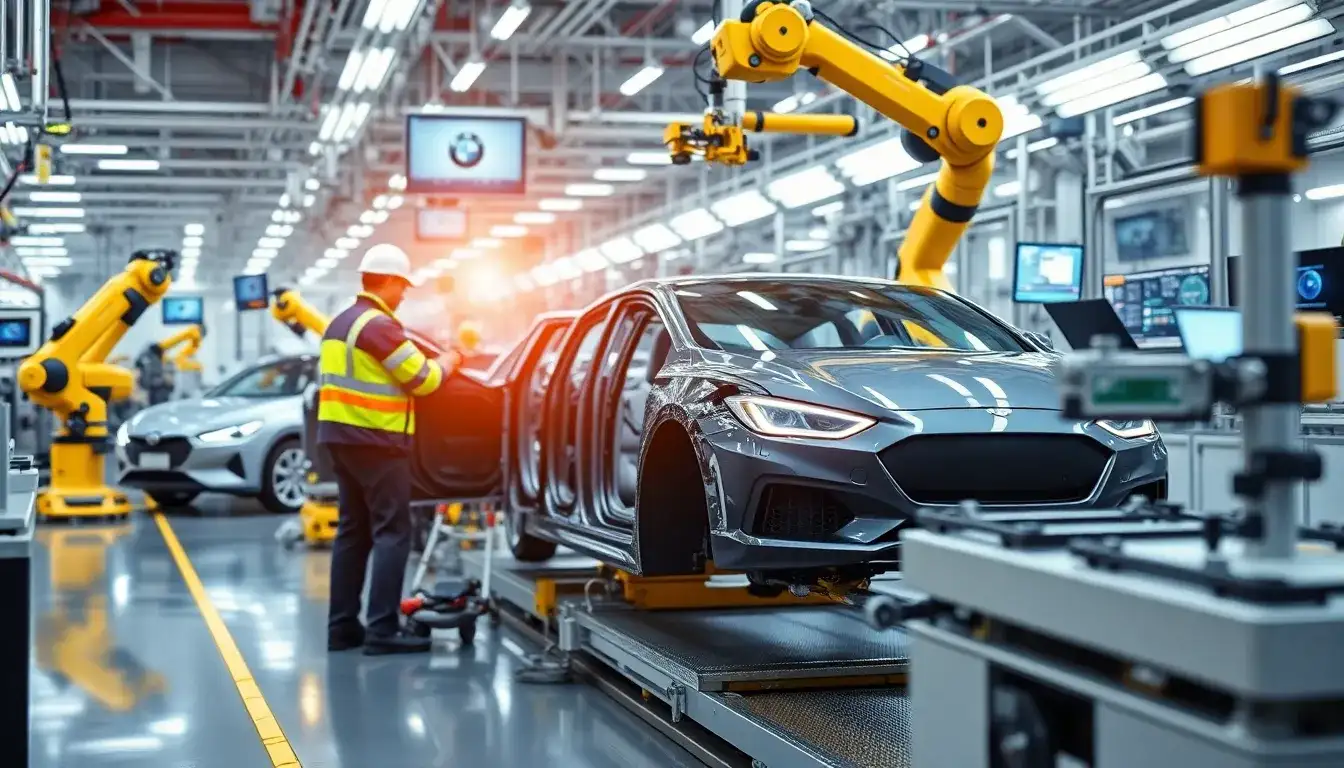
As Industry 4.0 continues to deeply permeate various sectors, the automotive industry has moved away from the traditional “manpower-intensive” approach. Instead, automated assembly lines have become a core competitive advantage for automotive companies. The rise of electric vehicles has accelerated model iterations and increased precision requirements for components. Traditional manual assembly struggles to meet mass production demands and poses greater quality risks. In contrast, automated assembly lines leverage robots, sensors, and intelligent control systems to effectively address the three main issues of low efficiency, high error rates, and escalating costs.
Many automotive manufacturers are faced with the dilemma of whether the high investment in automated assembly lines is justified. Do the benefits vary across different scenarios? Today, we will explore three typical application cases—encompassing both traditional fuel vehicles and core processes of electric vehicles—along with real feedback from automotive companies. This analysis aims to clarify the actual value of automated assembly lines, providing insights for those involved in procurement and production management, as well as for anyone interested in industry trends.
Understanding the Core Pain Points Addressed by Automotive Automated Assembly Lines
Before diving into the cases, it is essential to clarify that an automotive automated assembly line is not a “single machine.” It is an integrated production system that includes three critical stages: body welding, component assembly, and inspection. This system is adaptable to all scenarios, from traditional fuel vehicles to electric vehicles. Compared to manual assembly, its core advantages lie in stability, speed, and precision, effectively targeting three major pain points faced by automotive companies:
- Addressing Insufficient Precision: Manual assembly is influenced by fatigue and operational habits, leading to errors often exceeding 0.5mm. Automated equipment, using visual positioning and servo control, achieves precision levels of 0.01mm, thereby eliminating batch quality issues.
- Overcoming Efficiency Bottlenecks: Manual assembly lines have limited daily output. Automated lines can operate continuously 24/7, with production cycles reduced by up to 50%, easily accommodating high-volume production.
- Reducing High Costs: Rising labor costs and difficulties in retaining skilled workers can be mitigated as automated lines can replace 60%-80% of manual labor, significantly lowering long-term labor investment and minimizing losses from defective products.
Three Typical Application Cases: Effective Results Across Various Domains
The following cases are drawn from leading domestic and international automotive companies (specific brands omitted to retain anonymity), covering core processes for traditional fuel vehicles and critical stages for electric vehicles. Despite differing needs, all cases achieved the goals of cost reduction, efficiency enhancement, and quality improvement, providing valuable insights.
Case 1: International Luxury Brand – Automated Body Welding Line (Traditional Fuel Vehicles + Mixed Production)
This international luxury brand previously utilized a “manual + semi-automated” welding model, facing significant pain points: unstable welding precision, with return rates as high as 8%; high switching costs due to rapid model iterations; and increasing skilled labor costs of over 300,000 yuan per month for a single welding line.
To address these issues, the brand introduced a fully automated body welding line, featuring 28 industrial robots, a visual positioning system, and online testing equipment. This setup automated the entire process from part handling to welding and inspection, with a strong emphasis on optimizing the “mixed-model production” functionality. The robots can identify models in real-time and adjust welding paths and parameters automatically, eliminating the need for manual intervention during model switching.
Data from six months of operation revealed a welding precision increase from 98.2% to 99.9%, with the rework rate dropping to below 0.3%. Production cycles improved from 35 units per hour to 45, a 30% efficiency increase, resulting in an average daily output increase of over 200 units. Labor reduced from 22 to 13 workers, cutting monthly labor costs by 120,000 yuan, with an expected payback period of 18 months for the new equipment.
Feedback from the production director highlighted, “The most significant change is the drastic improvement in welding quality consistency, leading to a 70% decrease in customer complaints. The mixed-model production capability is incredibly convenient, eliminating the need for separate production lines for different models, enhancing flexibility, and exceeding expectations in labor cost reductions. We plan to expand the automation scope in future factories.”
Case 2: Leading Domestic New Energy Vehicle Company – Battery Pack Assembly Automation Line (Core Scenario for New Energy Vehicles)
The battery pack is central to electric vehicles, and its assembly accuracy and safety directly influence vehicle range and safety. Previously, this company employed manual tightening and inspection methods, resulting in two major issues: a high torque error rate (up to 5%), risking bolt loosening, and a leak detection rate of about 3%, leading to defective battery packs entering the market and risking customer complaints and recalls.
To address these challenges, the company introduced an automated battery pack assembly line, featuring automated tightening equipment, torque detection systems, and sealing detection devices. This setup fully automated the assembly of the battery pack shell, bolt tightening, sealing checks, and cell installation. The tightening equipment uses servo control to monitor torque data in real-time and halt operations if errors are detected, preventing defective products from proceeding to subsequent processes.
Data collected after eight months of operation showed that the torque error rate was controlled within ±1%, fully complying with safety standards for electric vehicles and eliminating the risk of bolt loosening. Leak detection rates approached zero, with battery pack pass rates improving from 97.1% to 99.9%, and no further complaints or recalls due to assembly issues. Battery assembly efficiency increased by 40%, with daily average output rising from 120 to 168 units, meeting the mass production needs for electric vehicles.
Feedback from the production manager stated, “The requirements for battery packs in electric vehicles are more demanding than expected, and the risks associated with manual operations are significant. The automated assembly line not only resolved precision and detection issues but also enabled full traceability of torque data, allowing for quick troubleshooting of any future issues. The annual failure rate has decreased by 60%, and operational costs have reduced significantly, making it a truly ‘worry-free and reliable’ solution.”
Case 3: Domestic Independent Brand – Upgraded Automated Final Assembly Line (Adaptable to All Models)
This independent brand encompasses both fuel and electric vehicles. Previously, its final assembly line was primarily manual, with core pain points including insufficient flexibility and low efficiency: significant differences in assembly processes for different vehicle types led to prolonged manual switching times, affecting production speed. Additionally, manual assembly of components (such as seats, dashboards, and doors) often resulted in poor fit and uneven gaps, impacting vehicle aesthetics and user experience. Labor costs were also high, exceeding 400,000 yuan per month for a single assembly line.
The company upgraded its final assembly line to automation by introducing 15 collaborative robots, intelligent conveyor systems, and visual guidance systems, significantly enhancing “flexible assembly” capabilities. This setup accommodates the final assembly needs of six different vehicle models, with robots automatically handling corresponding components based on the model, performing fitting, installation, and securing actions, while human workers focus on material replenishment, equipment monitoring, and handling exceptions.
Data collected after five months of operation indicated a 35% increase in assembly efficiency, with daily average output rising from 180 to 243 units. Model switching time was reduced from two hours to 30 minutes, and assembly pass rates improved from 96.8% to 99.8%, effectively eliminating issues such as uneven gaps and poor fit of components. Labor was reduced from 35 to 14 workers, lowering monthly labor costs by 250,000 yuan and significantly reducing the risk of work-related injuries.
The workshop director remarked, “The most significant improvement post-upgrade is the reduction in workforce, stress, and increased efficiency. Previously, the workshop was crowded with workers, making management challenging and often leading to rework. Now, automated equipment handles most repetitive tasks, allowing workers to focus on auxiliary duties. This not only boosts efficiency but also stabilizes product quality. Moreover, with the flexibility upgrade, we can respond faster to market changes and model iterations without worrying about production capacity.”
Summary of Customer Feedback: Addressing the Top Three Concerns of Automotive Companies
Based on the three cases above and feedback from over ten automotive companies, we have summarized the three most recognized advantages of introducing automated assembly lines, while also addressing the common concern regarding investment returns:
- Core Advantages: The three most acknowledged benefits by automotive companies are:
- Significant improvement in quality rates: Average improvements exceed 25%, with some core processes (such as battery assembly and body welding) achieving pass rates of up to 99.9%, dramatically reducing rework losses and recall risks, indirectly lowering costs.
- Flexible production to adapt to market demands: Capable of multi-model mixed production, allowing for flexible model switching to quickly respond to market changes without needing to set up separate production lines, thereby reducing initial investments.
- Long-term cost control: While initial equipment investments are high, they can replace 60%-80% of human labor, resulting in substantial reductions in labor and rework costs. Most automotive companies report that the equipment investment can be recouped within 18-24 months, offering excellent long-term cost-effectiveness.
- Common Concerns: High investment and operational difficulties? Real feedback alleviates concerns:
- Return on investment: Although the initial investment in automated lines is higher than manual labor, companies report that considering efficiency gains and cost reductions, they can recover their investments within 18-24 months, with equipment lifespans lasting 8-10 years, leading to significant long-term savings.
- Operational complexity: The maintenance of automated lines is not overly complex. Equipment manufacturers typically provide regular maintenance and technical support, requiring companies to assign only 2-3 maintenance personnel to ensure proper operation, with maintenance costs significantly lower than labor costs.
Conclusion: Automotive Automated Assembly Lines Are Not a Choice but a Necessity
From traditional fuel vehicles to electric vehicles, and transitioning from single-model production to mixed-model production, competition in the automotive manufacturing industry is becoming increasingly fierce. Efficiency, quality, and cost have become the core competitive advantages for automotive companies. Automated assembly lines are the key equipment that helps companies achieve these three objectives.
The cases and customer feedback demonstrate that whether for international brands or domestic companies, and regardless of whether the focus is on traditional fuel vehicles or electric vehicles, automated assembly lines provide immense value. They not only enhance production efficiency and ensure product quality but also lower long-term costs, aiding companies in adapting to market changes and achieving transformative upgrades.
For those automotive companies still hesitating, it is better to focus on the specific production needs and select the appropriate automation solution rather than getting stuck on initial investments. If you are advancing the mass production of automotive component assembly and testing equipment, we welcome further discussions. We are committed to leveraging technological innovation to evaluate product feasibility and assist enterprises in providing high-precision, high-consistency automated assembly solutions to break through manufacturing bottlenecks and seize key opportunities for the next wave of technological upgrades.
Original article by NenPower, If reposted, please credit the source: https://nenpower.com/blog/real-world-insights-on-automotive-automated-assembly-lines-3-case-studies-and-essential-feedback-for-industry-transformation/

