

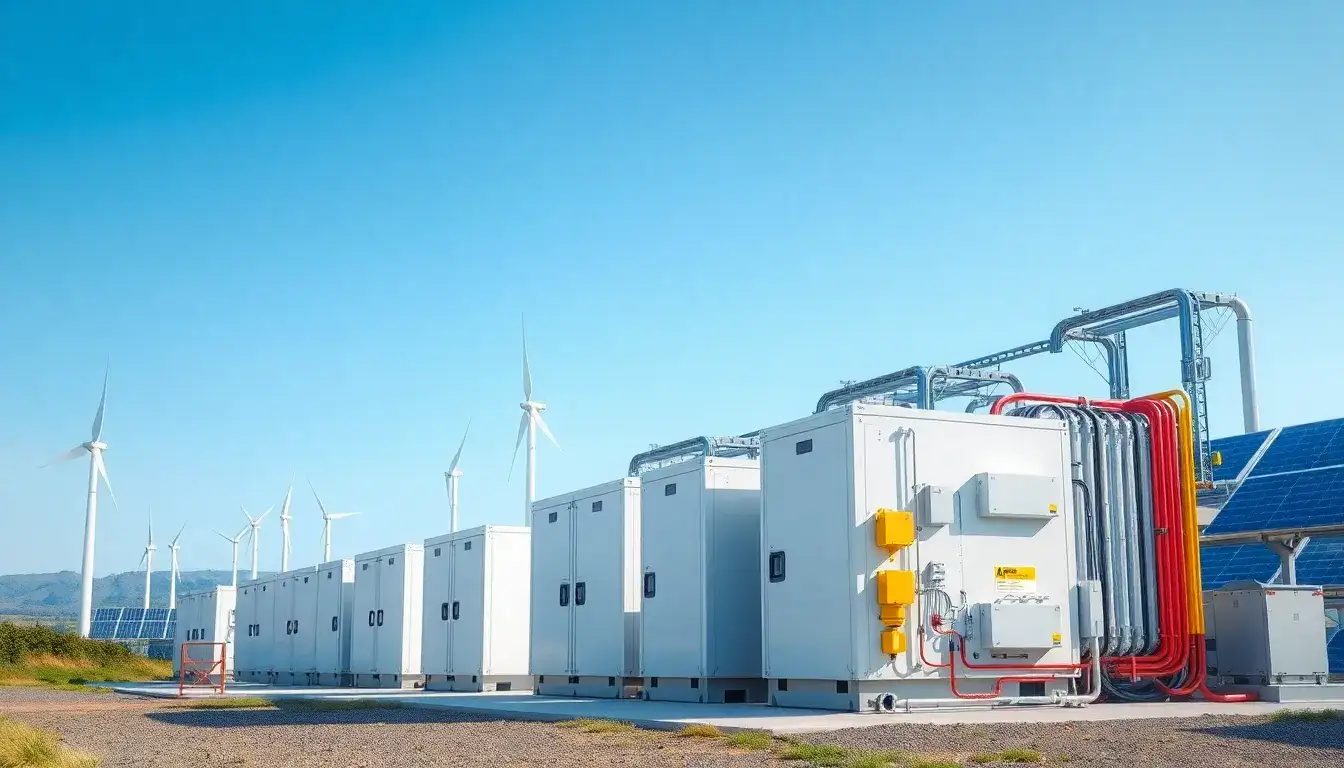
A large lithium-sodium hybrid energy storage station capable of storing 800,000 kilowatt-hours of electricity daily has been launched. On May 25, the Baoci energy storage station, part of the national pilot demonstration project for new energy storage, began operations in Qiubei County, Wenshan Zhuang and Miao Autonomous Prefecture, Yunnan Province. This facility is designed to store an impressive daily output of 800,000 kilowatt-hours (kWh) of electricity.
From an aerial view, the energy storage station features over 150 battery and power conversion units arranged in an orderly fashion, all with similar external appearances. However, upon entering the station, one can observe that the sizes of the battery units and power conversion units vary significantly across different areas. After walking approximately 200 meters from the entrance, visitors reach the sodium-ion battery storage zone, where a continuous humming sound can be heard from the battery units.
The Baoci energy storage station occupies around 50 acres and boasts a maximum instantaneous output capacity of 200 megawatts (MW) with a total storage capacity of 400 megawatt-hours (MWh). Based on a daily operation cycle of charging and discharging twice, the station can store 800,000 kWh of electricity each day and regulate up to 1.6 million kWh daily, equating to an annual adjustment capacity of 584 million kWh. This amount is sufficient to meet the electricity needs of approximately 270,000 households for a year.
Yunnan Province is recognized as a typical region in China with a high proportion of new energy sources, having installed over 60 million kilowatts of renewable energy capacity, with a penetration rate close to 70% in the power system. Luo Yao, a staff member at the dispatch control center of the Yunnan Electric Grid Company under the Southern Power Grid, noted that a high proportion of new energy leads to increased volatility within the grid, necessitating robust energy storage support.
According to Wang Hui, the station manager of the Baoci energy storage station, this facility utilizes a large lithium-sodium hybrid energy storage system featuring a networked sodium battery technology, incorporating China’s latest high-capacity sodium-ion batteries, which have a response speed six times faster than current sodium-ion batteries. This advanced sodium battery technology, combined with mature lithium battery systems and a 200 MW output capacity, enables the station to provide services for over 30 wind and solar power plants in Yunnan. It supports the stable integration of substantial new energy sources into the grid and facilitates participation in electricity market trading, promoting efficient utilization of renewable energy.
Wan Minhui, a researcher at the Southern Power Grid Energy Storage Company, stated that the Baoci energy storage station integrates the storage advantages of both lithium and sodium batteries in one location, further expanding the application scenarios for sodium-ion battery storage in China and accelerating the development of the new energy storage industry chain. Additionally, the use of networked energy storage technology allows for flexible adjustment of charging and discharging modes based on the integration of new energy, thereby balancing the volatility of these sources. This technology can further be applied in regions with a high proportion of new energy, such as Tibet, Xinjiang, Gansu, and Ningxia, facilitating the stable delivery of electricity from renewable energy bases in desert, gobi, and barren areas.
Original article by NenPower, If reposted, please credit the source: https://nenpower.com/blog/new-lithium-sodium-hybrid-energy-storage-station-launched-capable-of-storing-800000-kwh-daily/

