

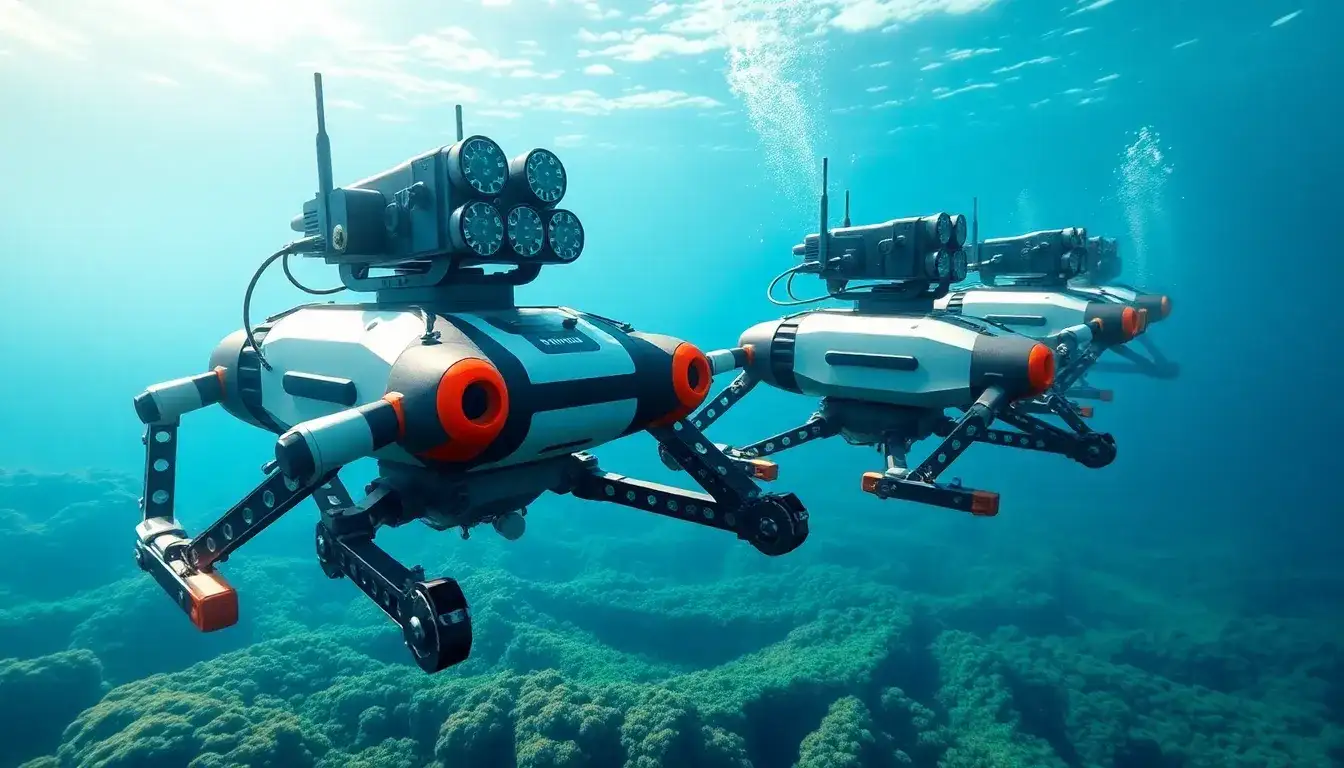
Marine robotics has seen significant advancements, with financing reaching hundreds of millions and annual sales of sensors exceeding 100,000 units. The commercialization of embodied intelligence is becoming a reality.
From May 8 to May 10, the 28th China Beijing International Science and Technology Industry Expo showcased cutting-edge intelligent equipment, including the Embodied Tian Gong 3.0, Yushu Technology’s humanoid robot, and the “Orca” marine robot. Many of the exhibited robots have already achieved large-scale commercial applications across various fields.
At the event, a performance robot developed by Zhuoshitech captivated audiences with its dance. Staff from the Zhuoshitech booth explained that this robot is equipped with diverse interactive functions, including dancing, explaining, and guiding. Leveraging the company’s self-developed “Xuanyue Yuheng” industry model, which boasts over a hundred billion parameters, Zhuoshitech has established a comprehensive technology system that integrates model, data, and intelligence platforms.
Another industrial robot showcased demonstrated high precision and flexible collaboration capabilities, making it suitable for smart manufacturing production lines. A total of 37 enterprises from Fengtai District presented 88 innovative achievements at the expo. These ranged from unmanned black-box workstations to brain-machine interface devices that assist spinal injury patients in regaining mobility. Notably, the “Orca” underwater robot can clean barnacles from ship hulls and inspect underwater pipelines, while care robots aim to support the elderly in their daily lives, illustrating the tangible transformation of advanced technology into accessible solutions.
In deep-sea environments, robots also play a crucial role. A product resembling a killer whale, named “Orca,” developed by Shihang Intelligent, garnered attention for its underwater inspection and cleaning capabilities. It is also designed for maintaining and inspecting marine photovoltaic systems, wind power installations, underwater cables, and pipelines, as well as conducting scientific research in deep-sea areas. A representative from Shihang Intelligent mentioned that this self-developed marine general-purpose robot is a global first, boasting a lifespan of up to 10,000 hours and the ability to perform 720° of free movement. Compared to traditional divers, the cleaning efficiency of this robot is enhanced by several multiples.
Recently, Shihang completed two rounds of financing, raising hundreds of millions. New investors include the National SME Development Fund managed by Huaying Capital, along with industrial investors such as Dashu Changqing Capital, Xinding Capital, and 36Kr Fund. Existing shareholders, including Jinsha River Venture Capital, Changshi Capital, Shengjing Jiacheng, Xiangfeng Investment, and Anyu Capital, also increased their investments.
According to the representative, the funds raised will be primarily allocated to core technology research and development, iterative technology for marine embodied products, global market expansion, and the ecological layout of the industrial chain.
2026 is widely anticipated to be the year of large-scale applications for embodied intelligence. At this year’s expo, the Blue Dot Touch Control showcased a comprehensive product matrix aimed at various robotic scenarios, covering everything from general high-precision force control sensors to specialized humanoid adaptations.
Staff from the Blue Dot Touch Control booth informed that in this critical sector, the company has experienced a doubling of sales revenue for three consecutive years. By 2025, the company is expected to account for over 80% of the domestic market share for six-dimensional force sensors in humanoid robots, with a joint torque sensor market share surpassing 95%. Their client base includes leading companies across the industry, such as Zhiyuan Robotics, Xiaomi Robotics, Galaxy General, UBTech, Zhongqing, and Beijing Humanoid.
The joint torque sensor provides dynamic force feedback for all joints of the robot, serving as a crucial component for ensuring dynamic balance and compliant control. The staff also revealed that the company’s shipment volume for 2025 has already exceeded 100,000 units. Additionally, tensile and pressure sensors are being developed to enhance linear force measurement solutions, complementing the six-dimensional force series products.
Original article by NenPower, If reposted, please credit the source: https://nenpower.com/blog/marine-robotics-secures-hundreds-of-millions-in-funding-as-sensor-sales-reach-100000-units-annually-advancing-embodied-intelligence-commercialization/

