

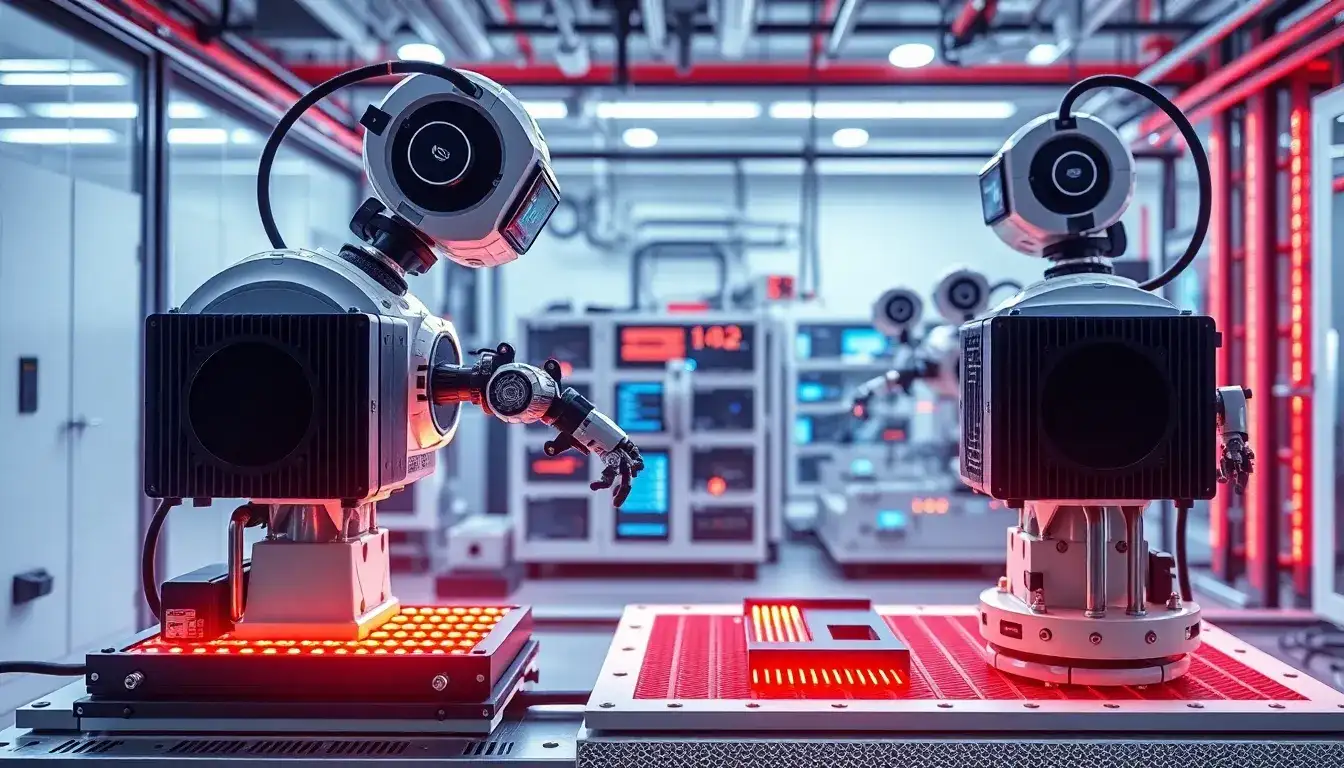
Do robots need to be protected from overheating? Recently, at the 2026 Robotics Industry Link Conference (FAIR plus 2026), Oriental Electric Heating (stock code: 300217.SZ) showcased a new generation of high-power liquid cooling joint modules developed by its startup subsidiary, Wenqing Intelligent Control (Shanghai) Robot Co., Ltd. This innovation aims to address overheating issues in embodied intelligent robots during movement and operation.
Founded in 1992, Oriental Electric Heating initially focused on household heat management solutions, such as electric heaters for air conditioning, and has since expanded its business to include industrial heat management, new materials, and thermal management for new energy vehicles. In 2025, with the rapid development of embodied intelligent robots, the company established Wenqing Intelligent Control to apply its accumulated thermal management technologies to this emerging field.
Notably, during the Humanoid Robot Half Marathon held in Beijing on April 19, several participating humanoid robots utilized the liquid cooling heat dissipation modules developed by Wenqing Intelligent Control. The head of Wenqing Intelligent Control highlighted that intelligent robots generate heat from various sources distributed throughout their bodies. For instance, a humanoid robot contains dozens of heat sources, including motors, chips, and batteries. In confined spaces where multiple heat sources interact, heat can easily accumulate, leading to localized overheating, malfunctions, or damage. Thus, efficient and reliable thermal management technology is crucial for ensuring robot performance, safety, and continuous operation.
The new generation of high-power liquid cooling solutions introduced by Wenqing Intelligent Control is designed to address the high local heat flow density of components such as motors, reducers, and high-torque actuators. By employing a microchannel parallel flow design and high thermal conductivity interface materials, they have reduced the thermal contact resistance at the robot joints by over 40%. Moreover, under conditions of sustained high torque output and frequent on-off cycles, the joint temperature can be lowered by more than 30%, effectively doubling the lifespan of the components.
Original article by NenPower, If reposted, please credit the source: https://nenpower.com/blog/innovative-heat-management-solutions-for-robots-by-dongfang-electric-tackling-overheating-challenges/

