

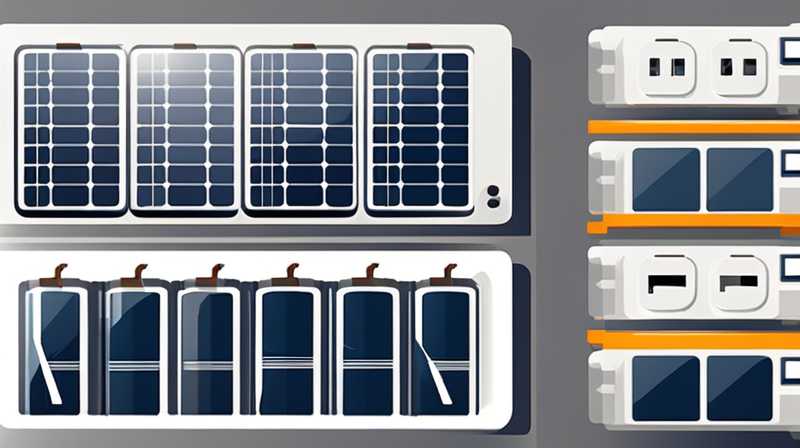
To select solar panels for batteries, consider several vital aspects: 1. Type of Solar Panels, 2. Power Output Requirements, 3. Compatibility with Battery Types, 4. Installation Location. The type of solar panels, whether monocrystalline, polycrystalline, or thin-film, significantly impacts efficiency and space utilization. Monocrystalline panels tend to provide the highest efficiency, making them ideal for limited spaces. Furthermore, assessing the power output required involves calculating the energy consumption of connected devices and ensuring the solar array can meet or exceed these demands, especially during peak usage times. Compatibility with battery types is essential for optimizing energy storage; different battery chemistries such as lithium-ion or lead-acid may necessitate specific charge controllers or inverter configurations. Lastly, knowing the installation location’s sunlight exposure and seasonal changes will influence panel placement and orientation, maximizing energy capture.
1. TYPES OF SOLAR PANELS
When embarking on the journey of selecting solar panels, one must first familiarize themselves with the diverse types available in the market. Monocrystalline, polycrystalline, and thin-film solar panels comprise the main categories, each possessing unique characteristics and efficiencies. Among these, monocrystalline panels stand out due to their high energy efficiency, usually exceeding 20%. They are crafted from a single crystal structure, enhancing their performance in limited spaces while showcasing a sleek, uniform appearance.
Conversely, polycrystalline panels, while slightly less efficient, typically demonstrate a positive relationship between cost and power output for larger installations. These panels consist of multiple crystal structures, leading to a lower production cost but potentially occupying more space. On the other hand, thin-film solar panels offer flexibility and lightweight attributes, making them suitable for unconventional or portable applications. However, their efficiency often lags behind that of crystalline options, necessitating greater surface area to achieve similar energy outputs.
Ultimately, the choice of solar panel type is determined by individual circumstances, such as budget constraints and available installation space.
2. POWER OUTPUT REQUIREMENTS
A critical component in the selection of solar panels for battery systems is the assessment of power output requirements. This stage requires a meticulous analysis of your energy consumption patterns, factoring in the devices you plan to power using the stored energy. It often involves calculating daily energy needs by examining the wattage of appliances and their usage hours. For instance, if you opt to store energy for a refrigerator, lighting, and other devices, aggregating the total wattage consumption and translating that into kilowatt-hours can provide insight into the minimum solar generation needed.
Once the energy consumption figures have been compiled, it’s time to align this data with the solar panel output. The power output of panels is rated in watts and should be compared against the calculated energy requirement to deduce how many panels will be necessary. For example, if your total energy needs amount to 2400 kWh per month, dividing this by the sunlight hours available in your area enables you to determine the requisite solar panel output per day. Transitioning from this information to specific models requires understanding how each panel’s rated wattage contributes to meeting or exceeding your energy needs.
3. COMPATIBILITY WITH BATTERY TYPES
Matching solar panels with the appropriate battery types is a vital aspect of forming an efficient energy storage system. Various battery chemistries present differing benefits and challenges; among the most common are lead-acid batteries, lithium-ion batteries, and newer technologies like flow batteries. Each battery type has unique charging profiles and discharge characteristics, thus influencing the selection of solar components.
Lead-acid batteries, being one of the oldest forms of energy storage, have their benefits, such as accessibility and cost-effectiveness. However, they necessitate careful management to ensure longevity, especially concerning depth of discharge. Solar panels must be selected to provide a reliable voltage and current profile that is compatible with lead-acid chemistry. On the other hand, lithium-ion batteries offer superior depth of discharge and longevity but require more sophisticated charge controllers due to their specific charging requirements. Selecting solar panels that align with these advanced parameters is quintessential for optimizing performance.
Additionally, system compatibility should also consider the inverter, which converts the direct current generated by solar panels into alternating current for home use. The inverter must be compatible with battery and panel configurations to prevent energy loss or system malfunction.
4. INSTALLATION LOCATION
Installation location significantly influences solar panel efficiency and energy generation. Factors such as sunlight exposure, tilt, and shading must be thoroughly assessed to maximize energy capture. First and foremost, the chosen site should receive an adequate amount of sunlight throughout the day, as prolonged shaded areas can drastically reduce energy production. It’s crucial to conduct a potential shading analysis, especially if trees or buildings surround the installation site.
The tilt angle of solar panels is another consideration. Depending on geographical location, the optimal angle to catch the maximum solar radiation might vary. Commonly, panels are installed at an angle equivalent to the latitude of the location, but adjusting for seasonal sunlight patterns can yield even higher efficiency rates.
Lastly, local climate conditions also play an essential role in determining the ideal installation site. Areas with frequent storms or heavy snowfall may call for sturdier mounting systems that can withstand severe weather, while temperature gradients can affect solar panel efficiency. Therefore, conducting site assessments not only helps in understanding potential risks but also supports the determination of the most favorable environment for solar panel operations.
5. FAQs
WHAT ARE THE MAIN TYPES OF SOLAR PANELS?
Solar panels primarily come in three varieties: monocrystalline, polycrystalline, and thin-film. Monocrystalline panels are known for their efficiency and sleek design, made from a single crystal structure. Due to their high energy conversion rates, they are ideal for installations where space is limited, despite being the most expensive. Polycrystalline options, composed of multiple silicon crystals, provide a lower efficiency rating and cost, making them a practical choice for larger installations. Lastly, thin-film panels are inexpensive, lightweight, and flexible, making them suitable for various applications, although they usually have a lower efficiency rating compared to crystalline panels. It is essential to consider the specific requirements of your energy consumption, budget, and installation space when weighing these options.
HOW DO I CALCULATE MY ENERGY NEEDS FOR SOLAR PANELS?
Calculating energy needs involves estimating the total wattage your household appliances consume over a defined timeframe. Begin by listing all devices you wish to power, checking their wattage usage, and noting how many hours they operate daily. Multiply each device’s wattage by the average amount of time it runs to find the daily watt-hour usage. Once you sum the watt-hours of all devices, convert that number into kilowatt-hours by dividing by 1000. This figure represents your daily energy consumption, which will guide you in determining the required solar panel output. You should factor in the number of sunlight hours your location receives and the efficiency of chosen solar panels to ensure that your system can adequately meet or exceed these energy needs throughout the year.
WHAT BATTERIES ARE BEST FOR SOLAR ENERGY STORAGE?
The best battery for solar energy storage largely depends on your system’s requirements. Common choices include lead-acid, lithium-ion, and flow batteries. Lead-acid batteries are budget-friendly and accessible but require careful management to ensure longevity, especially with regard to discharge depth. Lithium-ion batteries boast a longer lifespan and greater efficiency but come at a higher price point and require sophisticated charge management systems. Flow batteries, despite being less common, offer unique benefits, such as scalability and extended discharge capabilities. Ultimately, the selection of batteries should align with factors such as budget, longevity, discharge needs, and compatibility with associated solar components. A careful evaluation of your energy storage needs in light of these considerations will facilitate the optimal choice.
In summary, selecting solar panels for battery systems necessitates a multifaceted approach. Firstly, determining the type of solar panels, such as monocrystalline or polycrystalline, is essential for efficiency and suitability concerning installation space. Secondly, comprehending energy requirements is pivotal to ensure that the panel array can generate sufficient power to meet daily demands. Compatibility between chosen solar panels and battery types, such as lead-acid or lithium-ion, must also be prioritized to optimize performance and longevity. The significance of the installation site, including sunlight exposure, shading, and tilt, cannot be overstated, as these factors directly influence energy production. Therefore, conducting rigorous assessments across these dimensions can lead to an efficient solar energy system, enabling cost savings and a sustainable approach to energy consumption.
Original article by NenPower, If reposted, please credit the source: https://nenpower.com/blog/how-to-choose-solar-panels-for-batteries-2/

