

Hebei University Develops Robot for Accurate Monitoring of Underground Pipeline Networks
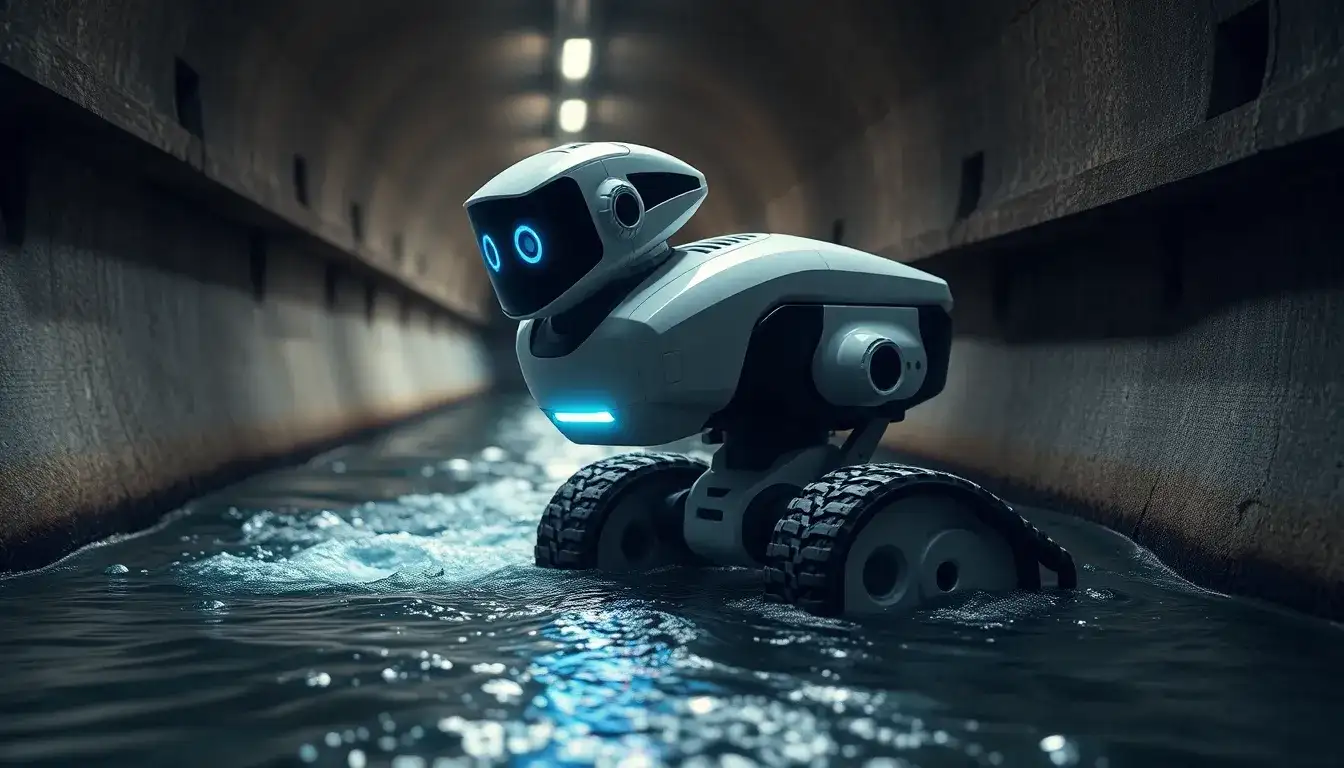
On May 6, in the flow measurement laboratory of the Quality and Technical Supervision Institute at Hebei University, researchers carefully introduced a detection robot equipped with multi-frequency ultrasonic sensors and laser spectral probes into a large-diameter experimental pipeline designed to simulate urban drainage scenarios. As the robot advanced, the dark, enclosed underground pipeline network gradually revealed its structure, with real-time data on instantaneous flow and solid-phase concentration displayed on a computer screen. This formerly inaccessible internal state of the pipeline transformed into a clear and understandable digital map.
This work is part of the project “Key Technologies for Multi-Parameter Measurement of Liquid-Solid Two-Phase Sewage in Urban Drainage Pipelines,” led by Professor Fang Lide, Dean of the Quality and Technical Supervision Institute at Hebei University. Recently, this project was awarded the second prize for technological advancement in Hebei Province as part of the 2025 Science and Technology Awards, contributing to the development of smart water management in Baoding.
Underground drainage pipelines act as the “veins” of a city, and their safe and efficient operation is crucial for flood prevention, environmental quality, and public welfare. According to Professor Li Honglian, a core member of the project, while urban atmospheric environment monitoring has become increasingly sophisticated, monitoring of underground drainage networks remains in a “primary stage.” Traditional methods can only assess the exterior of pipelines and structural damage, without grasping the true conditions of internal fluid and gas mediums. Risks such as illegal sewage discharge, heavy metal pollution, and harmful gas accumulation are difficult to predict under the complex flow conditions of non-full pipelines and liquid-solid two-phase systems, posing significant challenges for urban environmental governance and safe operations.
Professor Li explained that the biggest challenge in development was achieving precise flow measurement while the robot was in motion. The speed of the robot’s movement is coupled with the flow of fluid within the pipeline, which can severely distort the ultrasonic Doppler signals. Sensors that meet accuracy standards during static calibration in the lab exhibited significant data deviations during mobile measurements. To overcome this challenge, the team simulated hundreds of combinations of different liquid levels, solid-phase concentrations, and robot speeds in the laboratory, accumulating over 2,000 hours of testing. They ultimately established a dynamic multi-parameter measurement model for moving conditions, achieving domestic leadership in related technology and securing multiple invention patents.
Since 2006, the team has gradually built a leading flow measurement laboratory among domestic universities, designing and constructing over ten flow measurement standard devices. Among these is a large-diameter non-full pipeline liquid-solid two-phase flow calibration device, which fills a critical gap in measurement traceability within the field. Professor Fang noted that this technology not only addresses pipeline monitoring challenges but also has core applications in energy and carbon emission measurement.
“Receiving the second prize for technological advancement in the province is both an acknowledgment and a motivation,” Professor Fang stated. The team aims to deepen research and optimize technical solutions to implement their findings in more regions. “We hope that through technological innovation, we can provide precise monitoring of urban ‘veins,’ supporting the upgrade of smart water management in Baoding and across the province, contributing to the development of a modern, high-quality living city.”
Original article by NenPower, If reposted, please credit the source: https://nenpower.com/blog/hebei-university-develops-advanced-robot-for-precise-monitoring-of-underground-drainage-systems/

