

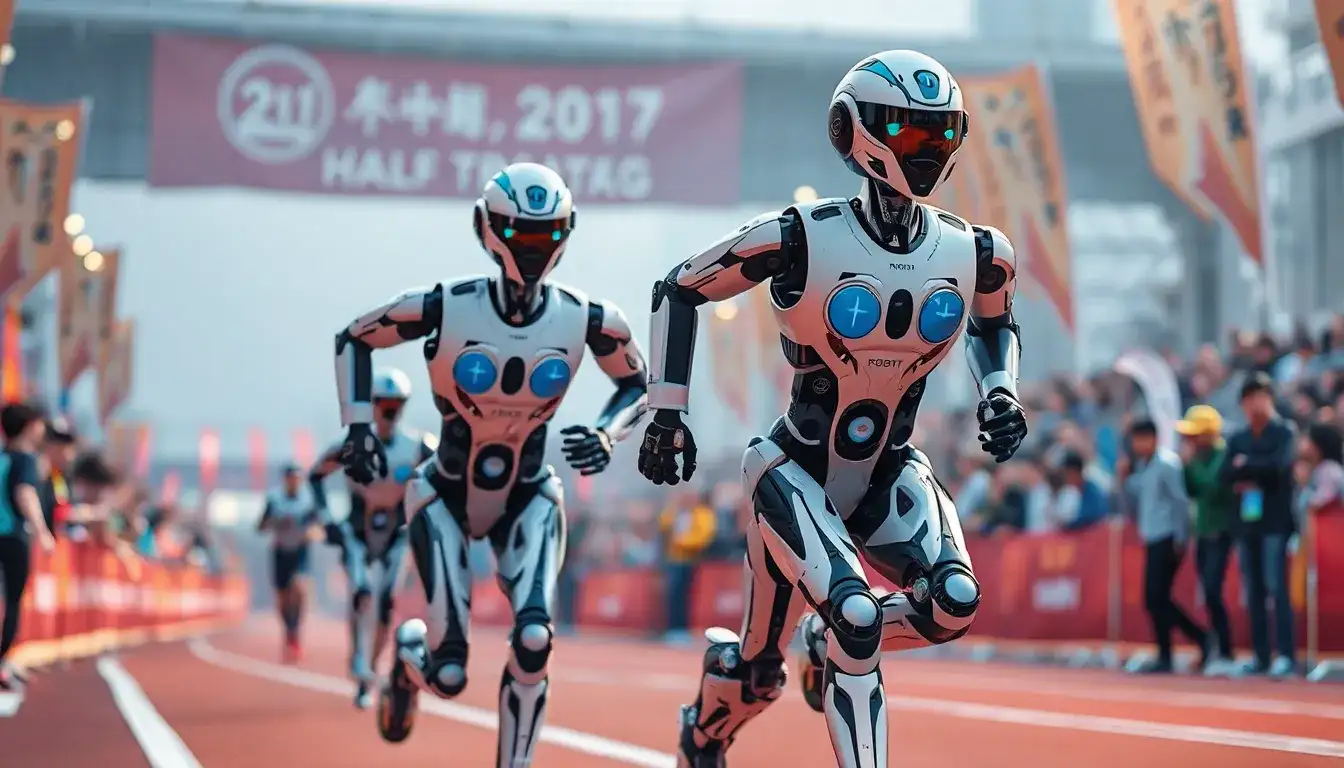
Deep Dive into the Yizhuang Half Marathon: 50 Minutes and 26 Seconds – An Explosive Example of “Useless Utility”
科工力量 narrates the story of China’s technological self-reliance and upward advancement. The article focuses on the recent developments in robotics and technology showcased in the Yizhuang Half Marathon, held on April 19, 2026.
1. How Was the Experiment Conducted? The “Explosion” of the Technology Tree
The preliminary success of the experiment is most visibly marked by the simultaneous “explosion” of various silent branches of the technology tree. It is important to understand that this is not just about “running faster due to new technology,” but rather that the challenge of completing a “useless” task of 21 kilometers has driven existing technologies from other fields into the robotics industry.
A prime example of this is thermal management. Last year, overheating was the “Achilles’ heel” of long-distance running. This year, liquid cooling technology, previously used in consumer electronics and graphics cards, was forcibly introduced. The liquid cooling system of the Honor “Lightning” directly reused technologies and simulation capabilities from smartphones. Teams from Shanghai and Shandong also brought their own liquid cooling or enhanced heat dissipation solutions. This “useless” scenario created an urgent engineering demand and quickly led to cross-industry technology transfer.
The precision manufacturing sector has also been activated. Skills associated with lead screws, harmonic reducers, and planetary reducers, which serve the automotive and aerospace industries, have been re-engineered to meet the extreme demands for power density and spatial efficiency in robotics. Zhao Zhongxia even predicts that the ultimate breakthrough in humanoid robotics might come from materials science—when the physical structure demands greater power, faster speeds, and smaller sizes, the limits of existing materials will be continually challenged.
2. Rules of the Experiment and Future Outlook: Redefining the “Endurance Race”
The success of this industrial experiment relies not only on the technological investments of the participants but also on a carefully designed set of “game rules.” The remote control group’s score is multiplied by 1.2, which subtly adjusts the value of technological development stages. This acknowledges and embraces the current indispensable role of remote control as a “open-book test,” teaching robots “how humans run,” while clearly encouraging the ultimate goal of autonomous navigation as a “closed-book test,” guiding resources towards more long-term valuable data accumulation. This lays the groundwork for the training of future general intelligence.
The strong performance of major players, particularly Honor’s “double crown,” has introduced new variables into the experiment. This is not just about the resource contributions from the “Huawei system” or giant consumer electronics companies but also a spillover of mature methodologies. Honor systematically infused the robotics field with simulation, liquid cooling, diverse product definitions, and brand-building capabilities from the smartphone industry. Their dual validation of “Lightning” and “Yuanqi Zai” effectively replicates the “performance + experience” dual-driven model already validated in consumer electronics within the robotics sector.
It is essential to observe how this “saturation” of investment plays out in a time when technology is still far from converging. Concentrating considerable resources on a few paths during a chaotic period of numerous technological options can accelerate engineering but also carries significant mismatch risks. This is precisely why many startups still find opportunities in the current landscape—they can quickly experiment and iterate across multiple paths due to their smaller size and agility.
As Zhao Zhongxia mentioned during a live broadcast, the window for purely “large-scale and comprehensive” startups is closing, and opportunities are becoming more vertical and niche. The parallel explorations by various entities within the system may foster internal competition that accelerates convergence or could lead to resource wastage, which will significantly influence the future landscape.
3. Infrastructure Development
The foundational infrastructure is also being strengthened concurrently. The Beijing Humanoid Robot Innovation Center’s pilot verification platform, covering an area of 9,700 square meters with an assembly pace of one unit per hour, provides a mass production outlet for the demands generated by the “performance track.” The Star Sea Map indicates that a scale-up of tens of thousands of units will commence in 2026, signaling the beginning of tangible commercial returns from these “useless” investments.
4. 210,000 Kilometers: A Promising Conclusion to “Useless Utility”
As the competition neared its end, a viewer commented in the live stream: “Looking back over the past 100 to 200 years, there have been so many inventions in human industrial civilization that have been discarded or neglected.” Zhao Zhongxia responded, stating that many frozen inventions will be reactivated in the next technological revolution.
The dramatic evolution from 160 minutes to 50 minutes, the silent explosion from air cooling to liquid cooling, and the reactivation of industrial skills from consumer electronics all point to a single conclusion: when an economy generates surplus, when society dares to invest in “useless” endeavors, and when neglected technological branches are challenged in extreme scenarios, the flywheel of industrial advancement begins to turn.
The time of 50 minutes and 26 seconds, along with 1.16 million votes, is not the endpoint. They represent the ink of “useless utility” falling into the distance. Honor’s red “Lightning” has notably inscribed the first striking footnote in this experiment.
The ultimate significance of this “useless utility” experiment is that it has provided China with invaluable time to explore paths, accumulate data, and refine its brand in the long “endurance race” of embodied intelligence. Zhao Zhongxia’s insights may reveal a final vision: the validations and data accumulations from today’s complex 21-kilometer scenarios are paving the way for tomorrow’s journeys into the 210,000 kilometers of deep space, deep sea, or extreme environments that humans cannot reach. When the “useless utility” converges and energy returns, its impact will be another expansion of the boundaries of human capability.
Original article by NenPower, If reposted, please credit the source: https://nenpower.com/blog/exploring-the-breakthroughs-in-robotics-at-the-yizhuang-half-marathon-a-deep-dive-into-innovation-and-technology/

