

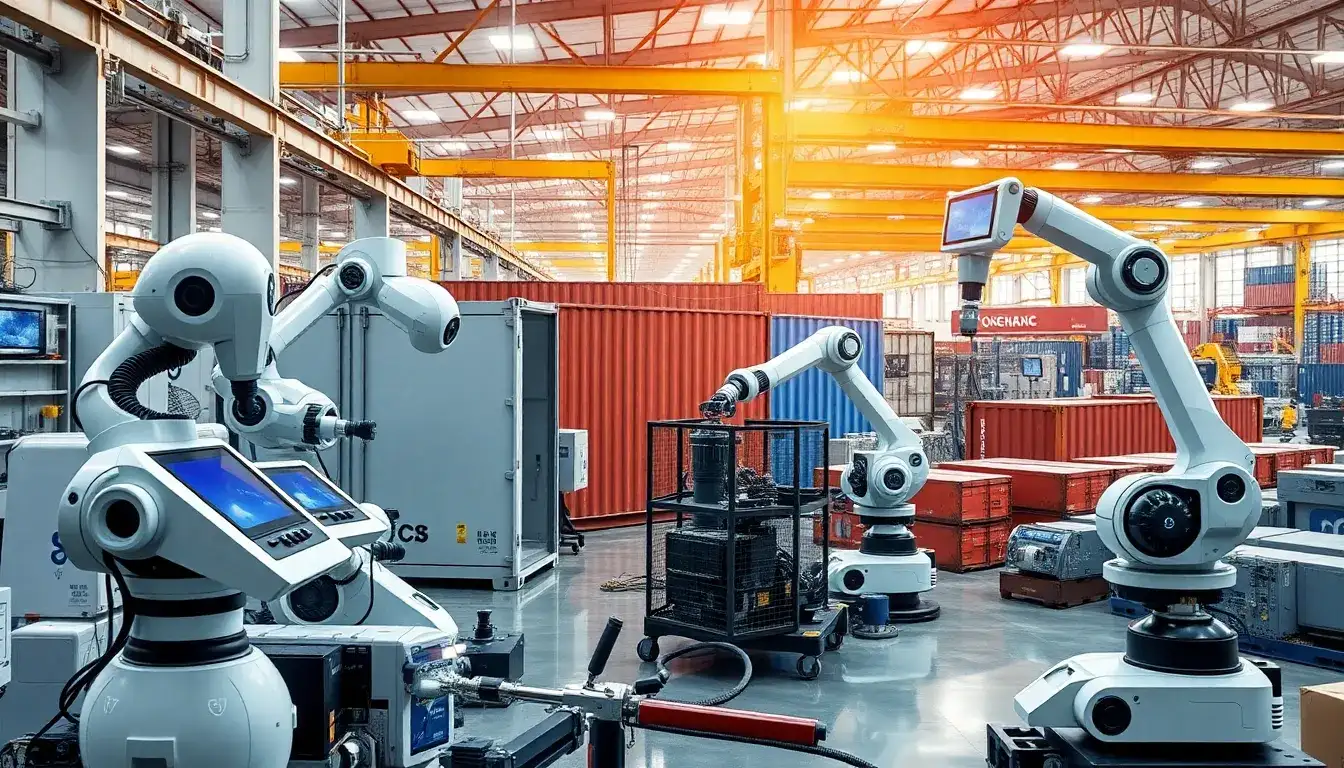
In the first quarter of 2026, China’s robot exports experienced a strong start, driven by various factors including the intelligent upgrade of global manufacturing, the continuous expansion of household consumption scenarios, and the rapid iteration of artificial intelligence technology. The Chinese robotics industry is transitioning from its previous reliance on cost advantages and single product exports to a more comprehensive output model that combines technology, products, and solutions.
According to the latest statistics from customs, the total export value of various types of separately listed robots reached 11.32 billion yuan in the first quarter of 2026, with products exported to 148 countries and regions worldwide. Among these, the export value of cleaning robots amounted to 7.75 billion yuan, accounting for 68.5% of the total robot export value, while industrial robots saw an export value of 3.16 billion yuan, representing a 42% year-on-year increase.
From the perspective of export structure, cleaning robots have become a core category in China’s robotics exports. In recent years, advancements in technologies such as artificial intelligence, visual recognition, lidar, and autonomous navigation have continually enhanced the functionality of products like robotic vacuum cleaners, pool cleaning robots, and commercial cleaning robots. As a result, Chinese brands have increased their market share in traditional markets such as Europe and the United States.
For instance, in the first quarter of this year, Beijing Roborock Technology Co., Ltd. (hereinafter referred to as “Roborock”) reported a revenue of 4.227 billion yuan, marking a 23.31% year-on-year growth, with a net profit attributable to shareholders of 323 million yuan, up by 20.83%. A representative from Roborock stated during an institutional survey that there is still significant room for growth in the penetration of smart cleaning appliances in the European market. The company continues to solidify its presence in traditional markets while actively expanding into more overseas regions. Additionally, they are advancing technological innovation and product iterations, deepening their understanding of local markets through the expansion of self-operated channels, and gradually enhancing their sales, operations, and after-sales systems to improve local operational capabilities and competitiveness.
According to IDC’s senior analyst Zhao Siquan, “Chinese household cleaning robots have entered global homes early due to mature technology and clear application scenarios, maintaining rapid growth driven by consumption upgrades, advancements in AI technology, and the expansion of scenarios. Currently, the industry is showing two development paths: some companies are vertically deepening around household scenarios, extending from robotic vacuum cleaners to gardens, windows, and pools; while others are horizontally expanding based on algorithms and supply chain advantages, upgrading to comprehensive technology consumer enterprises.”
Compared to consumer robots, the export growth of industrial robots more directly reflects the enhanced capabilities of China’s manufacturing sector. Guangdong Torsda Technology Co., Ltd. (hereinafter referred to as “Torsda”) reported in its first-quarter earnings that its industrial robot and automation application systems business achieved a revenue of 322 million yuan, a remarkable 81.20% increase year-on-year. A representative from Torsda mentioned that the company is continually intensifying its overseas market expansion efforts, accelerating its penetration into emerging markets through its operations in Vietnam, while also expanding into developed markets via its base in Mexico. Currently, Torsda’s overseas sales network covers over 50 countries and regions, establishing connections with approximately 4,000 potential overseas clients and servicing nearly 1,000 overseas customers, becoming a supplier to over 20 Fortune 500 companies.
The rapid development of the robotics industry has also driven the collaborative growth of upstream and downstream industries, including chips, sensors, precision components, and software algorithms. A representative from Orbbec Technology Group stated that the company has been laying out overseas markets since its inception, relying on the international research and academic backgrounds of its founding team. It is among the early firms in China to establish overseas sales channels and achieve stable exports of 3D vision perception products. In the first quarter of this year, the company focused on high-value customer groups while consolidating existing clients in Europe, North America, and the Asia-Pacific regions, resulting in a direct overseas sales income growth of about 80% year-on-year. To match global market demands, the company’s factory in Vietnam is expected to commence production this year, collaborating with its smart manufacturing base in Shunde to enhance global delivery efficiency and supply chain resilience.
The continuous growth of China’s robot exports is closely tied to the rapid advancements and industrial implementation of artificial intelligence technology. Currently, the robotics industry is entering a new stage of deep integration of AI and hardware. In the consumer sector, AI is driving the upgrade of robots from “execution tools” to “smart assistants.” Some new-generation robotic vacuum cleaners are now equipped with capabilities such as autonomous mapping, semantic recognition, dynamic obstacle avoidance, and multi-device interaction, leading to improved user experiences. In the industrial sector, AI is enhancing the flexibility of production capabilities in robots. Unlike traditional industrial robots that can only perform fixed actions, an increasing number of robots can adapt to complex working conditions, achieving autonomous recognition, path planning, and real-time adjustments.
Zhao Siquan believes that the core of future industry competition will shift from hardware performance to AI capabilities and ecosystem capabilities. Companies that excel in continuous algorithm investment, scene understanding, and global operational capabilities will gain an advantage in the next stage of competition. Zhang Xiaorong, director of the Deep Technology Research Institute, emphasized that the current robotics industry still faces challenges in core components, high-end chips, and the establishment of overseas brand channels. In the future, Chinese robotics companies need to continue increasing their R&D investments to enhance their ability to control core technologies independently.
Original article by NenPower, If reposted, please credit the source: https://nenpower.com/blog/chinas-robot-exports-surge-in-first-quarter-driven-by-clean-and-industrial-robots/

