

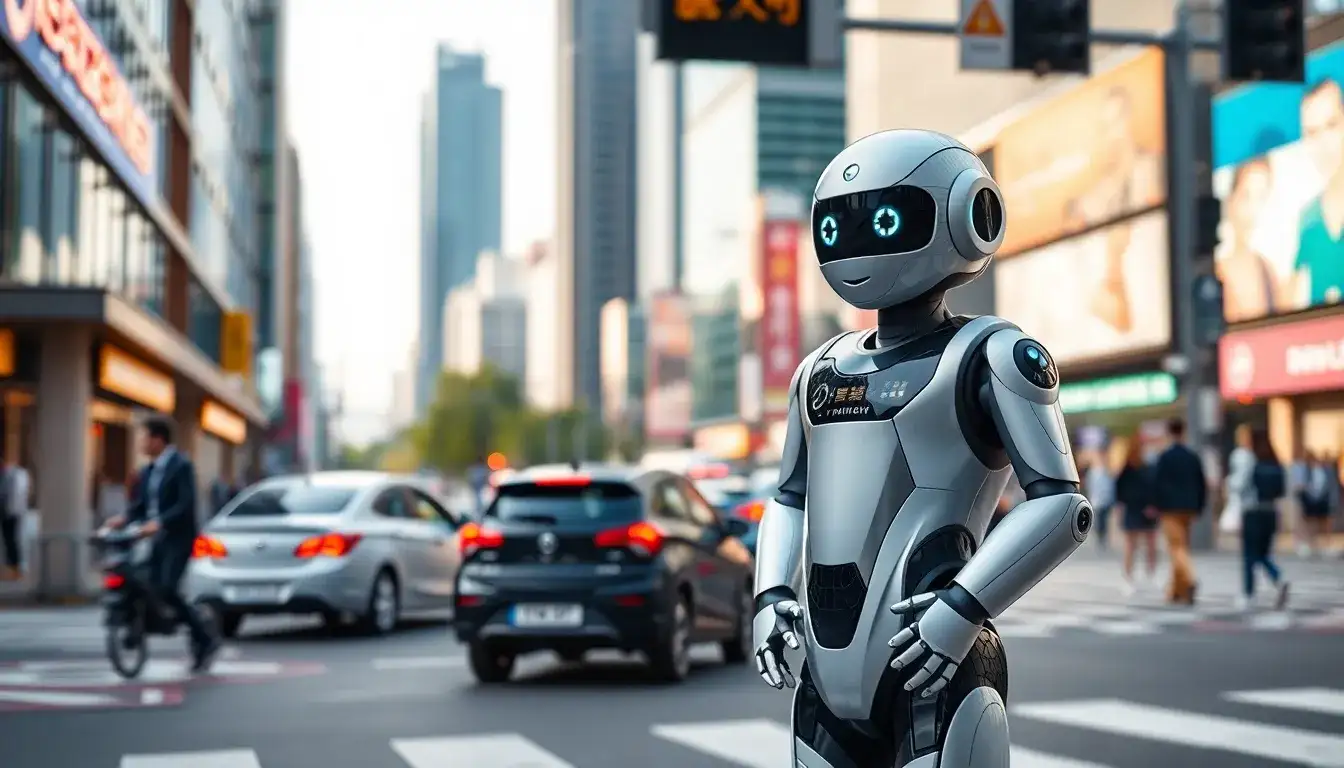
On the first day of the May Day holiday, a unique force was deployed in the core areas around West Lake in Hangzhou—the country’s first officially organized traffic management robot team, named “Hangzhou Smart Traffic.” This team consists of 15 intelligent traffic management robots that are primarily responsible for guiding pedestrians and non-motor vehicles, managing traffic, and assisting tourists with directions. They work alongside on-duty police officers to enhance the efficiency of traffic order management.
Prior to this deployment, the robot team had already participated in traffic management tasks during the West Lake Half Marathon in March and the Hangzhou Women’s Half Marathon in April, gaining valuable real-world experience. During the May Day holiday, they transitioned from event support to managing high traffic volumes, marking a significant upgrade from “individual trials” to “team support.”
According to the Hangzhou Traffic Management Bureau, the deployment strategy follows a “one point, one plan” approach. The 15 robots are strategically placed at key intersections in the districts of Shangcheng, Gongshu, West Lake, and Binjiang, ensuring comprehensive coverage of the West Lake scenic area, the Lakeside shopping district, and major urban thoroughfares. The robots are designed to perform differently based on the specific needs of each intersection, collaborating with on-ground police to create a new operational model of “human-robot collaboration and complementary strengths.”
In the scenic area of West Lake during the holiday, one of the most frequent requests is for directions. Therefore, the primary function of the traffic management robots stationed there is to assist tourists with navigation. Tourists can simply approach a robot and press the “I want to talk” button on its interactive screen to initiate inquiries. The robots are equipped with advanced speech recognition technology that can quickly identify verbal requests. By analyzing real-time traffic conditions and geographic locations, they provide optimal walking and public transport routes through voice interaction and visual displays on their screens.
At key urban intersections, the robots focus on monitoring violations by non-motor vehicles and pedestrians. These robots utilize high-performance visual recognition algorithms for round-the-clock, multi-target intelligent monitoring. They can accurately identify violations such as non-motor vehicles stopping beyond the line, riders not wearing safety helmets, and pedestrians lingering in motor vehicle lanes. Once a violation is detected, the robot immediately issues real-time guidance and warnings through a directional voice system. If the person does not comply after three reminders, the robot records the violation and sends the information to the warning center, creating an automated management loop of “real-time perception—precise identification—immediate guidance.”
In addition to monitoring, the robots assist in traffic management by integrating with the intersection signal control system, allowing for millisecond-level coordination with traffic lights. They are programmed with a set of traffic command gestures that meet the standards set by the Ministry of Public Security, enabling them to execute eight types of commands—such as go straight, stop, and turn left—accurately and smoothly. This synchronization provides clear and unambiguous instructions to both drivers and pedestrians.
The establishment of the traffic management robot team in Hangzhou primarily aims to free up police resources. In traditional intersection duties, police officers often engage in repetitive tasks such as directing traffic, blowing whistles, and providing guidance. This is especially demanding in tourist areas where management tasks are heavy and police forces are stretched thin. The robots can work continuously for 8 to 9 hours a day, effectively replacing these basic, repetitive duties. As a result, the released police resources can be redirected to more complex tasks that require human judgment and emergency responses, such as rapid accident handling, serious violation enforcement, and safety hazard inspections.
Original article by NenPower, If reposted, please credit the source: https://nenpower.com/blog/chinas-first-robot-traffic-police-team-officially-deployed-in-hangzhou/

