China’s agricultural technology progress contribution rate exceeds 64% as new technologies and equipment demonstrate their capabilities in the fields.
With the introduction of smart breeding robots in greenhouses, the addition of intelligent agricultural machinery in hilly areas, and the empowerment of digital technology in new farms, China’s agricultural technology progress contribution rate has surpassed 64%, transforming into a robust productive force on the front lines of agricultural production.
The 14th Five-Year Plan emphasizes the strengthening of agricultural technology and equipment support, aiming to develop agriculture into a modern industrial sector, with technological progress and innovation being crucial. Currently, the overall effectiveness of agricultural technology innovation in China has further improved, with the contribution rate exceeding 64%, the coverage rate of quality crop varieties surpassing 96%, and the comprehensive mechanization rate for sowing and harvesting reaching 76.7%. Major grain crops have essentially achieved full mechanization. Various intelligent devices are playing significant roles in agricultural production, allowing technology to give modern agriculture the wings to soar.
Intelligent Breeding Robot
Understanding Every Flower
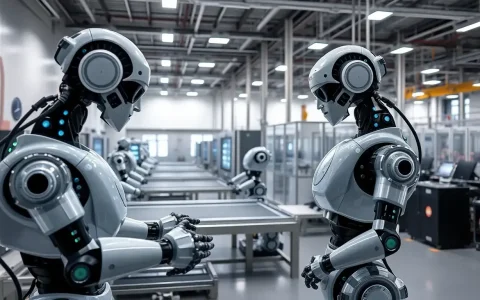
Sunlight filters through the greenhouse roof, illuminating rows of lush tomato plants with pale yellow flowers blooming in between. A white robot slowly stops along its track, extending its mechanical arm to recognize, position, and pollinate the flowers—a glimpse into the daily operations of the intelligent breeding robot named “Ji Er.”
“Traditional hybrid breeding and seed production rely entirely on human labor, which is costly and inefficient,” explains Xu Cao, a researcher at the Institute of Genetics and Developmental Biology, Chinese Academy of Sciences. During the process of “emasculating” tomatoes, workers must manually open the flowers and remove the stamens one by one with tweezers before performing artificial pollination. “It is even more challenging with soybeans, which have a higher flower closure degree. Despite having over 30% potential yield increase, efficient hybridization of soybeans has not yet been realized,” he adds.
A new cross-disciplinary approach has led to breakthroughs with “Ji Er.” The Institute of Genetics and Developmental Biology collaborated with the Institute of Automation, Chinese Academy of Sciences, and the Brain Cognition Function Mapping and Brain-like Intelligence Research Platform to create an intelligent breeding model that combines biotechnology, artificial intelligence, and robotic labor.
On the biotechnology front, the team has used gene editing to reshape crop flower structures, making precise modifications to self-pollinating crops like tomatoes and soybeans. “By gene editing, we can transform the straight stamens into curved ones, allowing the stigmas to naturally emerge from the enclosed petals,” Xu explains, likening it to a precise “plastic surgery” for flowers, enabling the petals to open without manual intervention.
The integration of artificial intelligence and robotic technology has made precise breeding a reality. Yang Minghao, a researcher at the Institute of Automation, states that “Ji Er” integrates a self-developed deep learning method for precise detection of small spatial targets and a delicate operation model for the robotic arm. “It can accurately identify and locate small flowers in complex agricultural scenarios, achieving a stigma recognition accuracy rate of 85.1% even in backlight or obstructed views.”
These innovative achievements are translating into tangible industrial value. In tomato hybrid breeding, “Ji Er” combined with Xu’s innovative domestication breeding technique can reduce the breeding cycle from five years to just one year, saving over 25% in labor costs. In soybean breeding, it has achieved rapid creation of a structural male-sterile line, saving 76.2% of manual pollination time, which could revolutionize the traditional breeding model that relies on human observation and touch. “The development of ‘Ji Er’ has not only overcome technological bottlenecks but has also nurtured a group of interdisciplinary agricultural technology talents, forming a two-way cycle of demand-driven talent cultivation and practical training,” Yang notes.
The core research findings related to “Ji Er” were published in the internationally recognized journal Cell last year. The research team has already begun work on version 2.0, focusing on adapting technology for more crops like soybeans and cotton. Yang admits that to expand the application range, the robot must also adapt to more varied and complex planting scenarios.
“Getting robots to understand every flower gives us the confidence to leapfrog towards agricultural modernization,” Xu states. The relentless pursuit of breaking through the limitations of arable land and continuously enhancing agricultural efficiency is the unwavering goal of generations of agricultural technology workers.
Bending Steering Wheel Tractors
Innovative Machinery for Hilly and Mountainous Terrain
As spring returns to the Loess Plateau, new greens emerge between the ridges. In Lujia Gou Village, Dingxi City, Gansu Province, villager Zhao Bin welcomes a new “partner”—a bending steering wheel tractor designed for mountainous terrains.
“Our terraced fields are scattered, steep, and have significant elevation differences. Previously, traditional agricultural machinery was too large and had a wide turning radius, making it impossible to maneuver in small plots. If the wheelbase is wide, the spacing for sowing becomes chaotic, leaving large areas exposed to the sun!” Zhao explains. “In the end, we had to rely on manual labor, which was incredibly exhausting!”
After examining the bending steering wheel tractor, Zhao hops into the driver’s seat, and with a turn of the wheel, the “iron bull” skillfully turns in less than three meters of width. “It can efficiently tidy up areas that larger machinery couldn’t access in one go.”
With functions like rotary tilling, plowing, sowing, and trenching, the “iron bull” can scale slopes and navigate obstacles, aided by a specialized navigation system for hilly terrains that supports automatic path planning for irregular plots.
Professor Zhao Wuyun from Gansu Agricultural University explains that while the bending steering feature is flexible, the vehicle’s body can sway left and right during turns, making it difficult to maintain a straight path. To address this issue, developers designed a dual-hydraulic lock to control the bending cylinders, locking the chassis during minor turns, ensuring consistent curved operational trajectories. “We need the machine to ‘bend’ but not ‘twist,'” Zhao likens.
With 76% of Gansu’s arable land situated in hilly and mountainous areas and over 60% of specialty industries concentrated there, the market for agricultural machinery is relatively small compared to plains, and villagers’ purchasing power is limited, leading to insufficient enthusiasm from companies to participate in research and development. A lack of suitable machinery has become a bottleneck for agricultural development in Gansu’s hilly regions.
To tackle the insufficient adaptability of agricultural machinery, Gansu has innovatively established an integrated pilot program for research, manufacturing, and promotion of agricultural machinery. Enterprises focus on innovation, farmers validate the equipment, and research institutions solve technical challenges, collaboratively promoting effective and practical technological routes. “We have launched actions to fill the gaps in agricultural machinery, relying on local agricultural machinery promotion stations to collect operational data, failure rates, and assessment records to ease the research burden on enterprises,” says Liu Wenwu, director of the Agricultural Machinery Management Department of Gansu Provincial Agricultural and Rural Affairs Department. By 2025, Gansu aims to achieve a comprehensive mechanization rate of 71.3% for crop sowing and harvesting, with the mechanization rate in hilly areas reaching 67%, showing initial positive results.
To make agricultural machinery a reliable partner for farmers, it is essential to bridge the “last mile” of service. “We are implementing ‘on-site training and convenient certification’ services, organizing professional teams to conduct training and certification in villages, aiming for a one-stop solution for training, certification, and annual inspections, ensuring minimal travel for operators, maximizing machinery usage, and simplifying farming,” explains Zhang Jilin, director of the Dingxi City An Ding District Agricultural Machinery Service Center.
Smart Radish Farm
Intelligent Management from Planting to Harvesting
In Yongcheng City, Henan Province, the phone of Feng Lei, chairman of the Minle Planting Professional Cooperative, buzzes. “The Yunyun APP reminds me that it’s time to water area 003.” Feng quickly operates his phone, and within seconds, the designated area’s “5G + water and fertilizer” smart irrigation unit automatically begins its work, with drip irrigation tubes buried in the ridges gradually inflating, directing water straight to the radish roots.
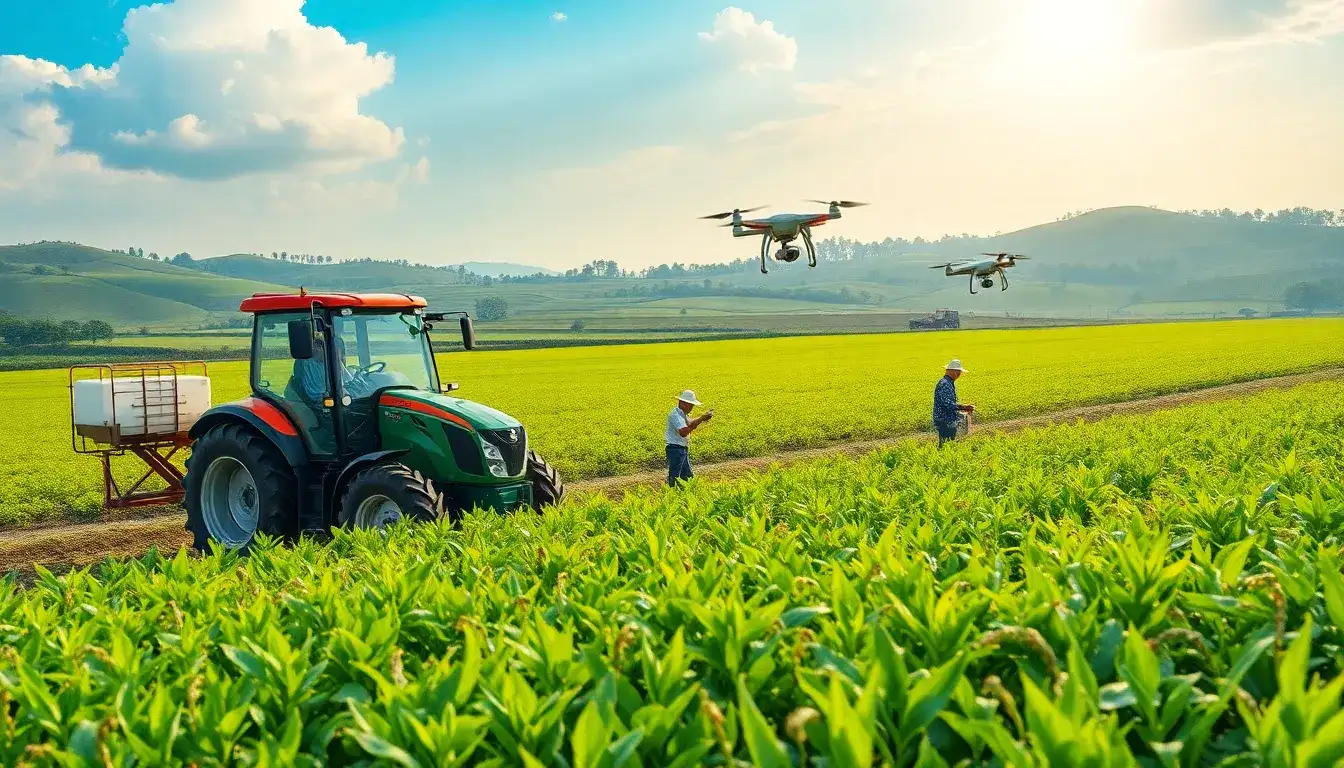
Following Feng to the field, he is amazed to see that the tractor operates without a driver, accurately creating ridges in a straight line; the irrigation system works without anyone hauling hoses or opening valves; when fertilization is needed, an unmanned sprayer takes off, intelligently identifying weak crop areas for precise fertilization…
“This is Henan’s first smart radish farm. Here, farming has transformed from a physical task into a technical one,” says Li Guoqiang, director of the Smart Agriculture Research Room at the Henan Academy of Agricultural Sciences. The smart radish farm creates a “perception-decision-execution” management system for intelligent oversight, achieving precise farming, smart management, and efficient storage and harvesting.
Within the farm, nearly ten thousand mu of radish fields are thriving. In Honglou Village, Jiangkou Town, Yongcheng City, a BeiDou base station has been installed at the field’s edge, and a laser leveling machine is operating in the fields, automatically adjusting its height according to the ground’s elevation changes.
From “sweat drips into the soil” to “full cloud-based planting and harvesting,” even the humble radish has integrated cutting-edge technology. “The establishment and operation of the farm is a successful practice of deeply integrating smart agriculture with specialty vegetable industries,” Li explains. Leveraging the smart radish farm, the Henan Academy of Agricultural Sciences has developed a digital map for radish planting in Yongcheng, successfully applying a smart production technology system to radish cultivation, innovating a three-crop planting model of “early spring radish + summer corn + autumn white radish,” and forming a comprehensive management system with “excellent varieties + smart planting + primary processing + cold storage + diversified sales,” thereby creating a large-scale specialty industry cluster.
Smart devices have significantly boosted the efficiency of radish management as well. The farm is densely equipped with soil moisture sensors and small environmental monitoring devices that continuously capture growth data such as temperature and humidity, which are intelligently analyzed and precisely fed back through an agricultural big data platform. Feng notes that since adopting the smart agriculture planting system, water usage has decreased by 30% per mu, and the use of fertilizers and pesticides has reduced by 25%, resulting in radishes with better appearance and taste, earning over 1400 yuan more per mu each year.
At the radish washing workshop located in Honglou Village, workers are cleaning and maintaining three smart radish washing lines and nine large cold storage facilities. The next batch of radishes will be processed here, bagged, pre-cooled, and sent to various domestic locations and overseas. This new ecosystem of smart agriculture, constructed through data intelligence, marks a new starting point for the upcoming planting season.
Original article by NenPower, If reposted, please credit the source: https://nenpower.com/blog/chinas-agricultural-technology-contribution-exceeds-64-with-innovative-equipment-transforming-farming-practices/