

April 26 News Summary: Advancements in Quantum Standards and Hydrogen Storage
Support for Lithography Machine Development: A New National Quantum Standard Established
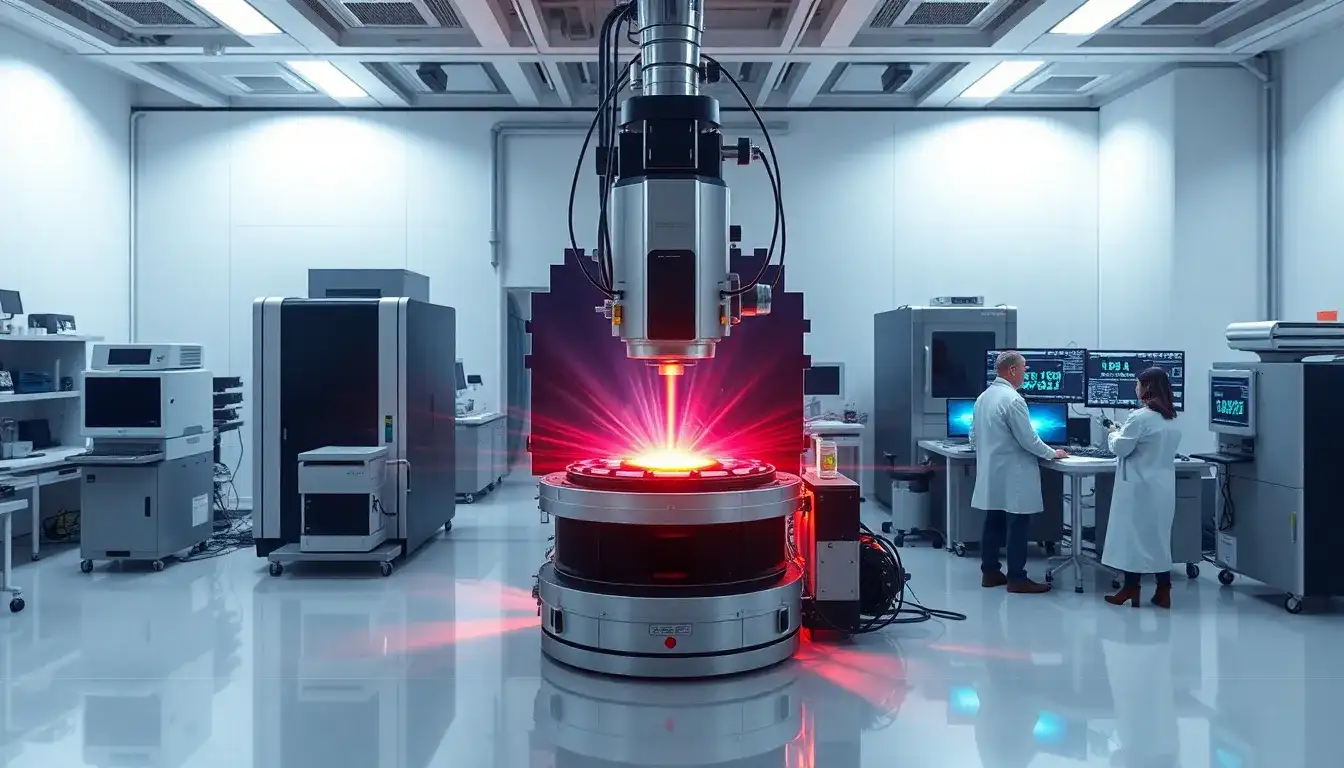
According to reports from CCTV News, in an effort to overcome critical technological bottlenecks in quantum measurement of optical wavelengths, China’s State Administration for Market Regulation has successfully developed and approved the establishment of a new national optical wavelength quantum standard. This achievement effectively addresses the challenges of traditional single-point wavelength measurement, which suffers from limited range and insufficient precision. As a result, China becomes the third country, following the United States and Germany, to independently develop a multi-wavelength synchronization locking system, achieving an overall technology level that meets international standards.
Commentary: The establishment of this new standard signifies the construction of a next-generation, quantum-based, and systematic framework for optical wavelength measurement, providing essential technical support for fields critical to national technological sovereignty and security, such as high-end equipment manufacturing, BeiDou navigation, fiber optics, next-generation communication (6G), and quantum sensing. The series of optical wavelength measurement methods proposed by the team will offer a comprehensive solution for the national integrated circuit industry, facilitating applications in semiconductor manufacturing, particularly for chips produced using 5nm processes and below. Additionally, it will provide nanometer-level wavelength calibration for advanced equipment like EUV lithography machines, addressing key barriers and promoting the development of domestic high-end lithography technology and measurement instruments. Relevant A-share concept stocks include Dingyang Technology (688112) and Tianao Electronics (002935).
Breakthrough in Hydrogen Storage: First Million-Cubic-Meter Salt Cavern Hydrogen Storage Project Launched
As reported by Xinhua News, on April 25, China’s first million-cubic-meter salt cavern hydrogen storage demonstration project officially commenced operations in Pingdingshan, Henan Province. This marks a new phase in the industrialization of China’s hydrogen energy sector, covering the entire hydrogen supply chain from production to storage, transport, and usage. Academician Yang Chunhe of the Chinese Academy of Engineering stated at the launch ceremony that this project fills a significant gap in large-scale salt cavern hydrogen storage technology in China, representing a breakthrough from concept to implementation.
Commentary: Compared to high-pressure gas storage (using cylinders) and liquid hydrogen storage, salt cavern hydrogen storage is regarded as the most effective solution for large-scale, long-term energy storage. Its advantages are clear: it offers enormous capacity at low costs and high safety. Unlike batteries, which can only store energy for short periods, salt caverns can store hydrogen like an “underground natural gas reservoir,” allowing for energy balance across seasons by storing hydrogen during peak renewable energy production and retrieving it during dry or windless periods. Salt cavern hydrogen storage is expected to become a cornerstone of national energy security, capable of absorbing unstable green electricity from the western regions and transporting hydrogen through pipelines, even enabling hydrogen blending with natural gas to provide deep decarbonization solutions for industries and transportation. Relevant A-share concept stocks include Suyuan Jingshen (603299) and Sanwei Chemical (002469).
Selected Major News
- On April 24, Premier Li Qiang presided over a State Council executive meeting to discuss technology innovation and reviewed progress on promoting high-quality development of the marine economy.
- The China Securities Regulatory Commission approved the Shanghai Stock Exchange’s recent revisions to the trading rules, expanding the scope of fixed-price trading to include all A-shares and exchange-traded funds.
- To regulate online marketing of financial products and safeguard the rights of consumers and investors, the People’s Bank of China and other departments have formulated the “Financial Product Online Marketing Management Measures,” effective from September 30.
- The National Medical Products Administration recently announced the 2026 project plan for cosmetics standards, which includes the preparation and revision of 27 standards to enhance regulatory precision in the cosmetics industry.
- On April 24, at 14:35, China successfully launched a satellite using the Long March 2D rocket from the Xichang Satellite Launch Center, successfully placing the satellite into its intended orbit.
- A research team from the Institute of Chemistry at the Chinese Academy of Sciences has developed roll-to-roll additive nano-printing manufacturing equipment, overcoming long-standing challenges in producing optical metamaterials cost-effectively and at scale.
- During the China Space Conference, the “Global University Satellite Alliance Constellation” was officially announced, with plans to launch 300 scientific experiment satellites from universities within six years.
Company Updates
- Zhijia Xuchuang (300308) announced that its 1.6T products are now in mass production with expected quarterly increases in shipment volume. The company has received orders for the entire year of 2026.
- Xinyi Technology (300502) reported that it anticipates rapid increases in capacity and delivery starting in the second quarter of 2026, with significant growth in orders for 1.6T optical modules.
- Wuxi Zhenhua (605319) plans to acquire Deweijia Automotive Electronics Systems (Wuxi) Co., Ltd., which specializes in high-frequency and high-speed wiring harnesses used in smart driving and cockpit applications.
- Megvii Technology (002881) has launched a new generation of central computing architecture for its 5G cabin AI modules, providing integrated smart solutions for various cockpit functions.
- Qiangrui Technology (301128) plans to invest 1.8 billion yuan to establish a headquarters for AI industrial research and development, including liquid cooling products and semiconductor precision equipment.
- Shengyi Technology (600183) has proposed an investment of approximately 5.2 billion yuan to build a high-performance copper-clad laminate project, targeting the automotive, 5G communication, and AI server markets.
- A subsidiary of China Oil Engineering has signed a $4.614 billion contract for surface engineering work at a gas field.
Market Trends
On April 24, the net outflow of capital in the Shanghai and Shenzhen markets reached 57.403 billion yuan. The sectors with the highest net inflows were batteries, semiconductors, and energy metals, with net inflows of 6.151 billion, 4.717 billion, and 4.410 billion yuan, respectively. The top three individual stocks with net inflows were N Lianxun, Ningde Times, and Duofuduo, with net amounts of 2.473 billion, 1.914 billion, and 1.364 billion yuan, respectively.
Duofuduo (002407) reached its price limit on April 24, with a trading volume of 6.342 billion yuan and a turnover rate of 18.47%. Post-trading data indicates that a dedicated trading position bought 511 million yuan and sold 188 million yuan, with institutional positions net buying 111 million yuan and 91.547 million yuan.
New Stock Subscriptions
- Changyu Group: Subscription Code 732407, Subscription Price 13.86 yuan, Issued Price-to-Earnings Ratio 23 times. The company specializes in zirconium products, specialty nylon products, and fine chemicals.
- Ruixiang Intelligent: Subscription Code 920178, Subscription Price 29.47 yuan, Issued Price-to-Earnings Ratio 14.99 times. The company focuses on the research, design, production, and sales of intelligent manufacturing equipment.
Original article by NenPower, If reposted, please credit the source: https://nenpower.com/blog/china-develops-next-gen-laser-wavelength-quantum-standard-to-boost-lithography-machine-research/

