

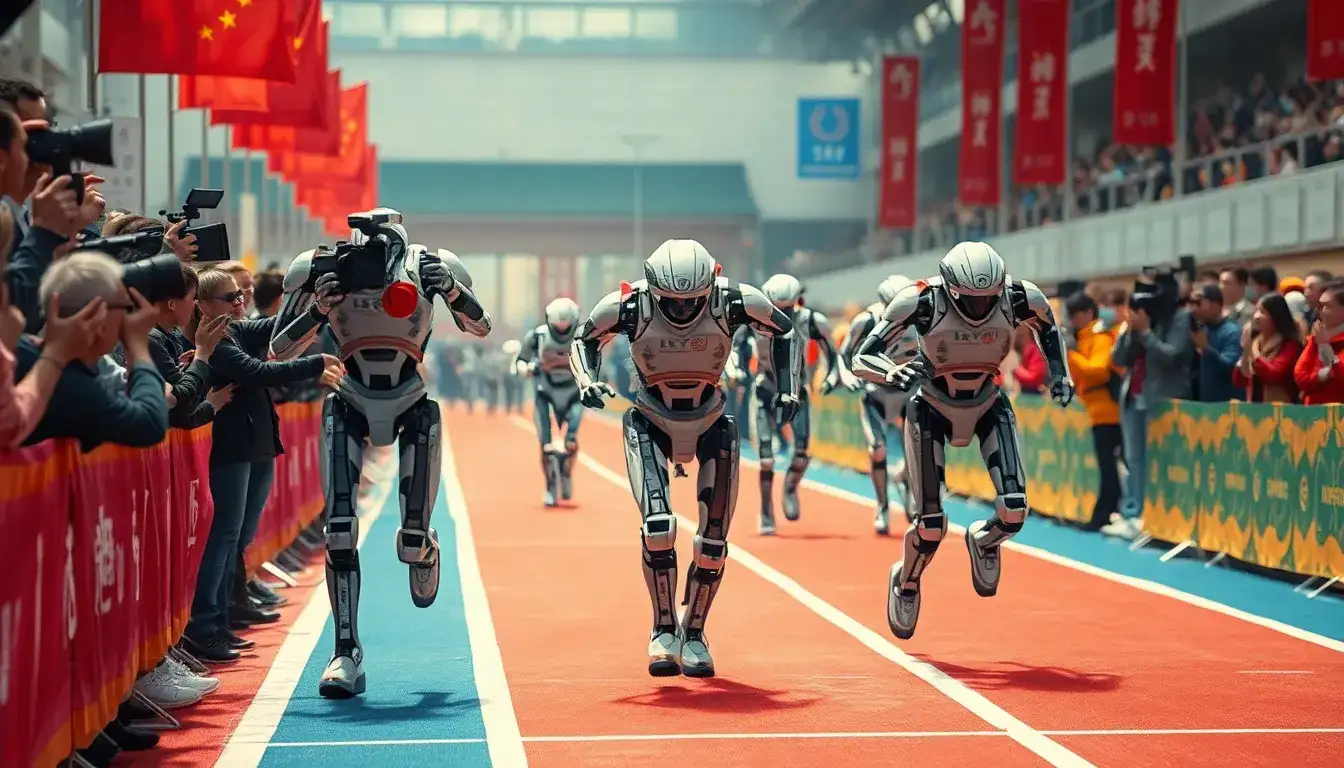
The humanoid robot half marathon in Beijing’s Yizhuang commenced on April 19, 2026. This event marked the third such competition in the last two years, showcasing instances where robots malfunctioned mid-race and had to be carried off on stretchers. For many, these occurrences have become all too familiar. Some Chinese media outlets had previously claimed that this represented a “technology war” between China and the United States; however, recent reports from the state-run Xinhua News Agency have begun to adopt a more cautious tone, emphasizing the importance of “cold reflection.” With another year of robots collapsing on the track, associated promotions have been toned down, yet the issues remain evident.
Coverage of the 2026 humanoid robot half marathon by Xinhua was notably limited, as reports were not prominently featured on their homepage as in previous years. On April 20, Xinhua shared an article from the People’s Daily titled “Accelerating not just Robots.” This piece highlighted advancements in battery swapping technology, stating that robots could now change batteries in ten seconds without needing a system reboot, compared to previous events where the process required several minutes and a reboot. This attempt at promotion inadvertently revealed the low performance standards of competing robots from prior events.
Previously, Xinhua had to acknowledge that “some robots experienced part failures, joint fractures, and accidental falls” during road tests, suggesting that organizers were “navigating with caution.” A year later, with more experience, the organizers were prepared with stretchers, quickly removing fallen robots from the course. During the April 19 event, a robot that fell was swiftly carried off, with the audience showing little surprise.
The recent report from Xinhua also noted that among the over one hundred teams, many utilized the same robot model. Although the number of participating robots has increased, there was no remarkable diversity in performance. It appears that many companies simply copied existing models, indicating a significant lack of innovation within the mainland. Original designs were often imitations of foreign technology, and there seems to be little genuine effort to develop unique solutions, with some entities likely prioritizing funding or rushed political objectives over quality.
The report mentioned that five international teams all used local Chinese robots, implying a trend of “Chinese machines, global intelligence.” However, many designs were mere imitations, and the so-called “intelligence” was still reliant on foreign technology, masquerading as “global intelligence.” This revelation paints a clear picture of the challenges facing humanoid robot development in mainland China.
Xinhua also referenced another article from the People’s Daily titled “Domestic Robots Surpass Human Half Marathon Records, What’s Behind It?” The report recalled that during the inaugural humanoid robot half marathon last year, most participating robots were remotely controlled and faced numerous issues. This year, nearly forty percent of the robots were reported to have autonomous navigation capabilities. While this was presented as an improvement, it also raised concerns about the potential risks associated with autonomous control. Should these systems fail, robots could behave erratically, posing dangers to both participants and spectators.
This year, the competition rules particularly encouraged “autonomous running,” stating that remote-controlled team scores would be adjusted with a multiplier, while autonomous navigation teams would not face such adjustments. This push from officials to use autonomous navigation increases risks unnecessarily, reminiscent of past political campaigns for rapid advancements without adequate preparation.
Despite the numerous challenges faced, Xinhua’s reports continued to proclaim that “Chinese manufacturing is worth anticipating.” This rush to promote achievements has translated into a push for unverified prototypes to participate, resulting in many unexpected issues during the event. Most viewers now perceive such occurrences as commonplace, showing little emotional response.
During the April 19 event, one robot finished the race with a net time of 50 minutes and 26 seconds, surpassing the previous human half marathon record of 57 minutes and 20 seconds. This achievement may be one of the few genuine highlights of the event, as it is the first instance of a robot outpacing a human. However, many see this as a long-overdue milestone, given the years of development in humanoid robotics in mainland China.
Xinhua also published another article asking, “After outpacing humans, where will robots go next?” This inquiry highlights a significant dilemma: aside from dancing and running, what practical applications do humanoid robots have? The report acknowledged that robots have become “language companions for children” and are employed in logistics centers, but these functions do not necessarily require humanoid robots. Simple machines or industrial robots could suffice for many tasks.
The article concluded by questioning how far we are from seeing robots integrated into households. While certain types of robots, like vacuum cleaners, have already made their way into homes, the question should focus specifically on the integration of humanoid robots. Xinhua seems to be subtly shifting the narrative.
Eight months prior, a “2025 World Humanoid Robot Sports Conference” was held in Beijing, touted as the first comprehensive event focused on humanoid robots. Initially, there was significant media promotion; however, the narrative quickly shifted to emphasize the need for “cold reflection.” The latest reports suggest that while progress is being made, achieving widespread application of humanoid robots in daily life will still require time and patience.
In summary, the ongoing push for humanoid robot development in China reflects a broader ambition that is encountering substantial hurdles. With three consecutive failures in these competitions, state media finds it increasingly difficult to maintain a positive narrative.
Original article by NenPower, If reposted, please credit the source: https://nenpower.com/blog/challenges-in-chinas-humanoid-robot-marathon-media-hype-meets-reality/

