

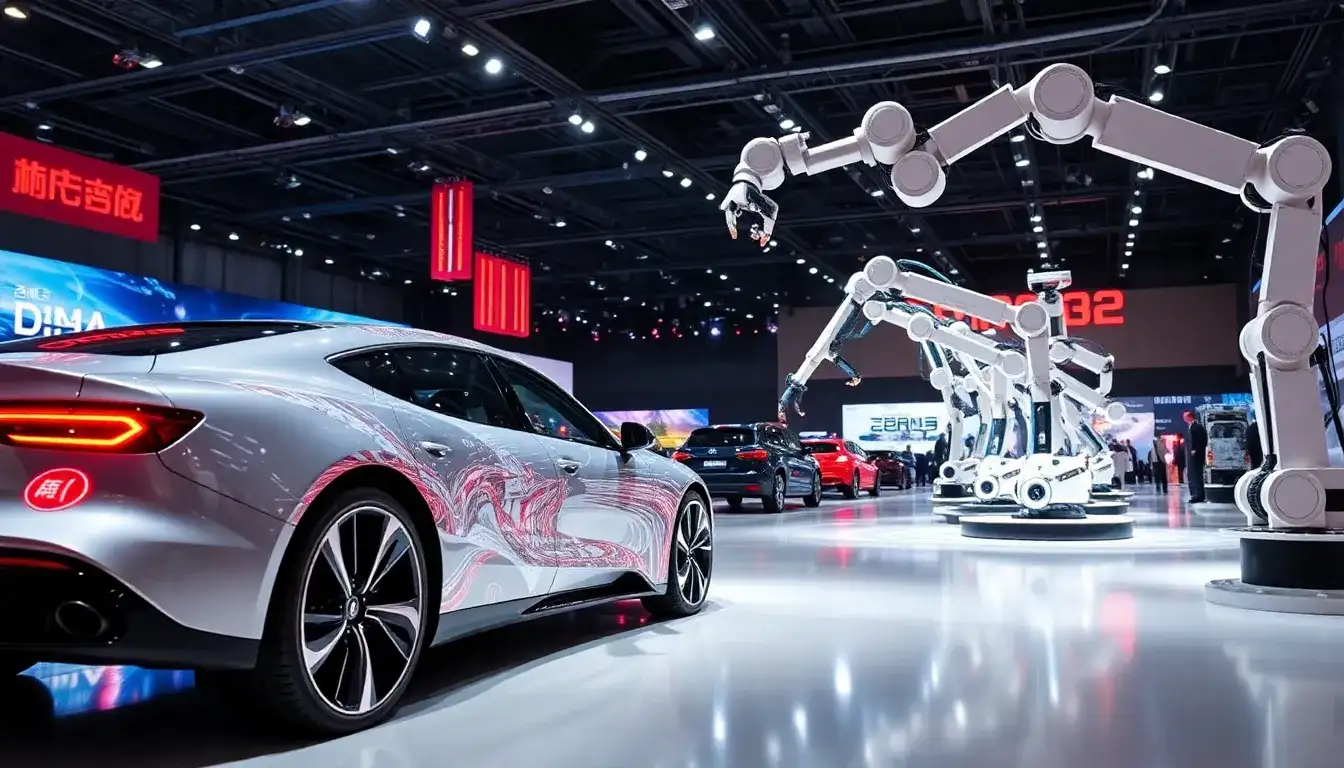
The Beijing Auto Show has revealed a new trend, connecting industrial dynamics with commercial potential, as global automotive and robotics companies accelerate their integration.
Recent developments in the technology manufacturing sectors of China and the United States have highlighted an intriguing trend: the traditional “industrial barriers” between automobile manufacturing and robotics appear to be dissolving rapidly. During the Beijing Auto Show, reporters discovered that this transformation is not merely the result of isolated efforts by individual companies, but rather a collective shift within the entire automotive supply chain. Analysts suggest that automotive suppliers are venturing into the realm of embodied intelligence not as a simple strategic response, but due to a high degree of technological homogeneity at the foundational level. In this round of cross-domain integration between automobiles and robotics, Chinese companies are playing an increasingly significant role due to their robust supply chains and talent reserves.
Recent Alignments Between Chinese and American Companies
On April 23, American electric vehicle giant Tesla announced during its latest earnings call that it would accelerate its transformation from an automobile manufacturer to an artificial intelligence (AI) and robotics company. Focusing on AI, autonomous taxis, and humanoid robots, Tesla plans to commence production of its first-generation humanoid robot, “Optimus,” in the second quarter of this year, with a target annual production capacity of 1 million units.
This trend of merging the automotive and robotics industries was also evident at the Beijing Auto Show, which opened on April 24. At the launch events for new vehicles from companies like Xpeng, Chery, and Honor, humanoid robots with innovative designs and lively movements attracted more attention than the quietly standing electric vehicles. During the exhibition, several leading domestic and international automotive suppliers disclosed their plans to enter the embodied intelligence sector, indicating their intention to adapt smart driving systems, perception technologies, and wiring capabilities for use in humanoid robots and industrial mobile robots.
Reporters learned that the closed-loop perception, decision-making, and execution processes of smart driving systems closely overlap with the action logic of humanoid robots in the physical world. This technological homogeneity enables numerous automotive suppliers to swiftly transition capabilities such as intelligent driving radar vision systems, wiring connection technologies, and computational platforms to the fields of industrial mobile robots and collaborative robots, resulting in practical technological solutions in a short timeframe.
Industry Leaders’ Insights
Yang Xiaoming, president of Aptiv’s China and Asia-Pacific operations, stated at the Beijing Auto Show that the company’s radar vision integrated perception system, initially designed for automotive platforms, has now expanded into the robotics sector, featuring capabilities for short-range multi-target detection and navigable space recognition. Aptiv is also collaborating with an AI industrial automation firm to jointly develop autonomous mobile robots and collaborative robot solutions. Aptiv’s CEO, Kevin Clark, believes that the total market scale of humanoid robots and aerospace could eventually exceed that of the automotive market.
Another automotive supply chain giant, Veoneer, is entering the robotics sector from a “nervous system” perspective. Qi Song, global vice president and president of Veoneer China, explained that many key technologies in humanoid robots are transferable to the automotive realm, as both require an efficient nervous system. This means that the architectural experience accumulated in the automotive industry can be rapidly transferred to the robotics sector.
The Chinese intelligent driving solutions company, NavInfo, views embodied data compliance and collection as a new opportunity. During the Beijing Auto Show, NavInfo’s CEO, Cheng Peng, noted that embodied intelligence is quite similar to smart driving—the core of both is data collection and training, with the smart driving scenarios being relatively straightforward. “Training embodied robots requires a massive amount of data collection. Based on industry scale estimates, we anticipate a potential growth of 1000 times within about five years. This presents a significant opportunity for intelligent driving companies,” Cheng stated.
The Future of Industry Integration
Experts believe that the convergence of the robotics and automotive industries is not merely driven by similar application scenarios, but also by the high degree of alignment in foundational technology systems, supply chain structures, and engineering methodologies. Liu Shaoshan, director of the Embodied Intelligence Center at the Shenzhen Institute of Artificial Intelligence and Robotics, explained that both sectors rely on AI software, batteries, sensors, computational chips, servo motors, and complex systems integration capabilities. The automotive industry can empower robotics through established supply chains, manufacturing systems, and factory environments, while robotics can enhance automotive manufacturing through flexible automation, intelligent inspection, complex assembly, and human-robot collaboration.
One of the central questions currently facing the industry is whether robots can achieve mass production similar to automobiles. Zhang Guibing, executive vice president of Chery Automobile and general manager of Mojia Robotics, shared that the connection between the robot and automotive industries lies in their highly compatible foundational capabilities. Currently, the company’s robots are already performing various tasks at overseas dealerships, assisting in urban traffic management, and providing services in hospitals.
“One of the advantages of domestic automakers like Chery in developing robots is their ability to leverage decades of manufacturing experience, management skills, and quality reliability systems from the automotive sector to enhance the safety and efficiency of robots, as well as their capacity for large-scale delivery,” Zhang stated. He emphasized that their understanding of industry integration is not merely about crossing boundaries, but about extending the capabilities of the automotive industry into the robotics industry.
Zhang further analyzed that robots will most certainly achieve mass production, but not by simply mimicking the automotive mass production model. The core tasks of automobiles are relatively clear, while robots face higher demands regarding intelligent generalization, motion control, safety reliability, and cost control. “Robots will first see mass production in structured environments, such as automotive factories, logistics warehouses, industrial inspections, and commercial services, before gradually branching out into more open residential and social service contexts,” Liu noted. Although the costs of key robotic components are currently decreasing due to the spillover effect from the electric vehicle supply chain, the overall costs, reliability, and application loops remain significant challenges.
Chinese Companies as Pioneers Amid Supply Chain Concerns
Recent observations indicate that Tesla is committed to mass production of bipedal humanoid robots. In contrast, Chinese companies are pursuing a more diverse technological approach, with some already entering the commercialization phase. So, is China leading in the integration and mutual empowerment of the automotive and robotics industries?
Zhang believes that China has a solid foundation for exploring the integration of the automotive and robotics sectors. On one hand, China possesses a complete intelligent electric vehicle supply chain with extensive experience in perception, planning, control, smart cockpits, software algorithms, supply chains, and large-scale manufacturing. On the other hand, China has a wealth of application scenarios, including dealerships, traffic management, healthcare, government services, shopping malls, and factories, which facilitate rapid validation and iteration of robots in real-world settings. “Therefore, I believe China has the opportunity to pioneer a path for ‘automotive industry capabilities to empower robot commercialization,'” Zhang asserted.
Liu Shaoshan also expressed that the dual support of talent and the supply chain gives China a notable advantage in the global integration of the automotive and robotics sectors. Liu previously articulated in a 2022 article in Foreign Affairs the idea that the supply chain of intelligent electric vehicles in China is “dripping into” the robotics field, a judgment that is now being validated through industry practices. “China not only has a leading global intelligent electric vehicle supply chain but also boasts complete manufacturing scenarios, a culture of rapid iteration, and a vast application market. Capacities like batteries, sensors, servo motors, manufacturing processes, and engineering talent are migrating from the automotive industry to the robotics sector,” Liu observed. While China still faces challenges in some areas of industrial integration, particularly in high-end chips and certain core software ecosystems, Liu believes that overall, China has the opportunity to explore a scalable path where the automotive industry nurtures the robotics sector, which in turn feeds back into manufacturing.
Recent reports indicate that China’s experience in the electric vehicle and drone manufacturing sectors is being transferred to humanoid robot production. According to a late April report from CNBC, China is already leading the United States in humanoid robot shipments. Research agency Omdia’s ranking shows that Chinese companies dominate the top six spots for global robot shipments in 2025, with Figure and Tesla being the only two American companies in the top ten. Analysts have noted that one reason for this gap is that American humanoid robot startups are often positioned as “general AI platforms,” while Chinese humanoid robot companies are primarily viewed as industrial hardware suppliers. This has led to a scenario where American businesses need to source humanoid robot components from Shenzhen and then integrate them with local software to finalize their robot products.
As China takes the lead in humanoid robot shipments globally, some American politicians have proposed “decoupling” measures. On April 20, two U.S. senators introduced legislation aimed at prohibiting the federal government from procuring or using robots and related equipment made by Chinese companies, including humanoid robots and robotic dogs. Ironically, U.S. manufacturers still heavily rely on Chinese components. If the ban extends down the supply chain, it would first impact American companies themselves. Analysts argue that Chinese humanoid robots are gaining market traction due to their solid manufacturing capabilities and pathways to commercialization, and if the U.S. enforces a “decoupling,” it may ultimately harm its own competitive edge.
Original article by NenPower, If reposted, please credit the source: https://nenpower.com/blog/beijing-auto-show-highlights-shift-towards-integration-of-automotive-and-robotics-industries/

