

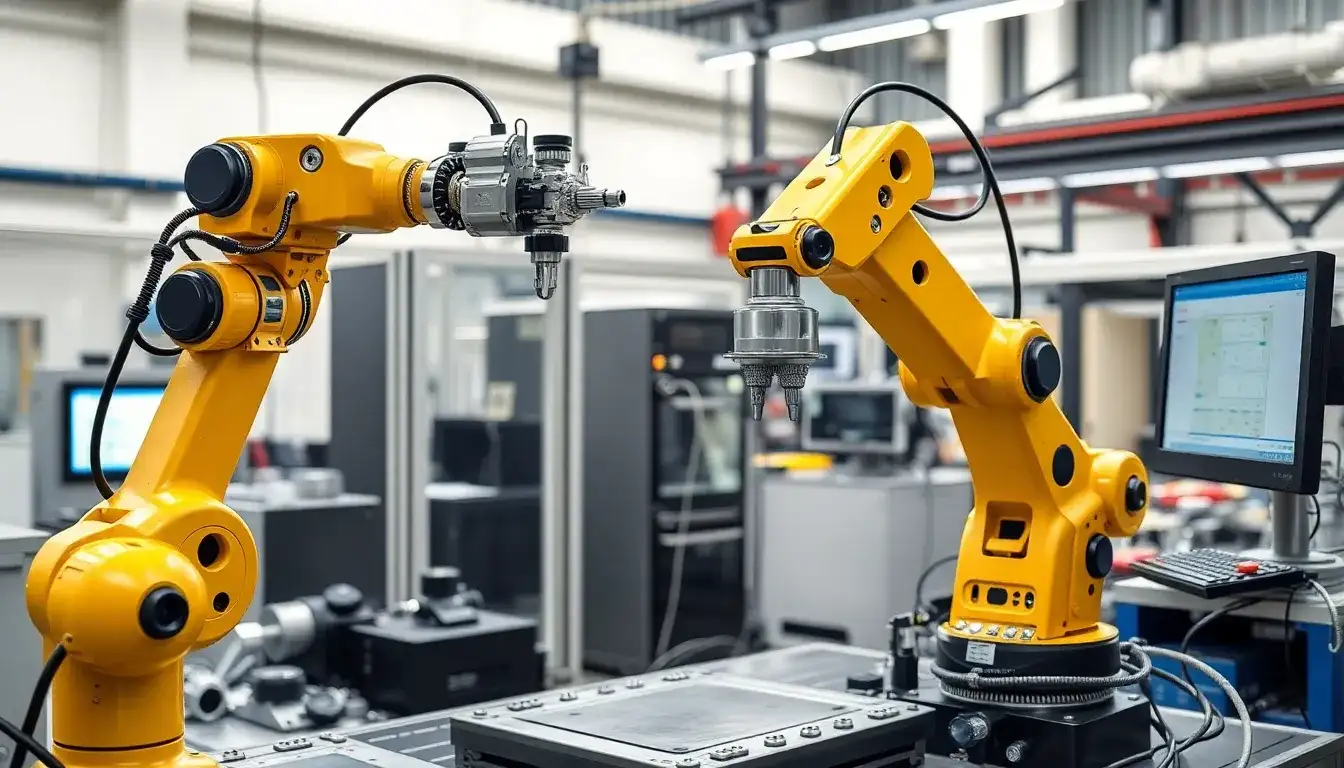
Professor Liu Xinjun’s Team at Tsinghua University: Parallel Robot Machining Technology and Equipment
The development of high-end manufacturing equipment is a crucial support for a nation’s industrial capabilities and is often referred to as the “heart of modern industry.” It has become a strategic focal point in international competition. Major equipment such as aircraft and satellites involves core components that are large in size, complex in structure, and require high precision in manufacturing. Achieving efficient and high-quality production of these components is a global challenge.
Parallel robots offer several advantages, including compact structure, coupled posture adjustment, high stiffness-to-weight ratio, and excellent dynamic characteristics. As a type of end effector capable of five-axis linkage, they can be reconfigured into various forms of machining equipment based on flexible and reconfigurable manufacturing concepts, providing effective solutions to the machining challenges faced by traditional manufacturing equipment.
Research on parallel mechanisms originated abroad but has been significantly developed in China, where many valuable design analysis theories and configurations have been proposed by Chinese scholars. However, widely recognized parallel machining equipment, such as Sprint Z3 and Tricept, was primarily developed overseas. When encountering technical bottlenecks, foreign engineers often refer to academic papers published by Chinese researchers. The core issue is the lack of a complete innovation chain that integrates theoretical understanding, foundational theories, key technologies, and engineering implementation.
To address this challenge, the authors of the book Parallel Robot Machining Technology and Equipment aim to bridge the gap between foundational theories and engineering applications. With continued support from the National Natural Science Foundation of China, they have spent nearly 20 years constructing a comprehensive research and development system for parallel machining equipment. This system covers key technologies including mechanism design, parameter optimization, motion control, and precision assurance. The book delves into fundamental theoretical issues in engineering applications and presents a complete process of equipment research, development, and application using a five-axis parallel machining robot as a typical case study.
The book features seven chapters. Chapter 1 analyzes the evolution of machining equipment and forecasts trends in high-end equipment development. Chapters 2 and 3 focus on the core five-axis parallel machining robot, detailing its innovative design and parameter optimization. Chapter 4 introduces a modeling and compensation method for the stiffness-flexibility coupling error of parallel machining robots, addressing the challenges of ensuring positioning accuracy under the influence of geometric errors and gravitational deformation. Chapter 5 offers a coupled posture motion control method for parallel machining robots, enhancing the efficiency of processing complex surface parts with open-closed angle conversion characteristics. Chapter 6 presents a dynamic accuracy control method that combines speed planning and dynamic feedback, improving trajectory tracking accuracy. Finally, Chapter 7 discusses the application of parallel machining robots in the milling of complex and large structural components.
Authors of the book include Xie Fugui, a tenured associate professor at Tsinghua University and a recipient of the National Natural Science Foundation’s Young Scientist Fund (Class A). He has led over ten projects, published two academic monographs, and authored more than 80 SCI papers. His work has earned him numerous awards, including the First Prize in the Beijing Technology Invention Award and the China Machinery Industry Science and Technology Award (two times). He is also actively involved in various academic committees.
Xie Zenghui, a researcher at Zhejiang University, focuses on the integration of design and measurement/control in parallel robots. He has led significant national projects and published numerous papers and patents. His achievements have also been recognized with prestigious awards.
Liu Xinjun, a long-term professor at Tsinghua University and a recipient of the National Distinguished Young Scientist Fund, leads a key laboratory on transformative high-end manufacturing equipment and technology. He has served as a chair for several international conferences and has published over 140 SCI papers and more than 100 patents.
The book Parallel Robot Machining Technology and Equipment is published by Science Press in 2026 with ISBN 978-7-03-084746-1.
Original article by NenPower, If reposted, please credit the source: https://nenpower.com/blog/advancements-in-parallel-robot-machining-technologies-and-equipment-by-tsinghua-universitys-liu-xinjun-team/

