

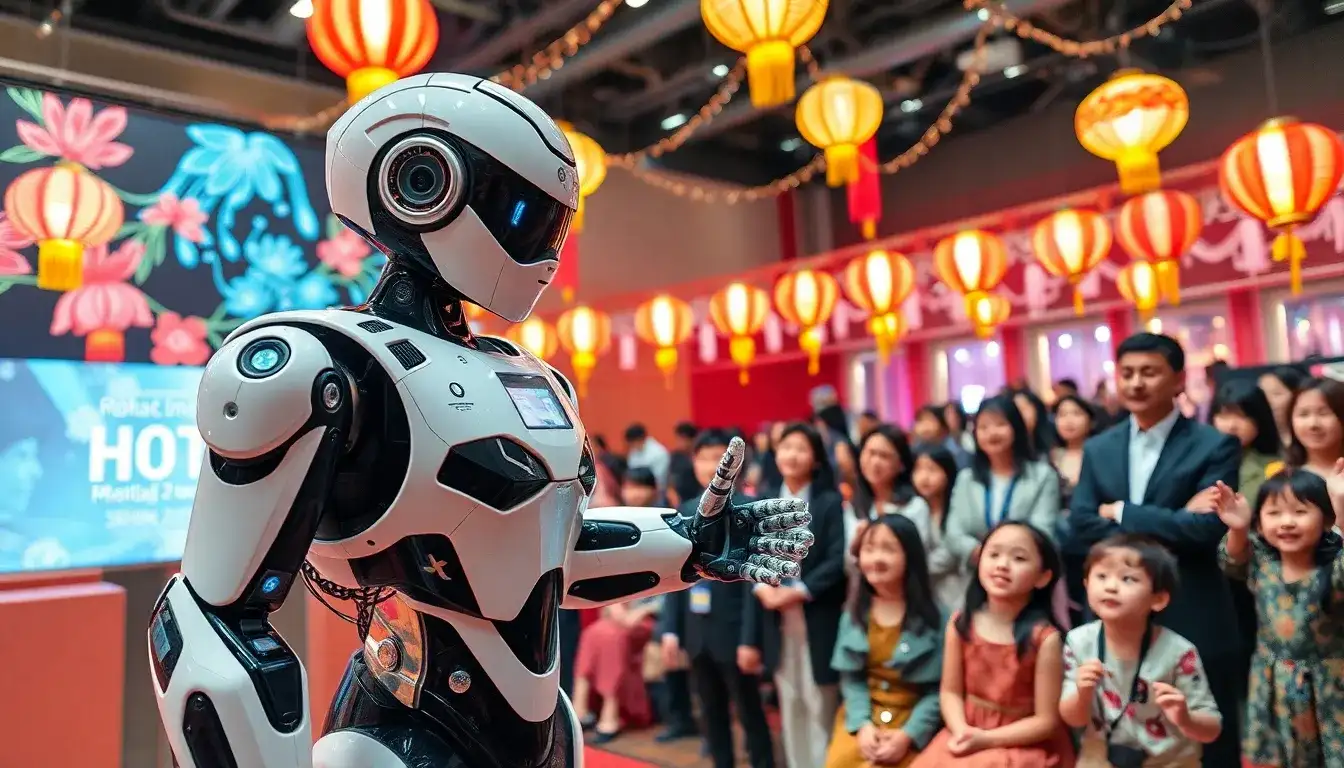
Yushu Technology Unveils Its Innovations! After showcasing robots performing martial arts at the Spring Festival Gala, the technology is set to be applied in real-world scenarios.
On the stage of the Central Radio and Television Station’s 2026 Spring Festival Gala, Yushu Technology made its third appearance as a partner for the gala’s robotic performances, featuring its G1 and H2 humanoid robots. They presented the world’s first fully autonomous humanoid robot cluster martial arts performance in a show titled “Wu BOT”. Yushu Technology highlighted that their humanoid robots demonstrated unprecedented athletic capabilities and achieved several global firsts: the first continuous acrobatic table-running, the first ejected somersault with a height exceeding 3 meters, the first single-leg continuous somersaults, wall-kicking backflips, and the first Airflare with seven and a half rotations among other difficult maneuvers. The performance utilized a newly upgraded high-concurrency cluster control system to achieve coordinated control, enabling dozens of robots to execute synchronized actions with strict error control and minimal delay.
According to Yushu Technology, the preparation for the “Wu BOT” program began in November 2025. The team dismantled the program’s concept into several technical modules, simultaneously developing basic software and verifying algorithms, including the dance cluster control platform, positioning algorithm upgrades, and testing new motion control algorithms. They collaborated closely with the performers (from the Tagou team) and set up real-world testing venues to fine-tune the process. Yushu Technology stated, “During this period, we engaged in multiple rounds of on-site communication and joint optimization with the gala’s directing team. After repeated iterations and numerous rehearsals, we showcased the complete program to the audience on New Year’s Eve.”
Throughout the preparation process, the Yushu Technology team tackled three major categories of technical challenges at different stages. In the early phase, the focus was on designing control algorithms and training models to address key issues such as action transitions, time synchronization, and cluster control. The mid-phase presented challenges related to navigation and trajectory tracking. Yushu used an AI-integrated positioning algorithm that processes the robot’s sensory data and deeply fuses it with 3D LiDAR data, handling hundreds of environmental data points per second, ensuring precise positioning even during intense movements, thus avoiding the loss of tracking during flips. The later stage concentrated on stabilizing high-difficulty actions, with the team performing extensive testing to analyze issues, leading to hardware upgrades and optimizations of action mapping and dynamic parameters, enhancing the quality of standard martial arts movements while ensuring stability for advanced stunts.
Yushu Technology identified three categories of the most challenging technical moves in the “Wu BOT” performance, each presenting its own technical barriers. The first category involves object interaction moves, such as staff techniques and double-section staffs, where the complexity lies in the robot’s real-time perception and adaptive control of the equipment’s state and external disturbances. Yushu developed a physical model for the equipment and conducted extensive reinforcement learning training in a simulated environment, allowing the robots to master dynamic perception and torque control of the equipment. The second category encompasses environmental interaction moves, such as parkour table flips and wall kicks, where the main challenge is precise estimation of relative positioning during high-speed movements and dynamic adjustments of landing points. Engineers trained the robots to plan their steps in real-time during sprints by exhaustively simulating possible posture deviations, ultimately achieving stable navigation over obstacles like tables and walls. The third category consists of extreme ground movements, such as continuous aerial rotations, which test the robot’s hardware performance, motion control, and integrated positioning to the limit. The Yushu team completed high-difficulty stunts capable of achieving centimeter-level landing precision after flips through hardware upgrades, motor performance optimizations, iterative control algorithms, and multi-sensor fusion positioning.
To achieve a fully autonomous performance involving dozens of robots, Yushu Technology implemented systematic upgrades across algorithms, hardware, and systems. They stated that the performance relied on a self-developed system, using 3D LiDAR for real-time laser scanning and positioning of the entire stage, enabling robots to ascertain their positions. Upon receiving commands from the control console, the robots utilized movement control algorithms to track the target point trajectory and reach it within the designated timeframe, followed by executing martial arts sequences with precision. During the high-intensity performance, Yushu robots feature real-time self-monitoring capabilities, allowing them to identify and quickly recover from anomalies to ensure stable and smooth execution of martial arts movements over extended durations. Additionally, multiple robots can autonomously maintain precise positioning and formation consistency while dynamically moving, enabling rapid recovery even if any robot deviates from its path.
Following the Spring Festival performance, the question of how these robotic capabilities can be applied and commercialized in real-world scenarios is a common challenge faced by humanoid robot companies and a focal point of market interest. Yushu Technology emphasized that the technical challenges overcome during the program are highly relevant to the challenges robots face in real-world applications, presenting a clear path for application migration. They noted that the multi-robot collaborative system supporting the martial arts performance’s automatic control addresses real-time scheduling and action synchronization for dozens of robots in complex formations. This technology can be transferred to industrial scenarios such as multi-robot collaborative inspections, warehouse sorting, and assembly lines, enabling efficient scaling of operations. The skills demonstrated in handling external forces during staff techniques are directly applicable to precision assembly, heavy lifting, and domestic services, allowing robots to adapt to external disturbances in real-time. The parkour table-flipping actions showcased relative positioning and environmental interaction technology, which aligns closely with tasks requiring robots to place goods on shelves, navigate tight spaces, and ascend or descend stairs. When transferred to real-world applications, this technology will significantly enhance the efficiency and adaptability of robotic operations.
Original article by NenPower, If reposted, please credit the source: https://nenpower.com/blog/yutree-technology-unveils-revolutionary-robotics-performance-at-spring-festival-gala/

