

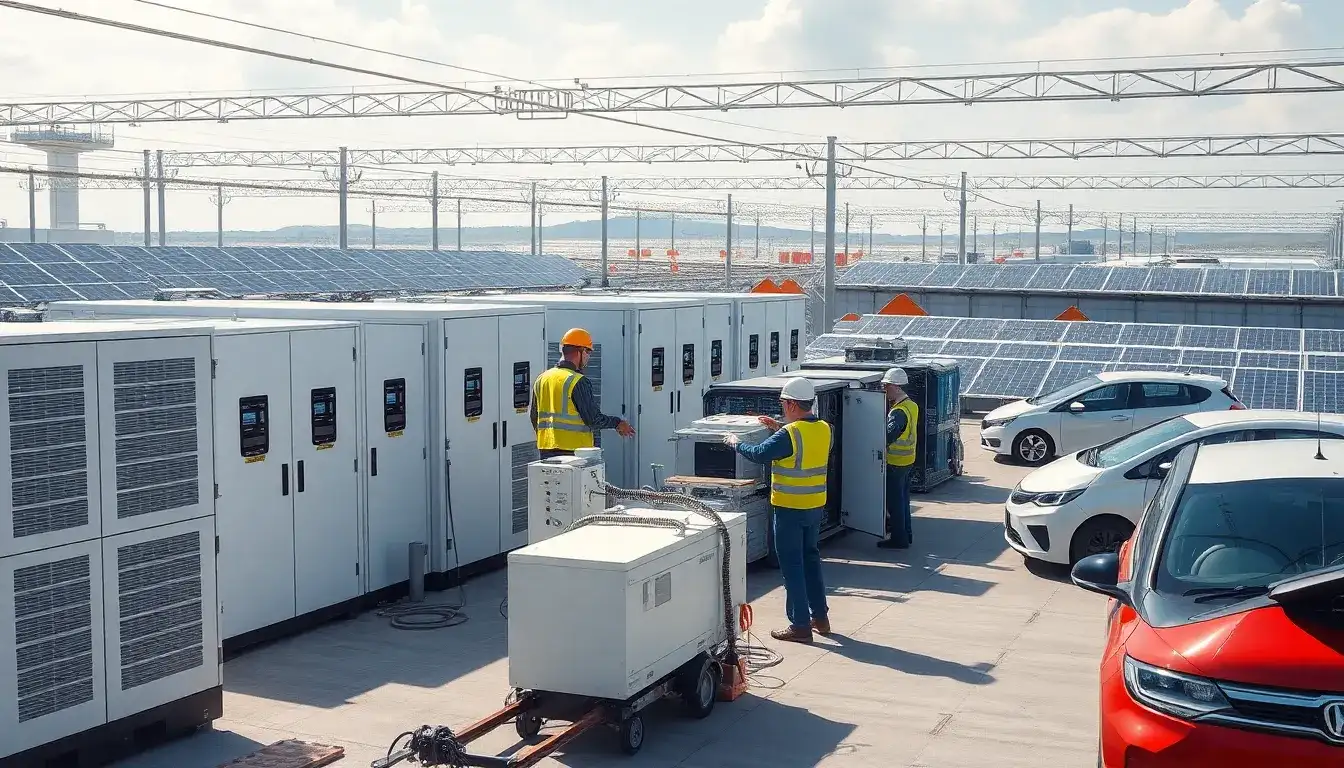
The era of the energy storage “aftermarket” is approaching. Are industry chain companies ready for it? The energy storage “aftermarket” era is on the horizon, marked significantly by the “Document 136,” which heralds the full market entry of new energy sources. This shift is characterized by energy storage operations and maintenance services, which are rapidly evolving. From an operational standpoint, following the issuance of Document 136, the revenue model for energy storage projects has transitioned from relying on “capacity leasing fees and government subsidies” to market-oriented transactions. These transactions include various channels such as arbitrage in the electricity spot market, frequency modulation, peak shaving assistance services, and capacity compensation. Consequently, the ability to operate energy storage projects has become a critical necessity. In other words, only those energy storage projects that can be effectively managed will be considered valuable assets, making operational strategies a vital component of the emerging energy storage market.
From the maintenance and operation perspective, data from the National Energy Administration indicates that by the end of 2024, the total installed capacity of newly built energy storage projects in the country is expected to reach 73.76 GW / 168 GWh. As we observe from multiple dimensions, the energy storage aftermarket era is indeed approaching. Are industry chain companies adequately prepared?
Changing Trends: The Arrival of the Energy Storage Aftermarket Era
Industry insiders believe that the “pre-era” of energy storage is characterized by policy-driven mandates and extensive growth, while the “after era” will implement refined operations and value creation through market mechanisms and technological innovation. This transformation is not only a necessary evolution of the energy revolution but also offers the industry an opportunity to shift from being “passive supporters” to “active profit generators.”
The pre-era of energy storage refers to the period dominated by policy, particularly before the rollout of the “Document 136” in 2025. During this time, policies mandated the integration of energy storage systems with renewable energy projects, leading to a situation where many photovoltaic power plants had idle energy storage facilities. The enforced integration ratio of 10-20% resulted in short-term growth in energy storage capacity but lacked a market-driven revenue mechanism, leading to low utilization rates—averaging only 6.1% and a prevalence of unused assets. Revenue for energy storage projects relied heavily on government subsidies or capacity leasing fees, resulting in generally low internal rates of return (IRR) and prolonged investment recovery periods.
The post-era of energy storage will be defined by competitive market dynamics following the removal of mandatory storage integration policies in the “Document 136.” The focus will shift to market mechanisms, diversifying revenue models to include arbitrage from peak and valley price differences, compensation for auxiliary services, virtual power plant responses, and carbon asset trading. Under this market paradigm, models such as shared energy storage, integrated photovoltaic systems, and virtual power plants are expected to transition from being cost burdens to revenue-generating assets.
Navigating the Energy Storage Aftermarket: Overcoming Operational and Maintenance Challenges
The vision for the energy storage aftermarket era is clear, yet two significant challenges remain on the path ahead. The first is determining how to make energy storage profitable. As renewable energy enters the market, electricity price fluctuations intensify, necessitating that energy storage systems optimize their charge and discharge strategies through precise forecasting of peak and valley price differences. Recently, the National Development and Reform Commission and the National Energy Administration jointly issued the “Basic Rules for the Electricity Auxiliary Service Market,” aimed at further exploring the potential for regulating the electricity system through market mechanisms. Electricity auxiliary services encompass various system adjustment services provided by both generation and consumption sectors, essential for maintaining system stability.
With the increasing share of renewable energy in China’s generation mix, the demand for flexibility within the power system has surged, necessitating further exploration of the system’s adjustment potential through market mechanisms. The newly released rules comprise 12 chapters and 67 articles. According to officials from the National Energy Administration, market participants in electricity auxiliary services include power generation enterprises, electricity sales companies, electricity consumers, and innovative operational entities. The rules specifically recognize the operational positions of energy storage companies, virtual power plants, intelligent microgrids, and vehicle-grid interactive operations, guiding new operational entities to participate in system adjustments.
Furthermore, the rules enhance the auxiliary service fee transmission mechanism, establishing a principle of “who benefits, who bears the cost,” and suggesting that in regions where the electricity spot market operates continuously, the costs of frequency regulation and reserve services should be shared by users based on their electricity consumption and untraded generation. The government continues to release new regulations to explore the potential for auxiliary services in the electricity market, which will ultimately make energy storage a lucrative venture.
According to Liu Jiale from the Southern Power Grid’s dispatch control center, “Our ideal goal is for the capacity price to cover most of the fixed investment returns of new energy storage systems, while the spot price differences should cover daily operating expenses, some financial costs, and taxes to meet basic operational needs, with the auxiliary service market providing additional incentives.” Wang Youjia, vice president of Rongheyuan Storage, views the shift towards market-oriented policies as a positive sign for the industry’s development. For companies focusing on energy storage asset operations, the complex attributes of storage operations mean that marketization emphasizes long-term value post-construction.
Historically, the industry has prioritized upfront construction costs, but now a balance must be struck between construction costs, operational expenses, and revenues for sustainable long-term development. This shift presents more opportunities for companies like Rongheyuan Storage, promoting healthy industry growth. For instance, Rongheyuan Storage currently operates nearly 300 sites, generating around 25,000 strategies daily. The emergence of AI technology has made the automation of strategy generation possible. However, AI also faces challenges such as “hallucinations,” which can lead to numerous erroneous commands that jeopardize operational asset safety. Therefore, continuous interaction between professionals and AI is necessary to refine its decision-making processes.
Looking ahead, the deep integration of AI and IoT technologies for accurate load forecasting, fault warning, and comprehensive lifecycle management will become the focal point for energy storage companies. Currently, there is a significant trend of equipment manufacturers transitioning towards operations in the commercial and industrial storage sectors, although this market is still in its infancy. Effectively realizing the operational efficiency of storage projects could establish a unique competitive advantage for industry chain companies.
The second challenge is ensuring the efficient and safe operation and maintenance (O&M) of energy storage stations. Presently, most storage stations have simple and crude maintenance processes, lacking effective management tools to meet safety and efficiency requirements. There is a shortfall of over 200,000 O&M personnel, with a high demand for skilled technicians outpacing availability at a ratio of 1:8. Current O&M service capabilities only meet 40% of market demand, with 60% of fault responses exceeding 48 hours. According to Li Zhanwei, deputy director of the New Energy Storage Research Center at Datang Central and Southern China Institute, there is a significant lack of dedicated personnel for energy storage operations and maintenance across the industry, coupled with high technical experience requirements.
O&M personnel are required to work shifts and systematically troubleshoot equipment failures, with labor costs constituting a significant portion of operational expenses. Comprehensive management using big data is essential for software operation, battery lifespan monitoring, early warning systems, and overall station management. Smart O&M can assist in identifying faulty equipment and problem areas, increasing efficiency among O&M staff. By implementing a system of comprehensive monitoring, the information can reach the personnel rather than requiring them to search for it, freeing them to focus on higher-value tasks.
Li Zhanwei also emphasized the importance of addressing equipment issues, noting that battery packs are becoming heavier and larger, complicating the replacement and maintenance process. When a battery pack malfunctions, removing it for repairs can be challenging due to its weight, often requiring several personnel. Furthermore, maintenance tools are often inadequate for accessing confined spaces, hindering effective servicing. The design of energy storage stations still largely follows that of traditional thermal and renewable power plants, and the spatial constraints between compartments can complicate maintenance efforts.
As the number of devices in energy storage stations increases, the maintenance gap widens, and prolonged, improper repairs can delay the return to normal operations, ultimately diminishing revenue and potentially affecting grid stability. More professionals in the industry are recognizing that effective O&M is crucial for ensuring the long-term safe operation of energy storage stations, supporting various functions such as peak regulation and valley filling to maximize value and profitability post-commissioning. For instance, in the commercial and industrial storage sector, the cross-cycle nature of products makes it challenging to completely mitigate risks associated with the investment model over the contract period, necessitating high-quality operational capabilities to secure revenue. Poor operational strategies and weak O&M capabilities can lead to financial losses.
Recent advancements in intelligent technologies are reshaping the O&M value chain. For example, CATL has introduced the “Tianji” system, which leverages extensive sensors for millisecond-level fault detection, enhancing the efficiency of thermal runaway warnings. Envision Energy’s EnOS platform integrates digital twin technology to improve frequency regulation response times, directly connecting to the electricity spot market for arbitrage opportunities. For thousands of energy storage equipment manufacturers, competition in the aftermarket era is no longer solely about device quality but rather about the comprehensive capabilities offered in operations and maintenance.
Are Energy Storage Industry Chain Enterprises Prepared for the Aftermarket Era?
Today, the energy storage sector is highly competitive, yet much of the focus remains on equipment. The operations and maintenance sectors still present a blue ocean opportunity. Notably, tech companies like Tencent have accelerated their entry into the energy storage O&M and scheduling markets, utilizing AI and big data since 2022. According to Sun Fujie, chief expert in the energy and resources sector at Tencent Cloud, their “city-level integrated energy digital operations platform” is designed to provide a range of services—including energy storage management, photovoltaic management, charging management, demand response, virtual power plants, energy efficiency analysis, and carbon asset management—leveraging cutting-edge technologies to assist various energy stakeholders in effectively achieving energy savings, carbon reduction, and cost reduction, thereby supporting regional energy coordination and the transition to a green, low-carbon economy.
Since early 2025, Tencent has been particularly active in AI initiatives, which may further deepen their algorithmic involvement in the energy storage industry. However, operations and maintenance should not only be an extension of business for tech giants but also a key focus for energy storage equipment manufacturers. Liu Weizeng, chairman of Singularity Energy, previously noted in an interview that the real risk in commercial storage arises after one year of project operations when actual performance data diverges significantly from initial investment models, leading to unpredictable revenue risks.
Leading companies such as Tesla, Sungrow, Haibo Sourcing, Envision Energy, Trina Storage, Kelu Electronics, and JinkoSolar have developed software algorithm platforms tailored to the energy storage sector. For example, Rongheyuan Storage, as the first domestic energy storage system integrator to operate power stations, has consistently adhered to the “operations+” strategy. They have developed an integrated operational cockpit system called “Rongheyuan·Bai Ze” specifically for managing commercial energy storage systems. Currently, their digital services account for over 80% of supervisory management tasks and 90% of equipment maintenance responsibilities, consistently ranking in the top five in terms of spot market revenue across similar projects, with capabilities in battery diagnostics, maintenance, and evaluations ensuring the safe and stable operation of energy storage stations throughout their lifecycle.
Singularity Energy has also innovated the eGo energy storage ecological collaboration platform, connecting all essential information across development, investment, construction, equipment manufacturing, and O&M, creating a data-driven growth cycle that empowers users and investors to achieve safe, reliable, and consistent returns. Users can search for the “Singularity Storage” mini-program on WeChat to digitalize operations, clarify revenue, and simplify services.
In the realm of O&M, some domestic energy storage stations have begun utilizing drones equipped with high-definition cameras and infrared thermal imaging devices for comprehensive inspection and diagnostics of battery groups. Drone inspections are not only faster and more extensive but also allow real-time transmission of inspection data, providing O&M personnel with clear diagnostic results. By comparing and analyzing inspection data, O&M staff can promptly identify anomalies in battery groups and implement appropriate corrective actions, effectively preventing faults.
Whether from internet giants or energy storage industry chain companies, actions in the energy storage aftermarket are still in the preliminary stages. However, it is optimistic to foresee that those who dominate the aftermarket will ultimately prevail. As the complexity of energy storage systems surpasses that of traditional thermal power by threefold, and with fault propagation speeds reaching the millisecond range, operations and maintenance are no longer a simple matter of “fixing,” but rather a critical battle for the survival of the new energy ecosystem.
Original article by NenPower, If reposted, please credit the source: https://nenpower.com/blog/the-rise-of-the-energy-storage-aftermarket-preparing-for-a-transformative-era-in-the-industry/

