

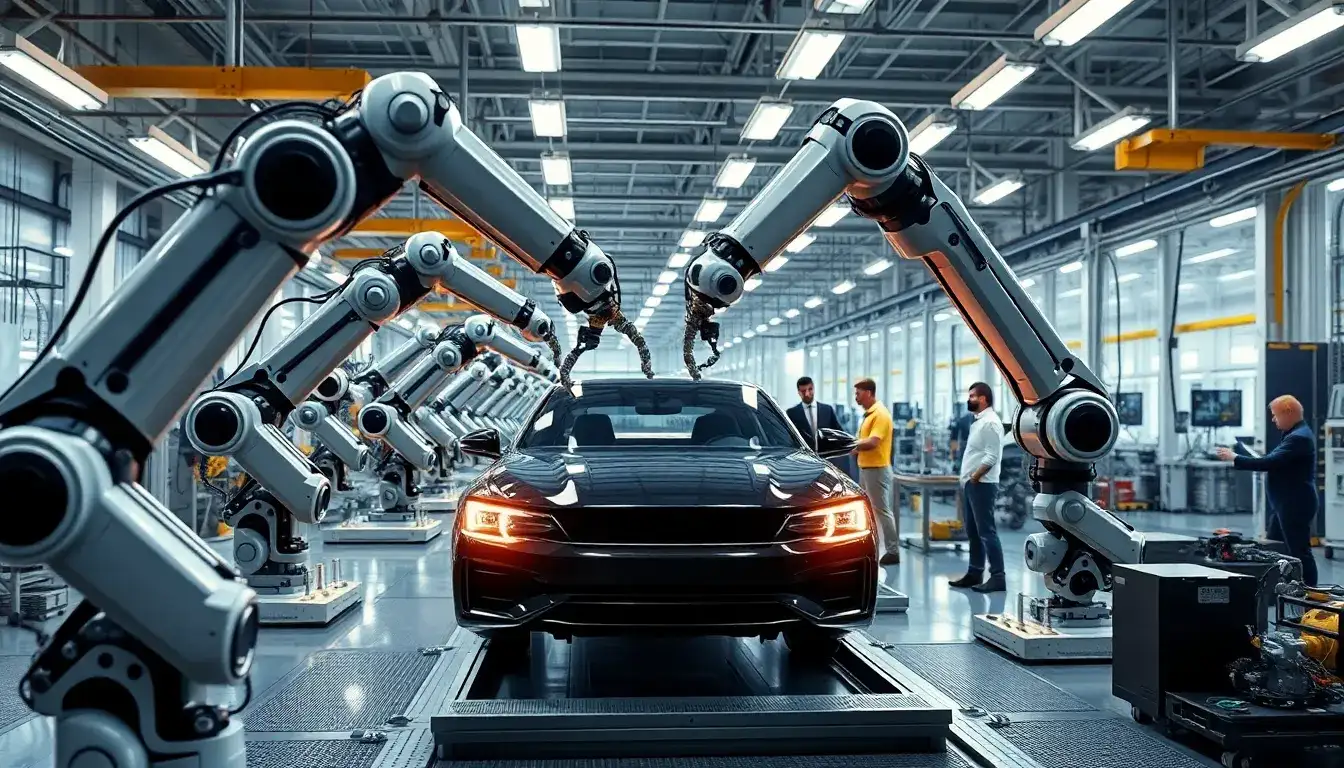
The Rise of Robotic Car Factories by 2030: Will They Fully Replace Human Labor?
Robots are making significant strides! From their early, clumsy movements, they have evolved to be agile enough to walk the runway, assemble parts, and even sell cars to customers. The growth of robotics is accelerating quickly.
Recently, industry experts reported that the world’s first fully robotic car manufacturing plant is expected to begin operations before 2030, with the United States and China poised to lead this sector. According to reports, nearly half of the top 25 global automakers are piloting advanced robotic technologies in their factories. This raises the question: will robots replace human workers in car manufacturing in the near future?
The Countdown to Robotic Factories
By 2030, a seemingly distant date, the automotive manufacturing industry is becoming a pivotal turning point. Several consulting firms from Europe and the U.S. predict that within just a few years, car manufacturers will overcome technological barriers to develop fully automated production lines, achieving 100% assembly automation and moving away from human dependency.
A representative from an American consulting agency, after analyzing the global automotive landscape, indicated that the U.S. and China have gained a competitive edge in revolutionary manufacturing processes, especially in the research and application of humanoid robots, making it highly likely they will lead the world in establishing fully automated car assembly lines around 2030. A German analyst expressed particular optimism about China’s development potential, stating that launching the first fully robotic car factory in China before 2030 is entirely feasible. By then, a “dark factory” where robots operate entirely independently will be a reality, with all automotive production processes executed with precision by robots, allowing for 24/7 manufacturing without human oversight.
In fact, the race towards robotic manufacturing is no longer a secret among global automakers. Recently, at CES 2026, South Korea’s Hyundai Motor Company announced plans to deploy humanoid robots from its Boston Dynamics subsidiary on a large scale in its Georgia manufacturing facility starting in 2028. Moreover, Hyundai aims to establish a comprehensive production system targeting an annual output of 30,000 robots, enabling these “Iron Men” to excel in various aspects of car manufacturing, from precise component handling to complex operations, thus significantly enhancing production efficiency. Notably, Hyundai’s newly unveiled humanoid robots can rotate their heads 180 degrees without turning their bodies, allowing for seamless transitions between front and back operations.
Reports indicate that Mercedes-Benz is actively piloting humanoid robots at its digital factory in Berlin. A spokesperson for Mercedes believes that the integration of artificial intelligence and humanoid robots will open unprecedented opportunities in automotive production, leading to significant advancements in sustainability, efficiency, and intelligence. The robots in the pilot program are gradually adapting to the factory environment, collaborating with traditional assembly line workers to optimize and innovate production processes.
Solid Support and Challenges Ahead
Not only abroad, but domestic automotive companies in China are also incorporating various types of robots in their factories. Industry experts believe that the intelligent transformation of automotive factories brought about by robots is not due to a single technology but results from the deep integration of generative AI, intelligent agent technology, digital twin technology, and robotics. In the future, robots are expected to significantly enhance operational efficiency in automotive factories, allowing companies to greatly reduce costs.
In this technological revolution, generative AI acts as a creative “brain,” capable of generating new design schemes and processes based on vast data, injecting continuous innovation into automotive development and manufacturing. Intelligent agent technology empowers robots with autonomous decision-making and learning capabilities, enabling them to adapt flexibly to various unexpected situations in complex production environments. Digital twin technology bridges the physical and virtual worlds, allowing for real-time simulation and monitoring of production processes, which helps anticipate potential issues and optimize workflows to enhance efficiency and quality.
Humanoid robots are at the forefront of this transformation, gradually integrating into various stages of automotive production due to their unique human-like form and operational flexibility. They can mimic human movements and operate comfortably in tight spaces to complete intricate tasks that traditional robots struggle with. Research suggests that if large automotive companies can accelerate the development and application of these advanced robotic technologies, they could unlock up to $150 billion in potential economic value annually.
However, some industry experts caution that despite rapid technological advancements, achieving fully robotic car factories presents significant challenges. An analyst from a U.S. consulting firm highlighted that the installation of wiring harnesses and the assembly of cockpit components are major obstacles hindering the progress of full automation. Wiring harnesses, which serve as the car’s “nervous system” by transmitting power and signals, are complex to install. The cumulative length of wiring in each vehicle can reach thousands of meters, incorporating numerous intricate branches and connections that must be accurately linked to various electrical components. Current robots often struggle with this complexity. Additionally, the assembly of cockpit components remains challenging due to the diverse shapes and sizes of parts like seats and dashboards, which require high precision during installation—skills that currently necessitate human expertise and touch.
The Debate Over Replacing Human Labor
As advanced technologies bring more conveniences, the question arises: will fully robotic car factories render human workers obsolete? Some experts argue that even in a highly automated future, automotive factories will still rely on human intelligence and creativity. While robots can tirelessly complete production tasks, they are not infallible and require regular maintenance. When robots malfunction, skilled technicians with extensive experience and expertise are needed for repairs. These technicians must be well-versed in both the hardware and software of robots, as well as their operational principles. Currently, Tesla’s production facility, despite its high level of automation and numerous robots, still requires a significant number of skilled technicians to maintain and manage robots, ensuring optimal functioning across the production line.
Moreover, in automotive research and innovation, the role of humans remains indispensable. The design and development of cars demand a blend of market research, user needs analysis, creative thinking, and engineering calculations, making it a highly creative endeavor. While robots can provide data support and simulation analysis, they lack the market insight and imagination that humans possess to propose comprehensive and innovative designs. As of now, every new car represents the culmination of the expertise of countless automotive engineers and designers—an achievement that robots have yet to match.
Thus, experts suggest that, in practical terms, both robots and humans have their strengths in automotive manufacturing, and collaboration between the two will be the mainstream trend of the future. In some automotive factories abroad, robots primarily perform repetitive and standardized tasks such as painting and welding, achieving high precision within set timeframes to ensure product quality. However, in areas requiring fine manipulation and adaptability, such as installing suspension bolts, experienced workers are still essential for their analytical and judgment capabilities.
With the arrival of robots in automotive factories by 2030, experts believe that robots will take on standardized and repetitive tasks on the production line, enhancing efficiency as the new workforce. Meanwhile, human employees will leverage their unique innovative thinking, sensitive perception, and complex problem-solving skills in critical areas such as research and development, strategic decision-making, and quality control, driving the automotive industry toward greater innovation. The synergy between human and machine collaboration will be crucial in shaping a promising future for the automotive manufacturing sector.
Original article by NenPower, If reposted, please credit the source: https://nenpower.com/blog/the-future-of-automotive-manufacturing-will-robots-completely-replace-humans-by-2030/

