

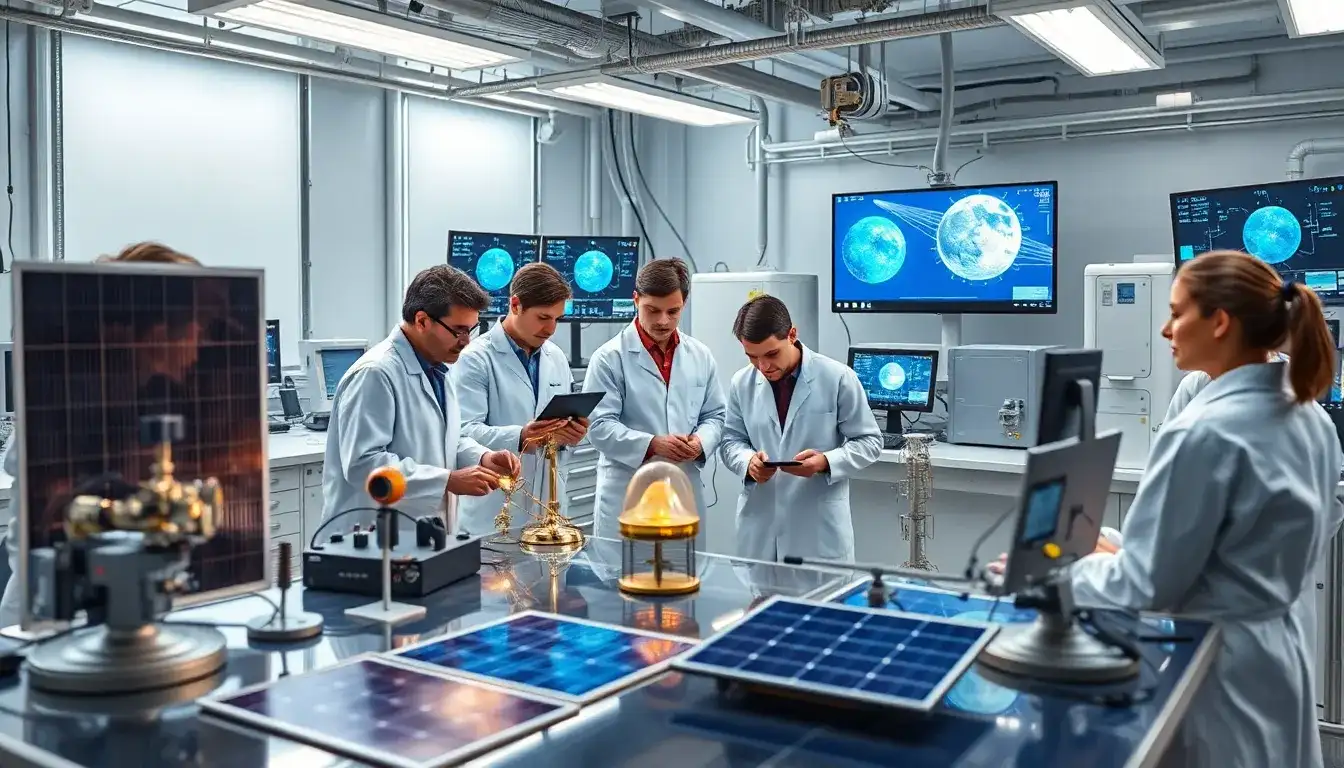
New Collaboration to Pioneer Solar Technology for Space
Swansea and Loughborough Universities have teamed up on an innovative mission to advance solar power in space by developing lightweight cadmium telluride (CdTe) solar cells on ultra-thin glass. This groundbreaking technology is poised to transform energy systems for satellites and space-based manufacturing.
As the global space industry expands—valued at £17.5 billion in the UK alone—the need for efficient and scalable solar power is increasingly urgent. The European Space Agency anticipates a surge in space solar demand, predicting an increase from just 1 MWp/year to an impressive 10 GWp/year by 2035. This growth is fueled by the expansion of satellite constellations, such as SpaceX’s Starlink, and the rise of space-based manufacturing, which includes sectors like semiconductors and fiber optics.
Currently, space missions primarily utilize silicon or multi-junction solar cells (MJSCs). While MJSCs are favored for their high efficiency, their complex manufacturing processes and high costs hinder scalability. The new CdTe-on-glass technology, which was initially tested in space aboard the AlSat-Nano CubeSat, presents a lighter, more cost-effective, and highly radiation-resistant alternative. This technology aims for an efficiency of 20% in space and has already achieved 23.1% on Earth.
This three-year collaboration is funded by UK Research and Innovation’s Engineering and Physical Sciences Research Council (UKRI EPSRC) and utilizes state-of-the-art facilities at both universities. Swansea’s Centre for Integrative Semiconductor Materials (CISM) boasts advanced tools, such as the AIXTRON CCS MOCVD system, while Loughborough provides its National Facility for High-Resolution Cathodoluminescence Analysis, which is crucial for studying solar and optoelectronic devices.
Professor Paul Meredith, Director of CISM at Swansea University, stated: “CISM has historically focused on clean energy, efficient power, microelectronics, and semiconductors in healthcare. Recently, we have expanded into semiconductor technology for space applications through our UK-first Space Semi-Tech Foundry program. This partnership addresses a critical need and presents a unique opportunity to support the UK’s strategic vision of capturing a significant share of the global space technology market. Our technology offers higher specific power, longer service life in space, and significantly lower costs—key advantages for powering the next generation of space missions.”
Michael Walls, Professor of Photovoltaics at Loughborough’s Centre for Renewable Energy Systems Technology (CREST), added: “Space technology is an exciting growth industry. Reducing the weight of the payload is vital for lowering launch costs. This project aims to develop a lighter power source by depositing thin film solar cells directly onto the protective cover glass. Additionally, thin film cadmium telluride solar cells are exceptionally resistant to radiation, enabling longer deployment in space.”
The project also enjoys robust industry support, with six partners contributing technical expertise and in-kind assistance valued at £112,000. The partners include 5N Plus Inc. (Canada), AIXTRON (UK), CTF Solar GmbH (Germany), Teledyne Qioptiq (UK), the Manufacturing Technology Centre (UK), and Satellite Applications Catapult (UK).
Original article by NenPower, If reposted, please credit the source: https://nenpower.com/blog/swansea-and-loughborough-universities-collaborate-to-innovate-solar-technology-for-space-applications/

