

Carbon Footprint Innovation for the Future – The Successful Conclusion of the Third International Carbon Footprint Innovation Development Forum in Beijing
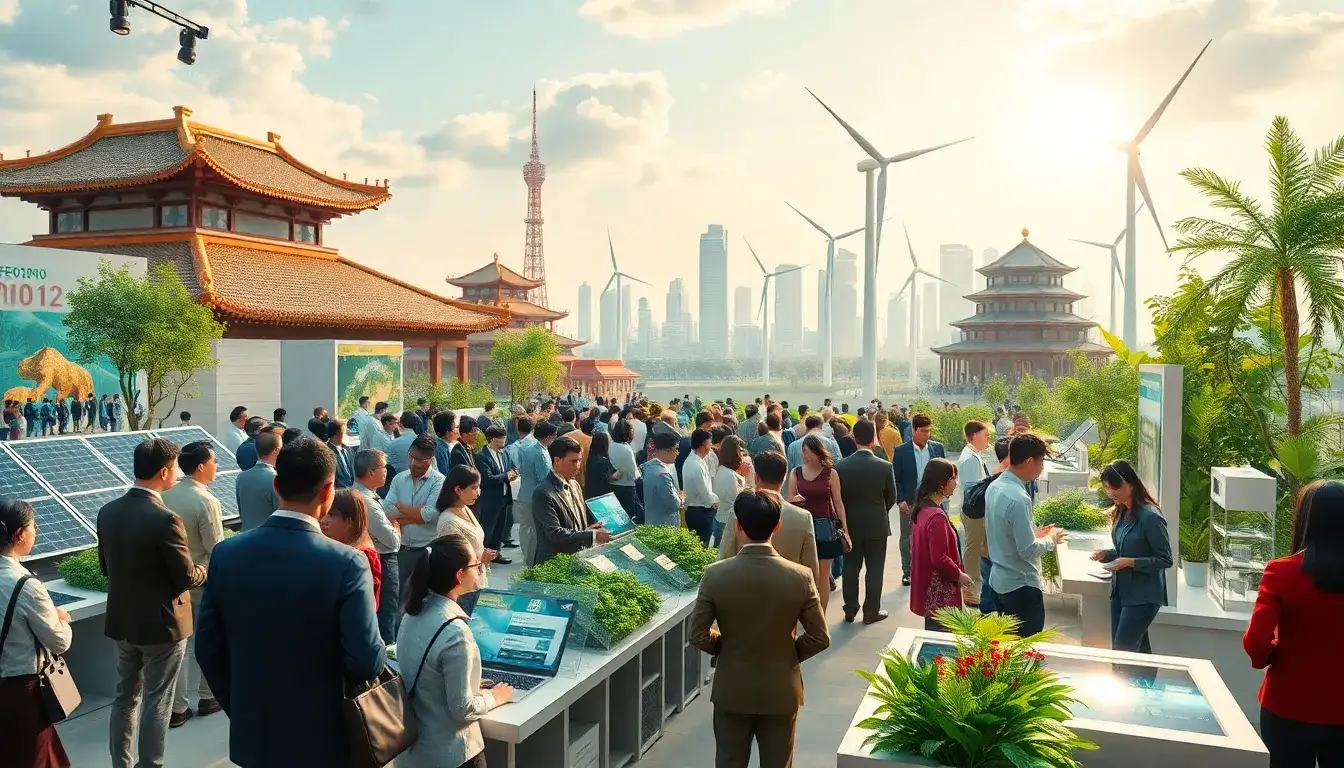
On May 16, 2025, the Third International Carbon Footprint Innovation Development Forum, organized by the China Building Materials Market Association and hosted by Beijing Green Forest Certification Co., Ltd., concluded successfully at the Beijing International Hotel. This event was strongly supported by various organizations, including the National Carbon Footprint Innovation Alliance, Beijing Green Aono Technology Service Co., Ltd., and China North Testing (Beijing) Technology Co., Ltd. Over 300 representatives from industry, academia, and research gathered to discuss innovative development paths for promoting green and low-carbon transformations across various sectors under the “dual carbon” goals.
Yuan Lele, the Deputy General Manager of Beijing Green Forest Certification Co., Ltd., welcomed all attendees warmly and expressed sincere gratitude for their presence.
XU Huaqing, Chief Scientist at the National Climate Change Strategy Research and International Cooperation Center, congratulated the successful convening of the forum and praised its focus on carbon footprint innovation and its role in fostering consensus for green and low-carbon transformations in industries. In his opening remarks, he emphasized the importance of addressing climate change, noting that carbon footprint management has become a key tool for overcoming international green trade barriers and enhancing corporate competitiveness. XU highlighted that promoting green and low-carbon economic and social development is essential for achieving high-quality growth. He called for deepening the “three collaborations” – technological innovation, standard recognition, and international cooperation, presenting the vision of “using carbon footprint as an engine to achieve a zero-carbon future together.”
DING Lizhong, Secretary-General of the China Building Materials Market Association, also welcomed the guests during his speech. He elaborated on the development paths and responsibilities of the building materials and home furnishings industry in the context of the dual carbon strategy. He cited data indicating that China, as the world’s largest producer and consumer of building materials, has an industry scale of 70 trillion yuan with 220,000 enterprises above designated size. However, it is also a key area for energy consumption and carbon emissions, necessitating breakthroughs through the reconstruction of green supply chains, development of low-carbon technologies, and implementation of circular economy models. DING revealed that the tightening mechanism for carbon emission quotas will strongly drive the industry towards resource recycling. The application of technologies such as recycled building materials, prefabricated buildings, and waste resource utilization has entered a rapid development phase. In addressing the industry’s transformation challenges, he called for the establishment of a collaborative innovation ecosystem to accelerate the creation of a carbon footprint management system with Chinese characteristics and international influence, jointly promoting high-quality development in the building materials and home furnishings sector.
WU Yiqiang, President of the National Carbon Footprint Innovation Alliance and an academician at Central South University of Forestry and Technology, could not attend in person due to important research commitments but shared his insights on low-carbon industries remotely. He analyzed the opportunities and challenges faced by Chinese enterprises under the new global carbon governance landscape and offered valuable suggestions on “co-establishing standards, collaborative innovation, and empowering green finance.” WU pointed out that current policies such as the EU Carbon Border Adjustment Mechanism (CBAM) and the new battery regulations are reshaping international trade rules, elevating carbon footprint accounting from a technical issue to a multidimensional rule-based game. He urged for accelerated promotion of mutual recognition of carbon accounting standards and active participation in the formulation of international rules. WU emphasized the importance of integrating digitalization and low-carbonization, as well as the urgent need for top-level design. He expressed hope that the forum would serve as a new starting point for enterprises to collaborate and write a new chapter in low-carbon transformation.
Tian Jinping, a professor at Tsinghua University’s School of Environment, delivered a keynote speech titled “Building Zero-Carbon Industrial Parks for a Beautiful China,” proposing a methodological transformation for parks based on industrial ecology theory. He stated that industrial parks are the main battlefield for promoting industrial green and low-carbon development in the new era. By analyzing the Beijing Economic and Technological Development Zone, he showcased the current situation where the energy infrastructure of parks contributes to 75.2% of carbon emissions and suggested strategies for promoting upgrades to small-scale cogeneration units and renewable energy alternatives through “existing stock renovation + incremental optimization.” Tian emphasized that “zero-carbon parks are not merely about labeling, but rather about finding the optimal balance between industry and ecology through a three-dimensional analysis of material flows, energy flows, and carbon flows.”
CHAI Qimin, Director and Researcher at the Strategic Planning Department of the National Climate Strategy Center, shed light on the urgency of the global carbon budget and the constraints posed by carbon emission rights on industrial development. In the face of new changes in international conditions, he underscored China’s solemn commitment to “three unchanges” in responding to climate change: maintaining domestic climate action strength, continuing international cooperation efforts, and persistently building a community with a shared future for mankind. He indicated that carbon emission rights are becoming scarcer than traditional natural resources, with global green investment continuing to expand, and China maintaining its position as the world’s largest green investment country for ten consecutive years. CHAI further elaborated on national policy directions under the dual carbon objectives, including the shift from energy consumption control to carbon emission control and the expansion of the carbon trading market. Finally, he proposed a series of response strategies, including building zero-carbon parks and implementing major climate projects, as well as establishing a differentiated policy support system and strengthening market mechanisms and technological innovation to provide robust guidance for the green and low-carbon transformation of industries.
XU Runsheng, a professor at Beijing University of Science and Technology’s School of Metallurgy and Ecology, provided an in-depth analysis of the prospects for biomass energy applications in the metallurgy and steel industry. He noted that the steel industry, as a high-energy-consuming sector, accounts for 16% of national carbon emissions and is under tremendous pressure to reduce emissions. He detailed the application scenarios of biomass energy in various processes such as ironmaking and steelmaking and discussed the advantages of biomass energy over traditional fossil fuels. Additionally, he shared his team’s latest research results in biomass energy pretreatment technology and industrial applications in companies like Shougang, showcasing the immense potential of biomass energy for achieving a green and low-carbon transformation in the steel industry.
Amidst the dual carbon goals, WU Shengfu emphasized the seriousness of current trade barriers and shared a series of response strategies. He promoted the independently developed intelligent carbon management platform and carbon sink management platform by Green Forest Certification, stating that as a benchmark enterprise in the green, low-carbon, and sustainable certification field, Green Forest Certification has been recognized as a “High-tech Enterprise” and a “Specialized, Refined, Unique, and Innovative” small and medium-sized enterprise in Beijing. The two platforms, launched earlier this year, provide full-process services such as carbon inventory, emission reduction path planning, and certification report generation, offering customized solutions to over 30 Fortune 500 companies and more than 40 central state-owned enterprises.
HU Guoli, Deputy Secretary-General of the China Building Materials Market Association, focused on the green and low-carbon transformation of the industry in his speech, sharing progress made in promoting the development of green building materials and international cooperation. He elaborated on the future direction of the building materials industry on the path to sustainable development. He pointed out that building materials enterprises should actively embrace green and low-carbon concepts, enhance their market competitiveness by optimizing production processes and developing new green building materials. Furthermore, Hu emphasized the importance of policy guidance and the formulation of industry standards in driving the green transformation of the building materials sector.
WANG Yanguo, Chairman of the Asia-Pacific Trade Agreement Business Council, discussed cooperation and innovative development in the dual carbon field within the Asia-Pacific region. He highlighted that as a significant engine for global economic growth, the dual carbon process in the Asia-Pacific region has a crucial impact on global climate governance. WANG analyzed the characteristics of the Asia-Pacific region in terms of technological innovation, market potential, and cooperation mechanisms, while also projecting future development trends. He introduced a series of actions taken by the Asia-Pacific Trade Agreement Business Council to promote regional dual carbon transformation, including defining innovative energy rules, establishing a digital sharing platform, and creating an Asia-Pacific Climate Exchange. These actions aim to further strengthen cooperation in the dual carbon field within the Asia-Pacific region to collectively address climate change challenges.
During the forum, the establishment ceremony of the Asia-Pacific Climate Change Committee of the Asia-Pacific Trade Agreement Business Council was a highlight. The establishment of this committee marks a significant step forward in the Asia-Pacific region’s efforts to combat climate change. During the ceremony, Chairman WANG Yanguo presented credentials to XU Jinliang, Chairman of the Asia-Pacific Climate Change Committee, WU Shengfu, Vice Chairman, and MA Xianfeng, Vice Chairman, symbolizing cooperation among all parties to contribute to green and low-carbon development in the region.
Additionally, the forum launched the Research Project on Carbon Footprint Management System for Forest Products, co-led by Tsinghua University’s School of Environment and Beijing Green Forest Certification Co., Ltd. This project aims to establish a comprehensive carbon accounting model covering bamboo forests, engineered wood, and wooden products, enhancing China’s voice in international standard-setting. The initiation of this project not only provides robust support for China’s green and low-carbon development but also offers new ideas and methods for the sustainable development of global forest product trade.
As a major highlight of the conference, the concept of “Zero-Carbon Meeting” sparked extensive discussions. From its preparation to successful execution, the organizers adhered to the standards of a “carbon-neutral meeting,” relying on the intelligent carbon management platform developed by Green Forest Certification to accurately collect and calculate carbon emissions data for participants’ transportation, accommodation, and venue electricity use. Through the CCER (number: Guangdong Wind Power A21000323) generated by the 250 MW offshore wind project at China General Nuclear Power Corporation’s Huizhou Port Phase I, a total of 24 tons of carbon emissions were fully offset.
At the meeting, Zhang Ruoyan, General Manager of the Beijing Green Exchange, presented a Carbon Sink Purchase Certificate to WU Shengfu, Chairman of Beijing Green Forest Certification Co., Ltd. Subsequently, Chairman WU awarded a Zero-Carbon Meeting Certificate to HU Guoli, Deputy Secretary-General of the China Building Materials Market Association. This ceremony not only marked a successful conclusion to the forum’s morning session but also highlighted the proactive role and significant influence of the China Building Materials Market Association as the conference organizer in promoting industry development and fostering international cooperation.
In the wave of the dual carbon objectives, the successful organization of the Third International Carbon Footprint Innovation Development Forum serves as a platform for industry wisdom and a vital window for China to express its commitment to green development to the world. This event, which gathered forces from government, industry, academia, and research, leverages carbon footprint management as a pivot to unlock infinite possibilities for industrial transformation, while the deep involvement of Beijing Green Forest Certification Co., Ltd. showcases the responsibilities and innovative strength of Chinese enterprises in global climate governance.
As one of the leaders in the domestic green certification field, Green Forest Certification operates under the core philosophy of “One Certification, Lifelong Service”, establishing a service system that spans the entire lifecycle of enterprises. Its services cover multiple high-carbon sectors, including forestry, building materials, and steel, offering a comprehensive suite of services ranging from product carbon footprint certification and carbon neutrality certification to carbon inventory and carbon asset management. Notably, Green Forest Certification is not only an authoritative third-party organization approved by the National Certification and Accreditation Administration but also utilizes blockchain traceability and AI big data analysis to develop the intelligent carbon management platform, providing customized low-carbon solutions for over 30 Fortune 500 companies and more than 40 central state-owned enterprises, becoming a green audit partner for global giants like Amazon, IKEA, and Apple.
During this forum, Green Forest Certification set an industry benchmark with its practice of the “Zero-Carbon Meeting” – accurately calculating the carbon emissions of the entire meeting process and achieving a 24-ton carbon offset through offshore wind power CCER. This accomplishment transforms the abstract goal of carbon neutrality into a practical action blueprint. Behind this achievement is their over twenty years of technical accumulation in green certification: as the exclusive strategic partner of SCS Global in the Greater China region, its certification system has gained mutual recognition in multiple countries, including the U.S., Europe, and Japan, deeply participating in international projects such as Boeing’s biofuel certification and Starbucks’ renewable packaging system, serving as a bridge connecting China’s low-carbon practices with global standards.
From the launch of the Forest Product Carbon Footprint Management System research project to the establishment of the Asia-Pacific Trade Agreement Business Council’s Climate Change Committee, Green Forest Certification continuously drives forward with a dual focus on “innovation + international cooperation”, enhancing China’s influence in carbon accounting standards and low-carbon technology applications. As WU Shengfu stated in his speech, “Carbon neutrality is not the endpoint, but a new starting point for high-quality development.” At this critical juncture of global green transformation, Chinese enterprises, represented by Green Forest Certification, are professionalizing and internationalizing their services, igniting the “spark of carbon footprint innovation” into a “prairie fire” of industrial transformation, contributing to the establishment of a global ecological community in harmony between humanity and nature, and writing a green answer sheet unique to China.
Original article by NenPower, If reposted, please credit the source: https://nenpower.com/blog/innovative-paths-to-a-low-carbon-future-highlights-from-the-third-international-carbon-footprint-development-forum-in-beijing/

