

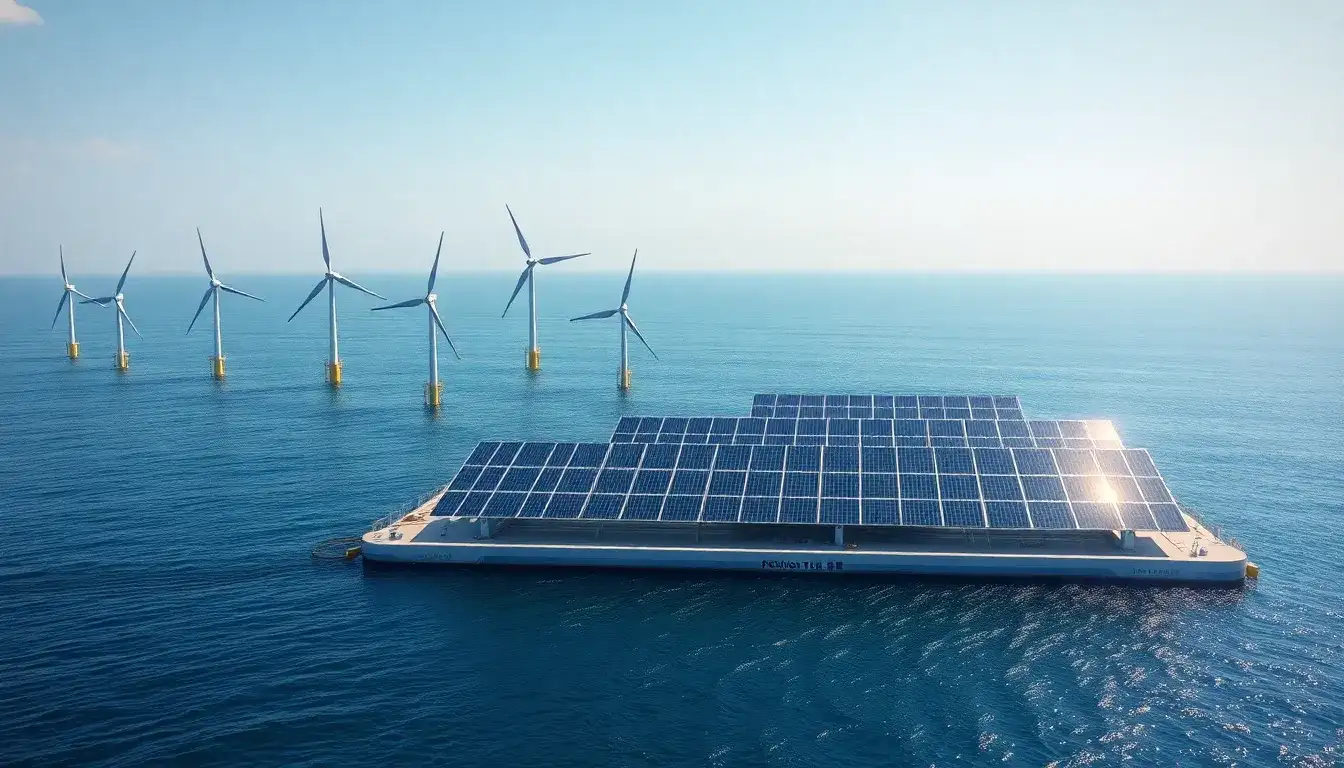
In May, at Laizhou Bay in Shandong, 760,000 offshore photovoltaic panels have been installed, creating a “blue power station” at sea, complemented by 38 towering white wind turbines standing on the waves, harnessing wind energy. Recently, a reporter from China Securities Journal visited this area to witness the full-capacity grid connection of the 400-megawatt offshore photovoltaic project by China General Nuclear Power Group (CGN) in Yantai Zhaoyuan, along with the accelerated development of the Laizhou offshore wind power and marine ranch integration project. This clean energy matrix, where technology and nature harmoniously coexist, is rapidly converting offshore wind and solar energy into abundant green electricity.
Creating an Offshore Photovoltaic Model Project
From the ship deck, the photovoltaic installation stretches out like a blue carpet into the deep sea. This expansive 6.2-kilometer project covers 512.7 hectares of maritime area, with 16 sets of 35 kV collection lines gathering solar energy and transmitting it to land. “Construction of this project began on December 26, 2023. It is the deepest among the first ten offshore photovoltaic project sites in Shandong, with water depths ranging from 8.5 to 11 meters,” stated Zhang Zhiwu, Secretary of the Party Committee and Chairman of CGN New Energy Holdings. The project integrates a green concept throughout its lifecycle, with an expected annual power generation of 694 million kilowatt-hours, equivalent to a reduction of approximately 208,700 tons of standard coal and a decrease in carbon dioxide emissions by around 535,800 tons, which is comparable to reforesting 1,562 hectares.
“CGN is committed to driving innovation and has collaborated with the industry chain to overcome marine environment adaptation technologies. The project team has developed three major innovative applications in photovoltaic module R&D, bracket unit design, and offshore piling,” said Li Guangming, Deputy Secretary of the Party Committee and General Manager of CGN New Energy Holdings. At the project site, nearly 500 hectares of blue photovoltaic panels extend to the horizon. Below this “blue ocean,” over 4,400 piles play a critical support role. Fu Hongxing, the project manager, revealed that the project has developed a “multi-pile high-precision synchronous positioning” construction technique and built the “Electric Construction Marine Equipment No. 001,” the first intelligent and efficient pile-driving vessel for offshore photovoltaic projects in the country. In practice, a dual precision positioning system using “Beidou + GPS” ensures pile positioning accuracy is controlled within centimeters.
“The full-capacity grid connection of the CGN Yantai Zhaoyuan 400-megawatt offshore photovoltaic project represents another vivid practice in Shandong’s energy sector, pushing forward the transformation and upgrading of the regional energy structure. It significantly contributes to building a diverse and complementary energy supply system and helps establish a modern marine economy,” commented Meng Fanzhi, a member of the Party Leadership Group and Deputy Director of the Shandong Provincial Energy Bureau.
Wind Power Farms and Marine Ranches Unite
With the sea breeze, the reporter boarded an engineering ship and sailed for over an hour into the blue waters west of Furong Island, revealing a magnificent sight: 38 white wind turbines, each 100 meters tall, standing like giants with their massive blades slowly rotating. This location is the site of the nation’s first experimental project integrating offshore wind power with marine ranching. Approved by the National Development and Reform Commission and the National Energy Administration, this 304-megawatt demonstration project is a joint venture between CGN New Energy and Shandong Chengyuan Group. It utilizes a three-dimensional structure of “offshore wind power + marine ranching” and a mixed ownership reform model to maximize the use of maritime resources, serving as a model for the “blue energy + offshore grain warehouse” approach in Shandong and nationally.
The project leader noted, “Each turbine is a micro energy station and serves as an ecological carrier.” The project consists of 38 wind turbines, each with a capacity of 8.0 megawatts. Since its commissioning in 2022, it has generated a total of 2.038 billion kilowatt-hours of electricity, equivalent to a reduction of approximately 612,800 tons of standard coal and a decrease in carbon emissions by around 1.648 million tons, which is comparable to reforesting 4,600 hectares. Moreover, the project adheres to a sustainable development philosophy by establishing kelp farms and seagrass beds through planting and transplantation methods, enhancing water quality and creating a favorable environment for marine product growth. This new green development model aims to generate clean energy above water while ensuring safe aquatic products below, providing a typical case and technological support for the integrated development of modern offshore wind power and marine ranching in Shandong and across the country.
This innovative area, merging “offshore wind power + marine ranching,” sketches a vivid practice of striving to achieve the “dual carbon” goals amid rising tides.
Accelerating the Green Energy Network
CGN’s 235-megawatt photovoltaic power station in Bixik, Yunnan, and the 50-megawatt photovoltaic project in Ninghe, Tianjin, have successfully connected to the grid. As a leading enterprise in China’s clean energy sector, CGN New Energy is rapidly weaving a comprehensive green energy network. As of March 2025, CGN New Energy’s total operational installed capacity reached 56.83 million kilowatts, comprising 36.86 million kilowatts from wind power and 19.31 million kilowatts from solar power, placing it among the industry’s leaders. According to plans, the company aims to exceed 70 million kilowatts in installed capacity within the year.
A company representative explained that they focus on market orientation and customer-centric strategies, actively developing wind and solar businesses while expanding into three specialized sectors: “solar thermal +,” “offshore +,” and “green electricity +.” They also promote new businesses in “heat, sea, green, sand, and hydrogen,” accelerate the construction of large-scale bases, and explore core technologies in hydrogen production, solar thermal, and solar-powered desertification prevention to cultivate differentiated competitive advantages. Additionally, they are actively exploring comprehensive regional energy utilization solutions, aiming to provide optimal energy solutions and supplies for clients across new products and services such as regional energy, coal-to-electricity, clean heating, and energy management.
From the shores of the Bohai Sea to the South China Sea, and from the heart of the desert to distant waters, CGN, as a clean energy giant, is navigating the waves with innovation as its oar amid the “dual carbon” tide.
Original article by NenPower, If reposted, please credit the source: https://nenpower.com/blog/innovative-offshore-solar-and-wind-projects-transforming-chinas-clean-energy-landscape/

