

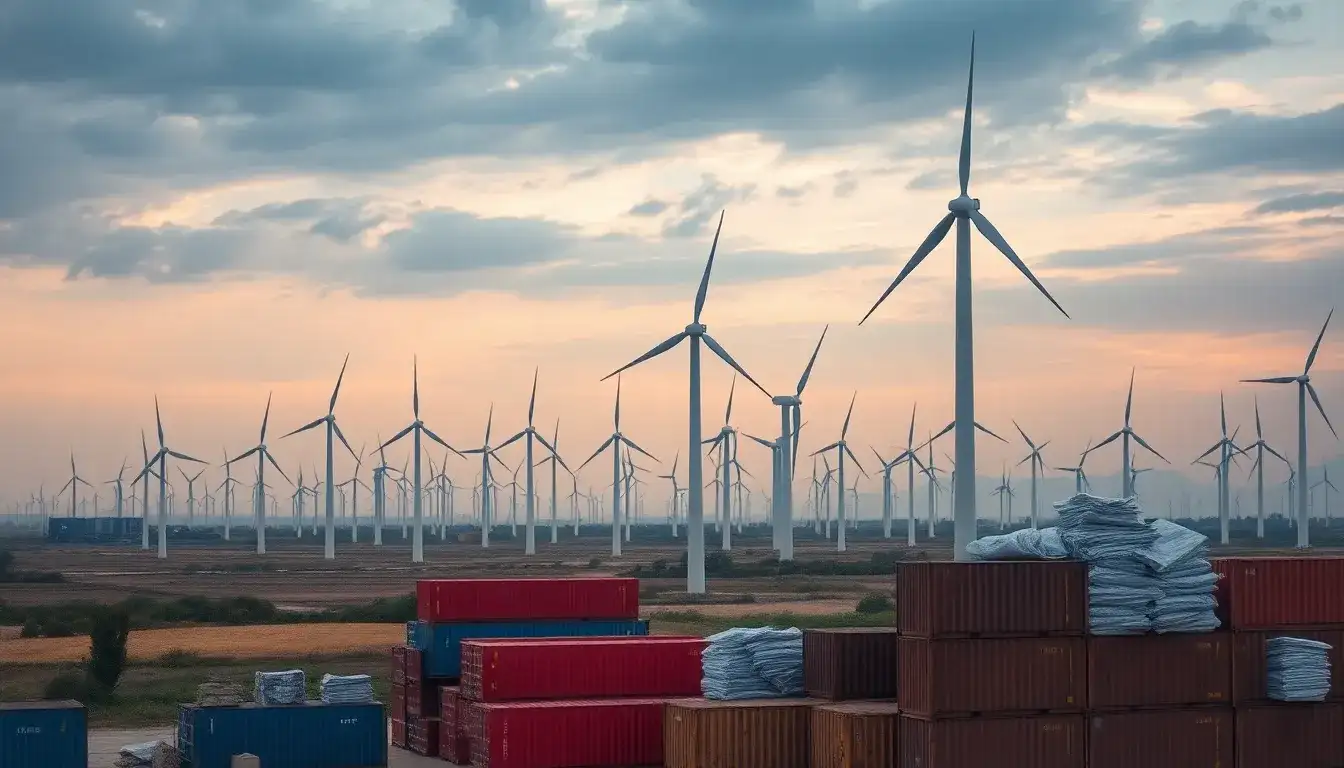
Impact of the U.S. Tariff War on China’s Wind Power Industry
Since 2018, the United States has imposed tariffs on various Chinese products in an attempt to curb the development of China’s manufacturing sector. Initially, this had some impact on China’s wind power industry. Recently, the Trump administration escalated the situation by implementing what it termed “reciprocal tariffs,” igniting a trade war that caused significant declines in global stock markets. This has raised concerns about whether China’s wind power industry would suffer direct repercussions, similar to other industrial sectors that might enter a recession.
However, analyses from media and industry experts suggest that such concerns are largely unfounded. Over the past two decades, Chinese wind turbine manufacturers have developed considerable strengths due to their position in the largest single market and their continuous technological advancements, allowing them to minimize the negative impacts of U.S. tariff policies. Major Chinese wind turbine manufacturers, particularly Goldwind, Envision Energy, and Mingyang Smart Energy, which have numerous overseas orders, have minimal exposure to the U.S. wind power market, rendering them largely unaffected by these “reciprocal tariffs.” Recent data indicates that revenue from exports of wind turbine equipment to the U.S. constitutes less than 3% of their total revenues, and aside from previously fulfilled overseas orders, there have been virtually no new orders from the U.S. market.
Chinese wind power companies have shifted their market focus towards countries involved in the “Belt and Road” initiative, including regions in Europe and Southeast Asia. Moreover, the domestic wind power industry has achieved a localization rate exceeding 90%, with core components being largely self-sufficient. As such, the U.S. tariffs have little impact on the cost structure of domestic manufacturers. In fact, the global wind power industry cannot function without China. According to the Global Wind Energy Council (GWEC), by the end of 2030, global wind power capacity must double (tripling the current installed capacity), a demand that existing supply chains cannot meet. The wind energy supply chain is highly globalized, with China holding a significant dominance in the refinement of rare earth elements and the manufacturing of wind turbines and components.
The GWEC report predicts that in the next decade, the world will likely face an “Increased Barriers” scenario, characterized by heightened trade barriers, compelling countries to focus on domestic investments. This shift could hinder the achievement of the 1.5°C climate goal.
Previously, the U.S. imposed tariffs on components of Chinese wind turbines and levied a 25% tariff on imported wind turbine components from Mexico and Canada, resulting in approximately a 7% increase in total costs for onshore wind projects. This has forced U.S. developers to rely more heavily on domestic, higher-priced supply chains, diminishing their competitive edge against Chinese manufacturers in third-party markets. The latest round of the tariff war not only exacerbates issues for the U.S. wind market but could further weaken the competitiveness of the U.S. wind energy supply chain outside its borders.
Additionally, U.S. wind power policies have been unstable in recent years, with Trump’s administration being particularly unfriendly towards wind energy, especially offshore wind. The continued stagnation of federal permits is expected to lead to a 40% decrease in newly installed capacity by 2025, significantly diminishing market allure for Chinese manufacturers. In contrast, the European Union plans to add over 60 GW of wind capacity, presenting a significant opportunity for Chinese manufacturers to leverage their cost advantages and enter the European market.
For instance, in 2024, Mingyang Smart Energy secured orders for large floating wind turbines in Europe, while Goldwind’s monopile offshore wind foundations have been awarded multiple contracts for significant European projects. These developments indicate that prevailing tariff barriers are unlikely to restrict the export pace of China’s wind power industry; rather, they may enhance its technological output capabilities.
Overall, the direct impact of the U.S. tariff war on Chinese wind turbine manufacturers is manageable; however, vigilance is necessary regarding the transmission of global supply chain costs and the intensification of technological competition. According to the GWEC’s “Global Wind Report 2024” and “2024 Global Offshore Wind Report,” in 2023, the top five wind markets—China, the U.S., Brazil, Germany, and India—saw China adding 75 GW of new installations, setting a new record and accounting for nearly 65% of global new capacity.
Goldwind has been the world’s largest wind turbine manufacturer for three consecutive years. Stabilizing the stock market is crucial not only for investor confidence but also for the country’s response to external economic shocks and the maintenance of overall economic stability. Following the decline of the A-share market due to the Trump administration’s “reciprocal tariffs,” state-owned enterprises have stepped in to support China’s capital markets with significant buybacks. By April 8, all four major stock indices closed in the positive territory, indicating a strong recovery.
The People’s Bank of China has expressed firm support for increased stock market investments and has committed to providing ample re-lending support as necessary to maintain market stability. Concurrently, the State-owned Assets Supervision and Administration Commission has pledged to encourage central enterprises to actively increase stock repurchases and buybacks. Various financial regulatory bodies have also adjusted asset allocation ratios to enhance equity investment.
The proactive measures taken by state-owned enterprises, including stock buybacks and increases in shareholding, serve to stabilize the market and reinforce investor confidence. For example, China National Nuclear Corporation announced a plan to repurchase shares worth between 300 million and 500 million yuan. Similarly, China Petroleum and Chemical Corporation and China Ocean Oilfield Services have unveiled substantial buyback plans based on their optimistic outlook for future development.
In summary, the response from major state-owned enterprises and the overall commitment to maintaining stock market stability amidst tariff pressures are pivotal strategies to ensure continued growth and development in the Chinese wind power industry.
Original article by NenPower, If reposted, please credit the source: https://nenpower.com/blog/impact-of-the-us-tariff-war-on-chinas-wind-power-industry/

