

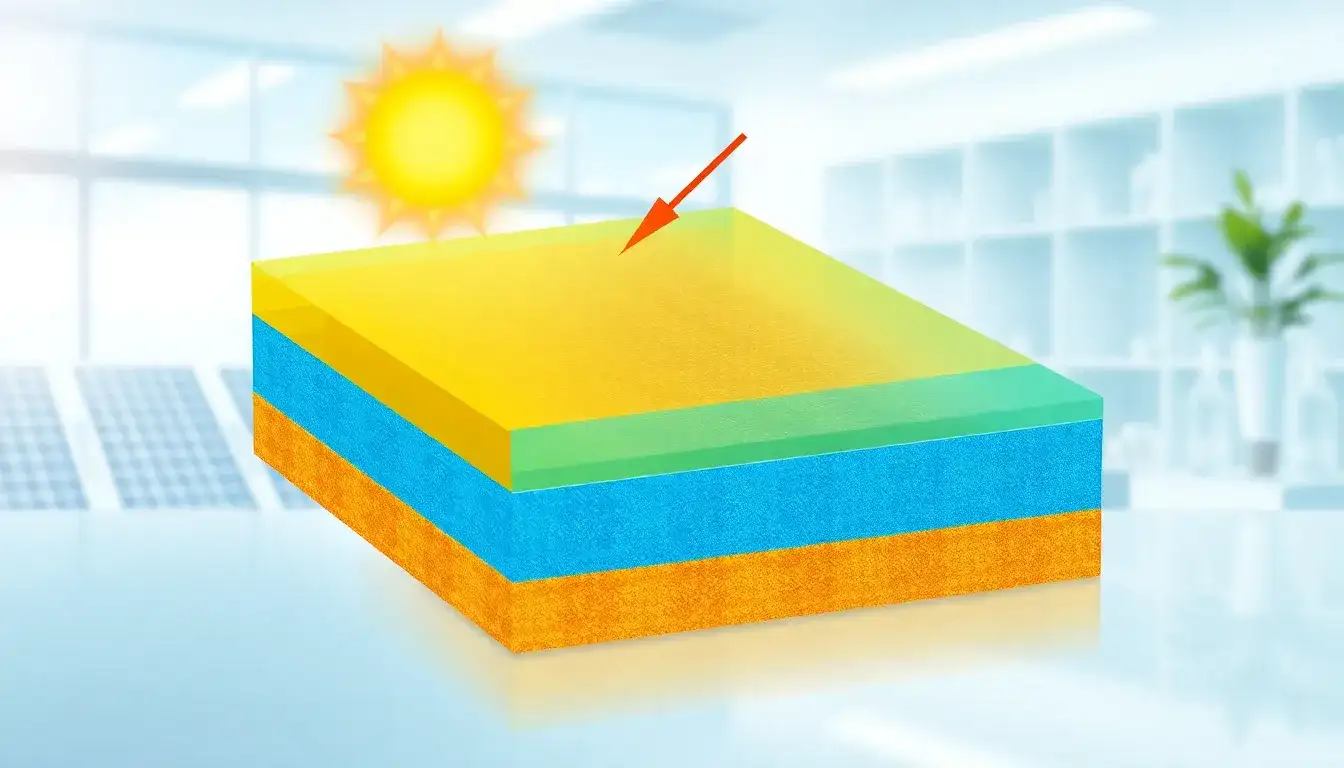
The incorporation of fluoride interlayers in perovskite-silicon tandem solar cells plays a crucial role in enhancing their performance by improving interface properties, which leads to better charge extraction, reduced recombination losses, and overall higher efficiency.
Effects of Fluoride Interlayers on Perovskite-Silicon Tandem Solar Cells
- Improved Band Alignment and Charge Extraction:
Incorporating fluoride-containing interlayers (such as phosphonic acids with fluorinated groups) modifies the interface between the perovskite top cell and the electron- or hole-transport layers. This modification can create beneficial dipoles at the interface, leading to enhanced band alignment that facilitates more efficient charge extraction and reduces nonradiative recombination losses. For example, in one approach, the addition of fluorinated phosphonic acid in the hole transport layer improved perovskite crystallization and minimized recombination losses, contributing to certified tandem efficiencies exceeding 31%. - Enhanced Perovskite Film Quality on Textured Silicon:
Efficient silicon solar cells often have chemically or physically textured surfaces to reduce reflection and improve light absorption. However, depositing uniform perovskite layers on these textured silicon surfaces is challenging. Fluoride-containing interlayers help improve the wettability and uniform deposition of the perovskite on such textured surfaces. This leads to better crystallinity and coverage of the perovskite layer, which is essential for high photocurrents and device stability. - Reduction of Defect States and Recombination Losses:
By passivating defects at the interface and within the perovskite layer, fluoride interlayers help reduce electron-hole recombination. This is crucial because recombination losses at the perovskite/contact interfaces limit open-circuit voltage and overall device efficiency. Ionic liquids containing fluorine or fluorinated molecules introduced at interfaces create dipoles that suppress recombination and enhance open-circuit voltages up to 2.0 V for tandem cells. - Stability and Scalability Advances:
The use of fluoride interlayers also shows potential for improving the stability of perovskite films, which is a major challenge for commercialization. These interlayers can help form chemically stable interfaces that improve device lifetimes. Moreover, their incorporation aligns with solution processing and scalable fabrication techniques that are compatible with industrial manufacturing.
Summary Table of Fluoride Interlayer Effects
| Performance Aspect | Effect of Fluoride Interlayers | Resulting Benefits |
|---|---|---|
| Band Alignment | Induce interface dipoles for better energy-level matching | Enhanced charge extraction efficiency |
| Recombination Losses | Passivate interface defects and reduce charge recombination | Increased open-circuit voltage (VOC) and efficiency |
| Film Uniformity on Texture | Improve wettability and film formation on textured silicon | Higher photocurrent and uniform layer quality |
| Stability | Chemical passivation of interfaces | Improved operational lifetime |
| Manufacturability | Compatible with solution processing and scalable methods | Industrial viability and yield improvements |
Impact on Efficiency
These interfacial engineering strategies involving fluoride-containing layers have contributed directly to achieving record-breaking power conversion efficiencies in perovskite-silicon tandem solar cells exceeding 31%, with some reports reaching 32.5% and even above 34% with other optimizations. The improvements in charge extraction and reduced recombination due to fluoride interlayers are key factors enabling these performance milestones.
In conclusion, the incorporation of fluoride interlayers in perovskite-silicon tandem solar cells crucially improves interfacial properties—enhancing band alignment, charge extraction, film quality, and stability—which collectively elevate the efficiency and reliability of these devices beyond 30% power conversion efficiency, marking a significant advance in photovoltaic technology.
Original article by NenPower, If reposted, please credit the source: https://nenpower.com/blog/how-does-the-incorporation-of-fluoride-interlayers-affect-the-performance-of-perovskite-silicon-tandem-solar-cells/

